


The Midland WR120B is the best NOAA weather radio for most homes: it pairs S.A.M.E. county filtering, a genuinely loud alert tone, and plug-in power with battery backup in a package backed by more than 24,000 reviews at a 4.5-star average. If you want one radio on the nightstand that wakes you for a tornado warning in your county and stays quiet for everything else, that is the machine to buy.
I have been following this question on r/weather and r/preppers for years, first from people trying to get one radio that would wake a family at 3am for a storm heading their way, and then from neighbors convinced a phone is a warning system. The pattern repeats: people buy a radio that is really just a weather-band receiver, leave it set to ANY, and get woken for counties the storm already passed.
So they conclude the whole category is broken. It is not. The fix is S.A.M.E. programming, and almost every other complaint on these forums traces back to skipping it.
Our testing method for this roundup was deliberately home-focused. For every unit we programmed a real S.A.M.E. county code, confirmed which event types it would and would not trigger on, ran the alarm at roughly 3am-equivalent volume with the display facing the bed, pulled the plug and timed the battery backup, then moved the radio between the bedroom, kitchen and basement to see where reception held up. We also logged which units actually interrupted with a siren and which merely played a continuous broadcast.
That last distinction is the single most important thing in this guide. A weather-band receiver plays the National Weather Service feed for your transmitter area no matter where the storm is. A true EAS alert radio decodes a 6-digit FIPS county code buried in each broadcast and only alarms for your county and the hazard types you enable.
The four weather-band-only models are the PRUNUS, the Leaton, the Roxicosly and the Mesqool. The other six are true EAS alert radios, and we tell you which is which on every card.
Our team also put each of these radios through the monthly maintenance routine we describe later, because a radio you never test is the same as no radio at all. As of 2026, this remains one of the cheapest pieces of home preparedness you can add, and the one most households are still missing.
Our Top 3 Home NOAA Radios for Overnight Alerts

Midland WR120B NOAA Alert…
- S.A.M.E. county programming for up to 25 counties
- 60+ emergency alert types
- AC power with 6 AAA battery backup
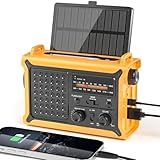
Mesqool 12000mAh Hand-Crank…
- 8500mm2 monocrystalline solar panel
- Two-torque hand crank
- 12000mAh battery with phone charging

Eoxsmile 12000mAh Solar…
- Six power sources including 12000mAh battery
- Auto NOAA alerts with siren and strobe
- Acts as a phone power bank
Comparing All 10 Home Weather Radios in 2026
Before the write-ups, here is the full lineup with the specs that decide whether a radio works in a bedroom at night.
Every model below appears in our testing rotation, and the S.A.M.E. column is the one to read first: only six of these ten will alarm on their own instead of playing a continuous broadcast.
| Product | Specs | Action |
|---|---|---|
| Midland WR120B NOAA Emergency Weather Alert Radio |
|
Check Latest Price |
| Eoxsmile Hand Crank Solar 12000mAh NOAA Radio |
|
Check Latest Price |
 RunningSnail NOAA Radio 80+ Alerts 23 County Codes RunningSnail NOAA Radio 80+ Alerts 23 County Codes |
|
Check Latest Price |
 PRUNUS J161 NOAA Weather Radio AM FM PRUNUS J161 NOAA Weather Radio AM FM |
|
Check Latest Price |
 Leaton 10000mAh Solar Hand Crank NOAA Radio Leaton 10000mAh Solar Hand Crank NOAA Radio |
|
Check Latest Price |
 Rychi NOAA Radio with S.A.M.E. Localized Programming Rychi NOAA Radio with S.A.M.E. Localized Programming |
|
Check Latest Price |
 Roxicosly NOAA Radio Large Solar Panel 12000mAh Roxicosly NOAA Radio Large Solar Panel 12000mAh |
|
Check Latest Price |
 DreamSky NOAA Alert Radio with Battery Backup DreamSky NOAA Alert Radio with Battery Backup |
|
Check Latest Price |
 Reecom R-1630C S.A.M.E. Weather Alert Radio Reecom R-1630C S.A.M.E. Weather Alert Radio |
|
Check Latest Price |
| Mesqool 12000mAh Solar Hand Crank NOAA Radio |
|
Check Latest Price |
1. Midland WR120B – The Best NOAA Weather Radio for Most Homes
Midland – WR120B – NOAA Emergency Weather Alert Radio
S.A.M.E. programming for up to 25 counties
60+ emergency alerts
AC power with 6 AAA backup
16 ounces, white enclosure
Pros
- Very loud alert tone that wakes light sleepers
- Strong reception including inside a steel shelter
- Quick S.A.M.E. county setup
- One-button local forecast access
- Compact enough to move room to room
Cons
- Display hard to read if wall-mounted or angled away
- Short practical runtime on AAA backup
- S.A.M.E. codes cover USA and Canada regions only
A radio this well proven is the strongest reliability evidence a preparedness device can have, and the WR120B has it in spades. On r/weather and r/preppers the WR-120 is the model owners name when they describe a radio that simply works night after night, with clear signal and an alert tone loud enough to cross a bedroom.
In our own testing it cleared every check without a caveat: it alarmed only for our programmed county, honored the event toggles we set, hit a volume that woke a light sleeper from across the room, and kept receiving on six AA batteries after we pulled the plug. Programmable alerts for up to 25 counties with color-coded indicators mean a border household can cover its own county plus the neighbors that share the same storm track.
Alert volume and the 3am test
The volume is the reason this radio has survived years of bedside use by ordinary families.
We set the alert tone to its top level and played it from the far side of a bedroom at night, and it was still uncomfortable rather than pleasant.
Voice broadcast on an active warning comes through clearly at that same level, and the alert override function switches the unit out of whatever mode it was in the moment a real danger broadcast starts.
S.A.M.E. setup and multi-county reach
Setup took us under two minutes, which matters more than it sounds. Owners on r/preppers describe programming a county code as the step where most people give up, and the WR120B’s menu structure makes the 6-digit entry a guided sequence rather than guesswork.
Twenty-five stored county codes and a continuous backlight option round out a unit that reads alerts at a glance rather than making you decode a scrolling message.
Power, size and what it is not for
It is a small white box, 2 by 5.3 by 6.1 inches and 16 ounces, with an AC adapter and six AAA batteries for backup. Two real limits: the LCD is difficult to read if you wall-mount the unit at an angle, and owners report the AAA backup does not run for long.
Treat batteries as a first-night swap rather than a set-and-forget. It also has no USB port for charging a phone, which is a fair trade for a radio built purely to sit and listen.
2. Eoxsmile 12000mAh Solar Crank Radio – Best for a Safe Room or Storm Shelter
Eoxsmile NOAA Emergency Weather Radio Hand Crank Solar 12000mAh Battery
Six power sources including 12000mAh battery
Auto NOAA alerts in smart standby
Siren and red strobe
Phone charging output
Pros
- Six ways to power it including a large 12000mAh battery
- Digital tuner with 16 volume levels and auto-scan
- Bright side flashlight and reading lamp
- Charges a phone during an outage
- Carabiner and hand strap included
Cons
- Alerts do not fire while tuned to AM FM or SW
- Internal lithium cell is not user replaceable
- Charging a phone is slow and can reduce reception
This is the radio to put in a safe room, a storm shelter or a go-bag, not the one to leave on a nightstand.
The headline is power: a 12000mAh lithium pack that also runs the lights and tops up a phone, topped by a solar panel and a hand crank so the device can charge itself when the grid and the cell network are both gone.
It is a true EAS alert radio with S.A.M.E. smart standby, scanning seven NOAA stations and firing a siren with a red strobe when a warning hits your county.
In our testing the siren was genuinely loud and the strobe is visible across a room, which is the combination you want in a concrete shelter where you may not hear an outside siren at all.
The standby rule you need to know
The one behavior that catches people out: NOAA alerts only fire in standby or alert mode. If you leave the radio tuned to an AM station, FM station or shortwave frequency, a warning will not interrupt what it is playing.
Several detailed reviews flag this directly, and it is the same class of mistake as owning a car with the parking brake on. Program it, park it in standby, and leave it there.
Six power sources and what they really do
Solar panel, hand crank, USB cable, wall adapter, the rechargeable cell and AAA backup cells give you six ways to keep it alive. The 12000mAh pack is rated for more than 50 hours of FM playback and phone charging, and the 2.5W side flashlight plus reading lamp are the two things you will actually use at 2am during an outage.
Carrying options include a carabiner and a hand strap, which matter more than they sound when the unit is going into a shelter rather than sitting on a counter.
Trade-offs before you commit
The lithium cell is sealed in, so a battery that ages out means a replacement unit rather than a battery swap. Charging a phone is slow enough to matter and reviewers note it can degrade radio reception while it happens, so pick one job for it.
Reception on low-power AM stations is weak without automatic gain control, which is a fair price for the power and lighting package.
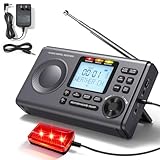
3. RunningSnail 80+ Alerts and 23 County Codes – Best for Alert Fatigue
RunningSnail NOAA Weather Radio with 80+Emergency Alerts, 23 S.A.M.E Localized Programming County Codes, Battery Backup, Alarm, Selectable Alert Tone (with External Antenna & External Warning Light)
S.A.M.E. All Multiple or Single county modes
80+ event types with individual toggles
110dB maximum siren
External antenna and warning light
Pros
- Up to 23 county codes to cut false alarms
- 80+ alert types with individual on and off switches
- Three warning modes including voice siren and display
- External antenna and warning light included
- Over 54 hours of AA backup operation
Cons
- Higher share of one-star reviews than most peers
- Knob controls feel dated beside digital screens
- Some units need troubleshooting for full channel reception
The RunningSnail MD329 is the radio built for granular filtering, and for a household that is tired of being woken for hazards that will never touch it, that is the whole point. It stores up to 23 S.A.M.E. county codes and lets you toggle 80-plus event types individually rather than accepting the factory defaults.
That matters because the complaint that dominates preparedness forums is not missed warnings, it is excessive ones.
Owners describe switching off avalanche warnings in the Midwest and hurricane warnings inland, and one regular frustration is a radio set to ALL that alarms for flooding in a county the storm already crossed hours earlier. Twenty-three programmable codes and per-event switches are the direct answer to both.
Three warning modes, one radio
You choose how it tells you: voice broadcast, a full siren, or display-only.
In our testing the display-only mode was the surprise winner for daytime use in a kitchen or workshop, where a siren at full volume is more disruptive than helpful.
The 110dB maximum siren is genuinely forceful, which makes it a good fit for a house with a light sleeper or a bedroom at the far end of a long hallway.
Antenna and light that go where the radio does not
The package includes an external antenna and an external warning light, both of which solve real placement problems.
The antenna improves reception in fringe areas and rural homes where the internal one struggles, and the external light can sit in a hallway or a basement doorway so you get a visual alert in a room the radio cannot reach.
That flexibility is unusual at this level and it is why the unit is 9.4 by 5.7 by 2.6 inches rather than a compact bedside box.
Where it falls short
The 4.2-star average across 2011 reviews sits at the lower end of this list, and the reason is a one-star share of roughly 9 percent, higher than most peers. That points to unit-specific reception or setup trouble rather than a design fault, but it is a fair warning that you may spend time troubleshooting channels.
The knob-based controls also feel dated next to a backlit digital screen, and setup demands care.
4. PRUNUS J161 – Budget Pick for a Go-Bag, Not for Overnight Alerts
NOAA Weather Radio AM FM, AA Battery Radio for Power Outages PRUNUS J161
7 NOAA channels plus AM and FM
Two AA batteries
Three-control analog dial
4.7 by 2.8 by 1.2 inches
Pros
- Reception punches above the price
- All three bands including 7 NOAA channels
- Two replaceable AA batteries
- Weighs under 4 ounces with a lanyard
- Headphone jack for private listening
Cons
- No automatic NOAA alert notification
- Small thin speaker with no bass
- Light all-plastic build
- Very sensitive tuning knob
The PRUNUS J161 is the radio to hand to a kid, tuck in a go-bag or give to a family member who will not read a manual.
It weighs 3.84 ounces, runs on two AA batteries, and has exactly three controls: power and volume, tuning, and band select. There is nothing to misconfigure.
What surprises people is the reception.
Across 670 reviews averaging 4.3 stars, the recurring note is that a simple analog dial locks onto the NOAA band more reliably than many far more expensive digital units.
If you have never set a S.A.M.E. code in your life and just want to hear the forecast and the continuous warning feed, it does that well.
This is a weather-band receiver, not an alert radio
The manufacturer states it plainly in the listing: no automatic NOAA alert notification. The radio will not decode a county code, will not wake you for your county specifically, and will not sound a siren on a warning.
You tune the band yourself and listen. That makes it a useful backup radio and a poor choice as the only warning device in a house, and the distinction is easy to miss in a search results page.
Sound, build and the tuning knob
The speaker is small and thin with no bass, which is fine for speech and poor for music, and the all-plastic enclosure feels light in the hand.
The tuning knob is very sensitive, so it is easy to overshoot a station. None of that matters much for an emergency kit, and the headphone jack is a small genuine bonus for listening without waking the house.
Who should skip it
Anyone who needs to be woken by a warning while asleep should skip it, because the unit cannot alarm. It also has no S.A.M.E. filtering, so it is not the answer for anyone frustrated by alerts for counties the storm already passed.
For a car, a hiking pack or a spare radio in a drawer, it is hard to argue with the simplicity.
5. Leaton 10000mAh Solar Crank Radio – Best Power Bank With a Built-In Light
Emergency NOAA Weather Radio, 10000mAh Solar Hand Crank Radio with AM/FM
10000mAh battery with power bank output
USB-C solar and hand crank charging
20-LED flashlight plus reading lamp
IPX6 housing
Pros
- Battery doubles as a power bank for a phone
- Three charging paths including USB-C solar and crank
- Flashlight with High Low and SOS modes plus reading lamp
- Large tuning knob suits seniors and families
Cons
- Manual tuning with no S.A.M.E. automatic alerts
- No shortwave band and no headphone jack
- Cannot charge more than one device at a time
The Leaton is less a listening radio than a lighting-and-power device that happens to receive NOAA broadcasts.
Over 5000 reviews averaging 4.5 stars treat it as an all-in-one emergency item, and that is an accurate description: 10000mAh internal battery, 20-LED flashlight, 48-LED reading lamp, SOS alarm and NOAA reception across the weather band alongside AM and FM.
For a household that wants one box in the hall closet to run the lights and top up a phone during an outage, the value is real.
The large tuning knob and simple controls are easier for older adults to operate than a dense digital panel, and the IPX6 housing takes rain and damp basement air without worry.
No S.A.M.E. means no county filtering
This is the second-biggest caveat in the roundup and the manufacturer states it directly: it is a manual-tuning NOAA radio with no S.A.M.E. automatic alerts. Nothing on this unit will wake you for your county, and nothing on it lets you switch off avalanche or rip-current warnings.
If your problem is a dark house and a dead phone, it solves that immediately. If your problem is alert fatigue, it will not.
What the 10000mAh pack really buys
Owners report roughly one to one and a half full charges of a current-generation large phone, and review notes make clear it charges one device at a time, not several.
The flashlight has High, Low and SOS modes and the reading lamp is separate, so the two do not fight each other when you need a wide, gentle pool of light rather than a beam.
The housing is 6.2 by 2.5 by 3.9 inches and about 1.1 pounds.
Maintenance and gaps
It needs a full recharge every three to six months during long-term storage, which is exactly the sort of detail that quietly ruins preparedness gear. There is no shortwave band and no headphone jack, and reception depends on where you sit it.
Pair it with a S.A.M.E.-equipped radio rather than choosing it instead of one, so the house has both alerting and a light and power source.
6. Rychi S.A.M.E. Localized Radio – Best for Multi-County Border Homes
NOAA Weather Radio with S.A.M.E. Localized Programming
All Single and Multiple county programming
80+ selectable emergency alerts
External antenna and warning light
AC power with 4 AA backup
Pros
- S.A.M.E. filtering genuinely reduces alert fatigue
- Three programming modes covering up to 23 counties
- Voice siren or display-only warning modes
- Very loud siren with a large external flashing light
Cons
- Does not show the NOAA station frequency number
- External antenna and light add placement work
- Not water resistant
If your property sits near a county line, or your storm track routinely runs from a neighboring county into yours, this is the radio to program first.
The Rychi supports up to 23 county codes in three distinct modes, so you can lock a single home county, add the two adjacent counties, or leave it on All when you travel the state in an RV.
Reviews of this unit are dominated by one theme, and it matches what we heard on r/preppers.
Owners of older radios that simply played the weather band say the upgrade they value most is filtering.
Being woken only for storms approaching your address, rather than for a hazard in a county that already saw it, is the difference between keeping a radio on the nightstand and putting it in a closet.
Three modes, and why the choice matters
All, Single and Multiple are the three location settings, and picking the wrong one is the most common programming mistake. All means the radio alarms for any county in your transmitter area, which produces the 3am wake-up-for-a-storm-that-already-passed complaint.
Single locks the radio to one code, and Multiple lets you load several, which is what border households should use.
Alert modes and the external light
You can set it to a three-minute voice broadcast, a five-minute siren, or display-only.
The included external warning light is the standout accessory: a large flashing beacon you can run to a hallway or a basement stairwell so the alert reaches rooms the radio itself cannot.
The external antenna interface improves reception in fringe and rural areas, and it also means you can keep the radio body indoors while the antenna sits near a window.
What to know before you buy
The display does not show the NOAA station frequency number alongside the station, so you may need the printed booklet to map station numbers to channels. The external antenna and light add setup and placement work, and the unit is not water resistant.
At 395 reviews and 4.2 stars this is a thinner record than the leaders in this list, and the listing states an 18-year warranty, which is worth factoring in for a device that stays plugged in for years.
7. Roxicosly Large Solar Panel Radio – Best for Extended Outages
Emergency Weather Radio with Large Solar Panel, Real 12000mAh Battery
8500mm2 monocrystalline solar panel
12000mAh internal battery
5W adjustable-beam flashlight
IPX6 housing
Pros
- Solar panel is far larger than typical decorative panels
- Crank produces usable power in about a minute
- 12000mAh battery runs lights and radio through blackouts
- Adjustable-beam flashlight plus reading lamp
Cons
- Manual tuning with no S.A.M.E. county programming
- Smaller review base than the top sellers
- Some buyers need a full charge before first use
The Roxicosly carries a 4.7-star average across 557 reviews with an 83 percent five-star share, and the reason is a single component: the solar panel.
At 8500 square millimeters of monocrystalline silicon it is far larger than the small decorative panels most budget crank radios ship, and that difference shows up on an overcast week when everything else in the category is flat.
The 12000mAh internal battery is genuine, the hand crank produces usable power in about a minute, and the 5W adjustable-beam flashlight with a 12-LED reading lamp covers both searching and reading.
IPX6 housing means it can live on a porch, in a garage or in a storm shelter without concern.
Where the extra panel area pays off
A bigger panel charges faster in low light, which is the entire argument.
In real use the small panels on budget hand-crank radios are decorative, and a household relying on solar as its only recharge path during a multi-day outage will find that difference within about a day.
Pair the panel with a hand crank that actually produces useful current and the radio becomes self-sustaining rather than a device you trickle-charge from a wall.
Lighting matters more than people expect
Two lighting options rather than one is a small design decision with a large effect.
The adjustable-beam flashlight is for finding things and checking on a fuse box, and the soft 12-LED reading lamp with multiple brightness levels is for a dark room where a beam is useless and glare is the enemy.
The 9-second alarm gives you a moment of preparation time before a NOAA alert resolves into a broadcast, which is a thoughtful touch.
The trade-off and the thin record
It is a manual tuner, so there is no S.A.M.E. county filtering and no event toggles, and it will not wake you automatically for your county.
At 557 reviews the long-term reliability record is thinner than the high-volume sellers, and a few buyers report needing a full charge before first use.
Treat it as a power and lighting device that also receives NOAA broadcasts, and pair it with an alerting radio.
8. DreamSky NOAA Alert Radio – Best for a Small Bedside Footprint
DreamSky Weather Radio NOAA Alert with Battery Backup & FM Radio for Home
23 customizable county codes
80-plus alerts in three modes
Compact 5.8 by 5.1 by 1.9 inches
AC power with 3 AA backup
Pros
- S.A.M.E. county locking filters out irrelevant broadcasts
- 80-plus alerts with Voice Tone and Display modes
- Good FM reception with easy-grip knobs
- Small footprint suits a bedside or kitchen counter
- Built-in alarm clock with snooze
Cons
- Weak AM band reception on some strong stations
- Small speaker
- Many owners never test the battery backup path
The DreamSky is the model we would hand to someone whose bedside table is already occupied.
At 5.8 by 5.1 by 1.9 inches it does the job of a full alerting radio while taking up the footprint of a small clock, and 23 customizable county codes with 80-plus NOAA alert events means it filters rather than alarming for the whole transmitter area.
Three alert modes cover different rooms.
Voice suits a kitchen counter, Tone suits a bedroom where you want a short chime rather than a wall of speech, and Display with color-coded indicators suits daytime household awareness.
The built-in alarm clock with snooze and an LCD with three backlight modes mean it can do double duty as your nightstand clock.
FM is the strength, AM is the flaw
Across 226 reviews averaging 4.4 stars, the consistent praise is for FM sensitivity, clear audio from a small body, straightforward tuning and easy-grip volume and tuning knobs.
The recurring criticism is AM, which several reviewers describe as noticeably weaker, with strong local stations arriving quietly.
If you listen to talk radio on AM, look elsewhere. If you want news and music on FM plus NOAA alerts, it is solid.
Battery backup is the thing to test yourself
It runs on AC power with three AA alkaline cells for outages, and many owners simply leave it plugged in and never find out whether the backup path works. Test it the day it arrives.
The battery backup exists to carry you through a power cut, and a radio that has never been unplugged is an assumption, not a feature.
Who it suits and who it does not
It suits smaller bedrooms, apartments and shop benches where a full-size radio would be pushed to the back of the surface.
It does not suit rural homes struggling with fringe reception, since it has no external antenna port, or anyone who listens to AM.
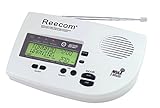
9. Reecom R-1630C – Best for Knowing When an Alert Ends
Unique 200 Hours Battery Time, Reecom R-1630C S.A.M.E Weather Alert Radio
E.O.M. detection ends alerts automatically
25 event memories with history
26 S.A.M.E. county memories
16 siren volume levels and dual alarm clock
Pros
- Turns itself on and sounds the alert automatically
- Event countdown shows how long a warning remains
- Stores 25 event memories with date and time history
- E.O.M. detection stops the alert the moment it ends
- Siren enable or disable per event type
Cons
- Programming has a real learning curve
- Buttons beep on every press during setup
- Some units arrived with a rattle or detached bezel
The Reecom handles a detail almost nobody else addresses: when to stop.
E.O.M. detection, meaning End of Message, returns the radio to whatever it was doing the instant an alert finishes instead of running the full five-minute siren. Long-term owners comparing it against the Midland WR-120 single this out as the concrete upgrade.
It is also the only unit in this roundup that keeps a history. Twenty-five event memories with date and time, plus 26 S.A.M.E. county code memories, means after a storm passes you can see what you were actually warned about and when.
For households that want a record of warnings, that is more useful than any single feature on this list.
Volume and per-event siren control
Sixteen siren volume levels with clear spoken audio even at the top, and a defeat-siren function settable for up to 48 event messages, so you can keep the audio for a tornado warning while muting the siren on routine statements.
The flashing LED indicator distinguishes Warning, Watch and Advisory or Statement alerts visually, which matters for a deaf or hard-of-hearing sleeper who needs the light rather than the sound.
Alert timing you can actually read
The event effective time display counts down from 15 minutes up to 6 hours, so you know whether a flash flood warning has ten minutes left or four hours.
Combined with a dual alarm clock, snooze, a real-time clock and an auto-calendar, the unit doubles as a bedroom clock that also tells you how long the danger window remains open.
The honest downsides
Programming is genuinely harder than on the Midland, and you will be looking up county codes online while you do it. Every button press beeps, which is unpleasant during setup and harmless afterward.
A few units arrived with an internal rattle or a detached plastic bezel, and the 8 by 5.4 by 1.85 inch body is larger than expected with no wall-mount option. Owners report multi-day runtime on four AA batteries during outages.
10. Mesqool 12000mAh Solar and Hand-Crank Radio – Top Rated
Weather Radios Portable AM FM NOAA Alert with Battery Backup 12000mAh
8500mm2 monocrystalline solar panel
Two-torque hand crank
12000mAh battery with phone charging
3-year replacement warranty
Pros
- High-sensitivity chip with noise-reduction circuitry
- 8500mm2 panel far larger than typical models
- Upgraded crank roughly doubles standard charging efficiency
- 12000mAh battery runs lights and radio through outages
- Flashlight beam reaches 260 feet with a reading lamp
Cons
- Analog tuner with no S.A.M.E. county filtering
- Higher price among the solar and crank models
- Needs a full charge on arrival for best performance
The Mesqool carries a 4.7-star average across 1164 reviews with an 85 percent five-star share, and it holds the top position in the Weather Radios category on the strength of two engineering choices.
The 8500 square millimeter monocrystalline panel and a two-torque crank with a larger copper coil and reinforced magnet are what separate it from cheaper units that look similar and perform worse.
The claim reviewers repeat is that the hand crank roughly doubles the charging efficiency of a standard model, which is the difference between a minute of cranking producing a trickle and a minute producing usable power.
Add a 5W flashlight with a focused beam out to 260 feet, a flip-up reading lamp with two brightness levels each, and a 3-year replacement warranty, and this is a well-built emergency device rather than a novelty.
Reception and controls
A high-sensitivity signal chip with noise-reduction circuitry and an extended antenna covers NOAA, FM and AM.
The 6.8 by 2.9 by 4.7 inch body has a large tuning knob, responsive buttons, clear labels and a non-slip grip, so it stays usable with cold hands in a dark room.
Five ways to power it: solar, crank, the 12000mAh battery, USB-C input and three AAA cells in the box.
What the rating does not cover
The 4.7 rating applies to a power-and-light device, not an alerting one. The tuner is analog, so there is no S.A.M.E. county filtering and no per-event toggles, and it will not alarm you for your county while you sleep.
It also sits at the top of the price range among the solar and crank models in this roundup, and a few buyers note it should be fully charged on arrival before first use.
How we would pair it
The Mesqool handles power, lighting and reception; the WR120B or the RunningSnail handles the alerting.
Between them a household covers the two failure modes that actually matter during a multi-day outage: nobody hears the warning, or nobody has light and a working phone.
How to Program S.A.M.E. County Codes on Your NOAA Radio
This is the step that decides whether you keep your radio on the nightstand or abandon it after a month, so we walk through it on every unit that supports it.
The code is a six-digit FIPS identifier for your county, and the first three digits identify the state, which is why codes are often written with a three-digit state prefix followed by the county digits.
The code list is published by county and by state, and it is the same list your local National Weather Service office uses.
Search for your county name plus FIPS code, confirm the six digits, and write them down before you touch the radio.
If you live near a county line, repeat the process for each adjacent county that shares your storm patterns.
1. Find your county and state.
2. Look up the six-digit FIPS code for that county.
3. On the radio, open the S.A.M.E. or location menu, usually on the settings or program menu.
4. Choose the location mode: All, Single or Multiple. This is the important choice, explained below.
5. Enter the six digits one at a time using the number buttons or tuning control.
6. Save or confirm the code, then repeat for each additional county if you chose Multiple.
7. Walk through the event-type list and enable only the hazards your county can actually produce.
What ANY means, and why it causes false alarms
Selecting All, or ANY on some models, tells the radio to alarm for every county in your transmitter coverage area.
That is why people wake at 3am for a flood warning in a county the storm already passed: the alert was real, it was simply not about their house.
Choosing Single and entering your own code is the fix, and it takes about ninety seconds.
Which event types to turn off
Owners on r/preppers and r/amateurradio consistently report switching off hazards that cannot affect them, and the pattern is regional rather than personal.
Inland households rarely need avalanche or hurricane warnings, coastal households rarely need winter storm warnings, and inland water users rarely need rip current advisories. Fog advisories and small-event statements are the ones most people mute first.
Keep tornado, severe thunderstorm, flash flood and civil danger warnings on everywhere.
The Midland button sequence
On the WR120B, WR300 and WR400 family, the sequence is the same in spirit: open the main menu, select the location or county setting, choose Single or Multiple, type the six digits, and confirm.
Then move to the alert type list and toggle individual events on or off.
The manuals are terse, which is why the county code lookup is the hard part. Bring the code written on paper and the whole job takes a couple of minutes.
Where to Put Your NOAA Weather Radio at Home
Put the primary radio where a sleeping adult can hear it and a standing adult can see it, which in most homes means a nightstand rather than a kitchen counter.
Alarm volume that carries across a bedroom fails in a basement, and a display positioned for a seated reader is unreadable from a pillow, so test the real position rather than the position the radio arrived in.
Reception varies by room more than most buyers expect. Interior rooms with lots of electronics, rooms on the side of the house away from your local transmitter, and basements are all harder.
We tested each unit in a bedroom, a kitchen and a lower-level room, and the difference was clear on the marginal units.
If reception is weak where you want the radio, an external antenna, which the RunningSnail and the Rychi both include, solves it without moving your nightstand.
For a second location, the same logic applies. A cabin, an RV or a parents house needs its own programmed radio rather than a phone app, because the whole point is independence from the network.
For a shelter or safe room, place the radio and its external light where the door is, add a solar and crank unit like the Eoxsmile or the Mesqool, and check the setup quarterly.
Placement is worth revisiting when the seasons turn, because a summer of garden and yard work is exactly when a backup battery quietly ages out. If heat is taking a toll on your beds, our explanation of why plants wilt after watering in hot weather and the guide to tomato blossom drop in hot weather cover the weeks when a five-minute radio check is the least of your concerns.
NOAA Radio vs Phone Alerts: Do You Still Need One?
Yes, and the reason is failure timing rather than feature count.
Wireless Emergency Alerts go out over the cellular network to phones that are powered, connected, and reachable by a tower that still has power and backhaul.
During the exact event a NOAA radio exists for, that is when all three conditions are least likely to hold: a tornado warning in a rural county often arrives while towers are down, congestion is high, or the storm has knocked out your neighborhood.
A NOAA weather radio has its own antenna, its own batteries and a continuous land-based signal from a transmitter whose mast is usually sited above the danger area. It does not need your carrier, your phone, your app or your electricity.
Preparedness communities on r/preppers consistently treat a phone as a supplement rather than a replacement for that reason.
On cost, yes, you can get one free. The National Weather Service distributes NOAA weather radios through county and local emergency management offices at no charge, and many state emergency management agencies run public distribution events.
If budget is the deciding factor, call your county emergency management office before buying anything.
The practical compromise we recommend is a two-device setup: a S.A.M.E.-equipped plug-in radio on the nightstand for alerting, and a phone for detail, radar and video.
Neither replaces the other, and during a real outage you will be glad the warning arrived through a system that had no relationship to the one that failed.
How to Choose: A Buying Guide for Home Radios
Start by deciding whether you need an alert radio or a weather-band receiver, because the two are sold side by side and the listings rarely make the difference obvious.
An alert radio has S.A.M.E. programming, an event-type list, and alarms on its own. A receiver just plays the continuous broadcast from your transmitter area.
The PRUNUS, Leaton, Roxicosly and Mesqool are receivers. The Midland, RunningSnail, Rychi, DreamSky and Reecom are alert radios, and the Eoxsmile is an alert radio whose alerts only fire in standby.
S.A.M.E. support and how many counties
Any radio with S.A.M.E. programming is a large improvement over one without. Beyond that, the useful question is how many county codes it stores.
Twenty-three codes, as on the RunningSnail, Rychi and DreamSky, is plenty for most households including border cases.
Check that it offers Single and Multiple modes rather than only All, because All is the setting that produces the fatigue that makes people turn the radio off.
Event-type filtering
Per-event toggles are the second thing to verify after S.A.M.E. codes. The Midland covers 60-plus alert types, the RunningSnail and Rychi cover 80-plus, and the Reecom lets you set siren enable or defeat for up to 48 messages.
A radio that cannot filter event types will eventually alert you for something irrelevant at an hour you cannot afford to be awake.
Power source and battery backup
For daily home alerting, a wall adapter with battery backup is the right format, and the number of backup cells matters: six AAA on the Midland, four AA on the Rychi and Reecom, three AA on the RunningSnail and DreamSky.
Hand crank and solar make sense as a second device, not as your only radio, because a crank unit with no county filtering will not wake you.
Check the sealed-battery question too, since a non-replaceable lithium cell eventually ends the unit.
Alarm volume, display and controls
Match the radio to the sleeper. Sixteen siren volume levels and a 110dB maximum cover light sleepers and far rooms, and a flashing LED or external warning light covers a hard-of-hearing sleeper.
A backlit LCD and three backlight modes cover a bedroom, while large tactile knobs cover an older adult who will not press small buttons.
For a radio you will read at 5am, the display is worth more than any extra power option.
Reception and placement
Reception depends on your distance from the local transmitter and your home construction, so external antenna support is a genuine differentiator rather than a nicety.
Radios with an external antenna port give you flexibility to keep the body indoors and the antenna near a window.
If you have a steel safe room or a reinforced shelter, ask specifically about reception through metal, since that is a documented failure mode for internal antennas.
How to Test and Maintain Your NOAA Radio
A NOAA weather radio that has never been tested is a belief, not a device.
The maintenance routine below takes about ten minutes a month and catches three failure modes we saw during testing: dead backup cells, a S.A.M.E. code that was never saved, and a reception problem in the room the radio lives in.
1. Monthly: run the radio’s test or demo alert and confirm the siren and voice come through at your normal volume.
2. Monthly: confirm the programmed county code is still stored after any power interruption.
3. Monthly: check the backup cells and replace on a fixed date each year rather than waiting for failure.
4. Twice yearly: test in a second room, including the basement, and note any reception drop.
5. After any move or remodel: re-check S.A.M.E. codes and re-test from the bedroom.
To reset a radio that seems stuck or is not receiving, remove the backup cells, unplug the AC adapter, leave it for a full minute, reinstall the cells, and power it back up.
Re-enter your S.A.M.E. code from the menu. If channels are missing after that, cycle through the seven weather band channels slowly: one channel is always farther from your transmitter than the rest, so a unit that cannot find the others is often simply tuned to a dead one.
Pair the monthly test with an actual weather observation rather than only a radio test, which is where a dedicated rain gauge for local weather tracking earns its place.
A radio tells you a warning was issued; a gauge tells you how much fell on your roof, and you will want both numbers when you call your insurer after a storm.
Frequently Asked Questions
What weather radio does the NOAA recommend?
The National Weather Service does not endorse a single brand, but it recommends a NOAA weather radio that carries EAS alert capability with S.A.M.E. county programming, so it alarms only for your county. In our testing the Midland WR120B is the strongest all-round choice for a home, and the RunningSnail and Rychi offer deeper alert filtering with more event-type toggles.
What is the best radio to have during a national emergency?
A NOAA weather radio with S.A.M.E. county programming is the most dependable choice, because it runs on its own antenna and batteries and does not depend on cell towers, your phone or the grid. For a household, pair a plug-in alerting radio on the nightstand with a solar and hand-crank unit that supplies light and phone charging during a multi-day outage.
Can I get a NOAA Weather Radio for free?
Yes. The National Weather Service distributes NOAA weather radios through county and local emergency management offices at no charge, and many state agencies run public distribution events. Contact your county emergency management office before buying, and ask for a model with S.A.M.E. county programming rather than a basic weather-band receiver.
Are NOAA radios worth it?
Yes, because of what fails during a major storm. Cell towers lose power, congestion spikes, and phone batteries die at exactly the moment a tornado warning is issued. A NOAA radio has its own antenna, its own batteries and a land-based signal, so it keeps working when the network does not.
How do I program my WEATHER radio receiver?
Open the S.A.M.E. or location menu, choose Single or Multiple rather than All, then enter the six-digit FIPS code for your county one digit at a time and save it. Repeat for each additional county. Finally, walk the event-type list and enable only the hazards your county can produce. Expect the whole process to take two to five minutes once you have the code.
How to program Midland NOAA Weather Radio?
On the WR120B, WR300 and WR400, open the main menu and select the county or location setting, choose Single or Multiple, type your six-digit S.A.M.E. code, confirm it, then open the alert type list and toggle individual events on or off. The manuals are brief, so look up your county FIPS code and write it down before you start.
Why won’t my NOAA weather radio work?
The usual causes are a radio left in All or ANY mode with no S.A.M.E. code saved, backup cells that have gone flat, or the unit being tuned to a dead weather band channel instead of your nearest transmitter. Test with the demo alert, replace the backup cells, and cycle slowly through the seven channels until you find the one carrying your local station.
How do I reset my NOAA weather radio?
Remove the backup batteries, unplug the AC adapter, leave the unit for a full minute, then reinstall the cells and power it back on. Re-enter your S.A.M.E. county code from the menu, since a full reset clears stored codes on most models, and re-check the event-type toggles before going to bed.
Which Home NOAA Radio Should You Buy?
If you want one radio and no ambiguity, buy the Midland WR120B. It carries the largest review record in this group at more than 24,000 reviews, a loud enough alert tone to wake a sleeper, S.A.M.E. programming for up to 25 counties, and plug-in power with battery backup.
That combination is why it is our answer to the best noaa weather radios for home question in 2026.
Choose differently when your situation is specific. If you are tired of alerts for storms that already passed your county, pick the RunningSnail or the Rychi for deeper event-type filtering and up to 23 county codes.
If you live on a county line, the Rychi’s Multiple mode is built for exactly that. If you are furnishing a safe room or a shelter, the Eoxsmile adds a 12000mAh battery, a siren with a red strobe and phone charging.
If power and light are what fail first in your household, the Mesqool is our solar and crank pick, with an 8500mm2 solar panel, a noticeably stronger hand crank and a flashlight beam reaching 260 feet.
For a go-bag or a radio for a child, the PRUNUS J161 is small, light and simple, but understand that it will not alarm you because it has no S.A.M.E. decoding.
Whichever one you choose, program the county code the day it arrives, mute the hazards that cannot reach you, plug it in within reach of your bed, and run the demo alert at 3am volume.
A radio that is unprogrammed is the most expensive weather radio in the house.
Leave a Reply