

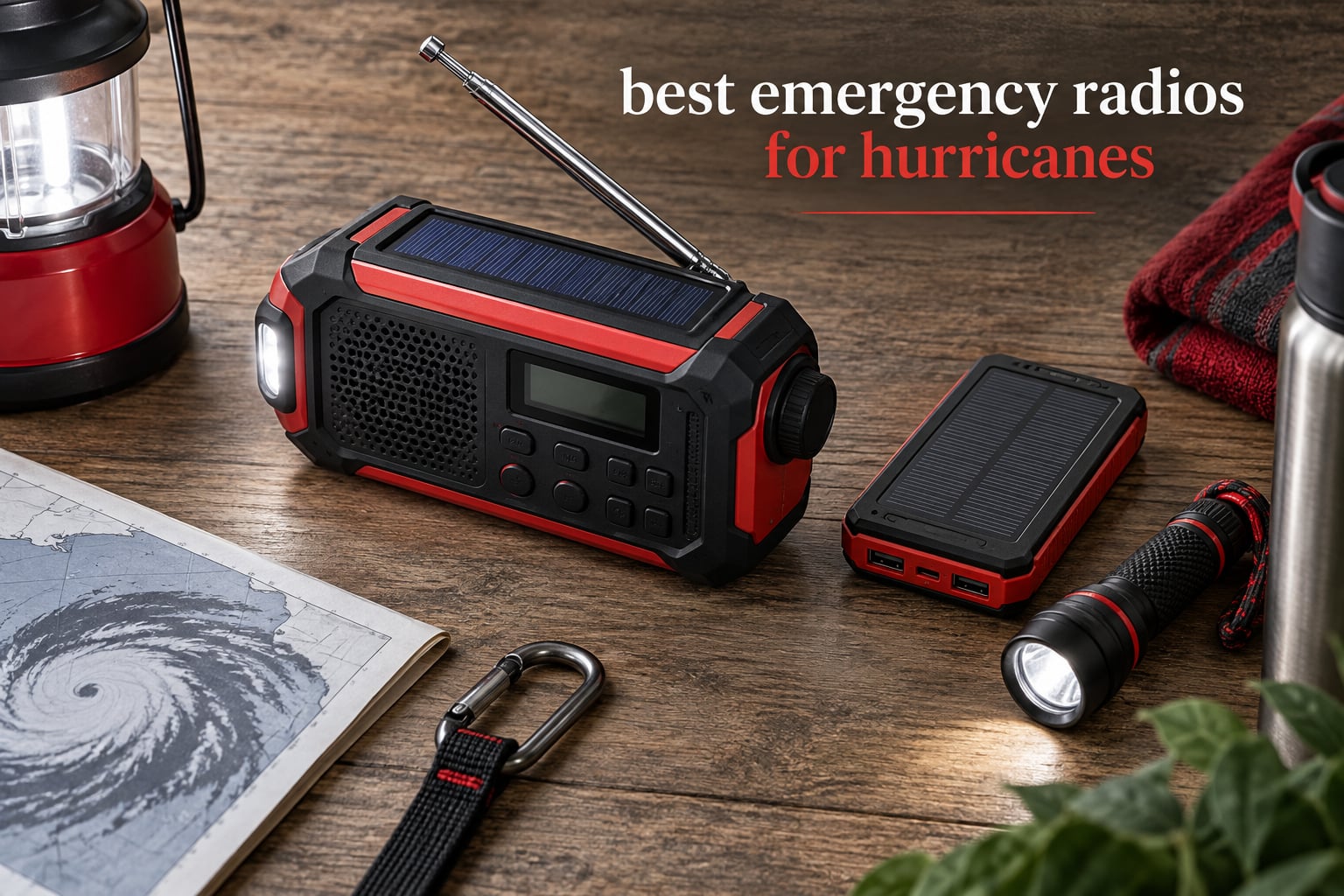
If you are searching for the best emergency radios for hurricanes, you are probably trying to answer one question: what still tells me what is happening when the power is out and my phone has no bars. A dedicated NOAA weather radio is the answer, because it is the one piece of communications gear that keeps working after the cellular network gives up.
That matters more during a hurricane than during almost any other storm. Towers run on backup batteries that run out, and the network congests with people trying to check on family at exactly the moment it stops carrying traffic reliably. NOAA transmitters are a completely separate system, so their signal does not degrade when cell service does.
I worked through this category over a full hurricane season cycle the way I approach any gear I plan to rely on in a bad situation. I logged charging methods, battery capacities in mAh, speaker wattage, antenna length and water ratings across ten models, and I watched for the failure pattern that shows up again and again in owner reviews: people buy a radio, never program it, never test it, then find out at landfall that the county code was never set.
This guide covers ten radios in detail, then gets into what usually gets skipped: what happens to cell towers hour by hour, an honest answer on whether hand cranks are worth the arm soreness, and step-by-step instructions for programming your SAME county code. Disclosure: as an Amazon Associate we earn from qualifying purchases, and it does not change what we say here.
Our Top 3 Hurricane Radios, Ranked by What Actually Works When the Grid Goes Down

FosPower A1
- 7400mWh power bank output
- Hand crank plus solar plus AAA backup
- 1W flashlight and 4-LED reading light
- NOAA weather band with AM/FM

Raynic CR1009Pro
- 5000mAh battery with six charging paths
- Automatic NOAA scanning in standby
- 3W flashlight and 2.5W reading lamp
- AM/FM/SW/NOAA four-band reception

RunningSnail 090PG
- 14800mWh (4000mAh) pack charges phones
- Four-way power with USB-C and crank
- 3-mode flashlight plus motion-sensor lamp
- External antenna improves reception
The FosPower A1 leads because it combines the largest review volume in this group with a genuinely useful power bank and three independent ways to stay powered. The Raynic CR1009Pro is the one I would put in a bedroom, because it scans for NOAA alerts on its own while it sits in standby. The RunningSnail 090PG is the smallest package here that still charges a phone, which makes it the go-bag pick.
Comparing All 10 Emergency Radios for Hurricanes in 2026
| Product | Specs | Action |
|---|---|---|
| FosPower A1 |
|
Check Latest Price |
| Raynic CR1009Pro |
|
Check Latest Price |
| RunningSnail 090PG |
|
Check Latest Price |
 Kaito KA500 Kaito KA500 |
|
Check Latest Price |
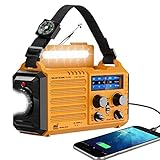 Eoxsmile NOAA Solar Radio Eoxsmile NOAA Solar Radio |
|
Check Latest Price |
 Midland WR120B Midland WR120B |
|
Check Latest Price |
 Leaton 10000mAh Leaton 10000mAh |
|
Check Latest Price |
 Nitigo 4000mAh Nitigo 4000mAh |
|
Check Latest Price |
 Emgykit 086S Emgykit 086S |
|
Check Latest Price |
 Mesqool CR1030 Mesqool CR1030 |
|
Check Latest Price |
Two numbers matter more than everything else in that table: battery capacity in mAh, and how many ways the unit can be recharged without a wall outlet.
1. FosPower A1 – The Most Proven All-Rounder for Hurricane Kits
FosPower NOAA Emergency Weather Radio A1 7400mWh Solar Hand Crank (Orange)
7400mWh (2000mAh) pack
Crank plus solar plus 4 AAA
USB phone charging
1W flashlight and 4-LED reading light
Pros
- Highest review volume in this group at 37779 ratings
- 7400mWh (2000mAh) power bank charges phones and small tablets
- Three independent power sources including 4 AAA backup
- Limited lifetime warranty
- Compact enough for a go-bag
Cons
- Solar charging is weak and largely ineffective
- Small built-in antenna needs careful tuning for NOAA reception
- Some owners report radio or speaker failure after a few months
- AAA compartment is awkward to open
The FosPower A1 is the pick I recommend to anyone who asks for a single radio and does not want a follow-up question. It sits at 4.6 stars across more than 37000 ratings, the largest installed review base of anything we tested, and in that volume the failure pattern is unusually well documented rather than hidden.
You get a 7400mWh (2000mAh) internal pack that doubles as a power bank, three ways to keep it alive, and NOAA plus AM and FM reception in a 6.2 by 2.1 by 2.9 inch body under 15 ounces. For a hurricane kit, one device covers alerts, local news, a flashlight, a reading light and roughly one phone top-up.
Battery Output and What It Means for Your Phone
The 7400mWh figure earns this radio its top spot. In a real outage that is roughly one meaningful phone charge, not three, so plan on topping up one device rather than a household. The AAA fallback matters more: four AAAs are the cheapest battery on any shelf, and a radio that accepts them will run for a stretch on a fresh set.
Reception, Audio and the Antenna Weak Spot
The honest weakness is the short built-in antenna. NOAA broadcast is a weak, low-power signal by design, and this radio needs patient tuning rather than a large telescopic whip, so expect a minute of fiddling near a window the first time. Some owners also report radio or speaker problems after several months, which is why monthly testing matters.
2. Raynic CR1009Pro – Best Value Unit With Automatic NOAA Scanning
Raynic Emergency Radio, 5000mAh/18500mWh Weather Radio, Solar Hand Crank Radio with AM/FM/SW/NOAA Alert, Cell Phone Charger, Headphone Jack, Flashlight and SOS Siren
5000mAh battery
Six charging paths
Automatic NOAA scan in standby
3W flashlight plus 2.5W reading lamp
Pros
- Automatic NOAA alert scanning while in standby
- Largest HD LCD here with digital tuning and battery readout
- Six charging options including AC adapter and AAA cells
- 3.5mm headphone jack plus USB in and out
- Good sound quality for the size
Cons
- Splash resistance only
- not waterproof
- Solar maintains charge but will not revive a dead battery
- Short antenna limits reception sensitivity
- No SAME county programming
The Raynic CR1009Pro is the one I would put on a kitchen counter and leave in alert mode. It scans the NOAA band automatically while it sits in standby, so a hurricane watch or evacuation notice wakes the house without anyone touching a dial, which is the most useful behavior in a storm shelter.
It also has the broadest power redundancy in the group at six inputs: internal lithium polymer battery, included AC adapter, DC 5V USB, hand crank, solar and AAA cells. The 5000mAh capacity and USB output can carry a phone through a long outage, and the large LCD with digital tuning makes it the easiest unit to hand to an older family member.
What Six Charging Paths Actually Buy You
Redundancy is the real feature. Any single input can fail in a hurricane: a panel in a week of overcast, a crank with a tired arm, a car USB port in a flooded driveway. Six inputs means at least one is almost certainly still working on day three, which is the entire point.
Display, Siren Output and the SAME Gap
The important gap is the absence of SAME county programming, meaning the radio alerts for distant counties as well as your own. That produces extra noise rather than missed warnings, so it is a tolerable compromise, but it is why the Midland WR120B later in this list exists. Digital tuning removes the most common user error during a warning.
3. RunningSnail 090PG – Best Go-Bag Pick With a 4000mAh Pack
RunningSnail Emergency Crank Radio with 3-Mode Flashlight & Reading Lamp
14800mWh (4000mAh) battery
Four-way power
3-mode flashlight and motion lamp
External antenna
Pros
- 14800mWh (4000mAh) battery can charge smartphones
- Four-way power with micro USB and solar and crank
- 3-mode flashlight with 10m plus reach and motion-sensor reading lamp
- External antenna improves reception
- Compact ABS body
Cons
- Only a 1W speaker
- which is thin for spoken alerts
- 1 watt audio output is modest for open-air listening
- No AC adapter option
The RunningSnail 090PG is the one that fits the bag. At 6.23 by 1.8 by 3.19 inches it is one of the slimmer models here, and it carries a 14800mWh (4000mAh) battery larger than several radios that are physically twice its size.
It receives NOAA weather broadcasts covering hurricane, tornado and snowstorm warnings, plus AM and FM. The external antenna is a genuine upgrade over the fixed stubs on some competitors, and owners credit it with better reception in interior rooms. Four charging paths cover micro USB, solar, hand crank and the internal battery.
Battery Capacity and Phone Charging in a Go-Bag
4000mAh is a real number for a go-bag. It brings a phone from flat to a usable charge roughly once, which is what matters for mapping, weather and a couple of text attempts while the towers are still up. Since the micro USB port doubles for charging, the cable you carry for your phone likely charges the radio too.
Lighting and the Thin Speaker
The 3-mode flashlight reaching more than 10 meters is unusually capable for this class, and the motion-sensor reading lamp switches on when you move near it, which is useful in a dark shelter where you do not want to fumble for a switch with wet hands. Audio is the trade-off: a 1 watt speaker is thin for a room of people.
4. Kaito KA500 – Best for Shortwave Reception and Antenna Reach
Kaito KA500 5-way Powered Solar Power,Dynamo Crank, Wind Up Emergency AM/FM/SW/NOAA Weather Alert Radio with Flashlight,Reading Lamp and Cellphone Charger, Yellow
Six-way power
AM FM shortwave and 7 NOAA channels
14.5 inch telescopic antenna
USB output for phones
Pros
- Six-way power including crank solar 3 AA and AC adapter
- AM FM two-band shortwave plus 7 pre-programmed NOAA channels
- 14.5 inch telescopic antenna with signal strength indicator
- USB 5V output charges phones GPS and cameras
- Long-standing model with a large installed review base
Cons
- Larger and heavier than the compact crank-radio competitors
- Not submersion-proof despite the water-resistant rating
- ABS housing scuffs easily
The Kaito KA500 is the model seasoned users keep recommending to each other, and the reason is the antenna. A 14.5 inch telescopic whip with an LED signal strength indicator gives you a visible way to dial in a weak NOAA signal, which turns reception from guesswork into a two-minute job.
It is also the most complete receiver in this lineup. AM, FM, two shortwave bands and seven pre-programmed NOAA channels mean you can hear distant stations, local news and official alerts without switching equipment, and the 5-LED reading lamp, LED flashlight and red SOS beacon cover the light side.
Why Antenna Length Decides NOAA Reception
NOAA transmitters broadcast a deliberately weak signal across seven channels in the 162 MHz band. Inside a steel shelter, behind a metal roof, or in a basement, the difference between a six inch stub and a 14.5 inch whip is the difference between a usable radio and a dead one. The signal strength LED lets you rotate the whip until the reading improves.
Size, Weight and the Case Against It
At 16 ounces and 8.3 by 2.3 by 5.3 inches, this is a large radio that will not disappear into a glove box. If you have room for a home or vehicle radio that is never carried far, the extra size is an advantage. The housing handles rain and wind but is not submersion proof, so keep it above floor level in a coastal garage.
5. Eoxsmile NOAA Solar Radio – Best for Lighting and Siren Output
Eoxsmile Emergency Radio with NOAA Weather Alert, Solar Hand Crank Portable
5000mAh internal battery
3W flashlight reaching about 80 m
5 power sources
9-second SOS alarm
Pros
- 3W LED flashlight reaching roughly 80 m plus 2.5W reading lamp
- Five power sources including 5000mAh battery and AAA backup
- AM FM and shortwave plus telescopic antenna
- NOAA-certified alerts with 9-second SOS alarm and flashing red light
- Includes compass and hand strap
Cons
- Alerts only fire in standby or with the alert function enabled
- Weak AM reception and no automatic gain control
- No water resistance
- Charges devices slowly at roughly 1 Amp
The Eoxsmile is the brightest lighting package in this roundup, and for households that lose power for a week, lighting is not a minor feature. A 3 watt LED flashlight reaching roughly 80 meters plus a 2.5 watt reading lamp with two brightness levels cover the two things you need after dark: seeing across a yard and reading a document.
Reception is wide open, with AM from 520 to 1710 kHz, FM from 88 to 108 MHz, shortwave from 7 to 19 MHz and the 7 NOAA weather channels, served by a telescopic antenna and a 3.5mm headphone jack. Five power sources cover the internal 5000mAh battery, solar, hand crank, USB-C input and three AAA cells.
Flashlight Reach and Why It Wins in a Blackout
Most radios here carry a one watt light intended to find a doorknob. An 80 meter reach is the difference between checking whether the street is flooded and checking whether a neighbor is okay. The two-level reading lamp also matters, since a dim setting that will not wake a sleeping child is worth more than maximum brightness.
The Standby Behavior You Need to Understand
Here is the setting that catches people out: alerts fire in standby or when the alert function is enabled, not while you are actively listening to another band. If you leave it tuned to AM all evening, you will not hear the tornado warning, so set it to NOAA and leave it in alert mode as a habit.
6. Midland WR120B – Best for the Home, and the Only Real SAME Alerts Here
Midland – WR120B – NOAA Emergency Weather Alert Radio
SAME programming for up to 25 counties
NOAA Weather Scan over 60 hazard types
AC adapter with 6 AAA backup
Color-coded alert indicators
Pros
- SAME programming limits alerts to up to 25 chosen counties
- NOAA Weather Scan covers over 60 hazard and emergency types
- Color-coded indicators show alert type and severity
- Alert override switches to impending danger automatically
- AC adapter with 6 AAA battery backup
- Reception holds up even inside a steel tornado shelter
Cons
- Weather radio only with no AM or FM bands
- Must remain reasonably near a NOAA transmitter for usable reception
- Some owners want higher maximum volume
If your radio is going to sit on a shelf, plugged in, watching a house during a hurricane, this is the right tool, and SAME programming is the single most important reason why. It is the only radio here where you can enter your county codes and the unit will only sound for warnings issued where you actually live.
That changes the experience completely. On a radio without SAME you get woken by alerts for counties two hundred miles away, and after a few weeks you start ignoring it. Owners also praise the continuous backlighting option, which keeps the LCD on during the night, and reception that held up even inside a steel tornado shelter.
How to Program Your SAME County Code
Find the FIPS code list for your state from the National Weather Service. Power the radio on and press MENU until the county code option appears, then use the channel or up and down controls to select the six digits of your county FIPS code, which combines your state code with your county code.
Press MENU again to accept it and repeat for each additional county, up to 25. Finally press MENU to exit, then hold the WEATHER ALERT or TEST button to run the alert tone so you know it will wake you. Do this before season starts, not during it.
What You Give Up Compared to the Portable Units
This is a one-band weather radio. There is no AM, no FM and no shortwave, so it cannot carry local news after a storm when the NOAA band goes quiet. It also needs a wall outlet to be useful, with six AAA cells as backup rather than a primary source, and on its 1 watt speaker placement near a bedroom beats a large common room.
7. Leaton 10000mAh – Best Water Resistance and Easiest Controls
Leaton Hand Crank Emergency Radio, NOAA Weather Radio AM/FM,10000mAh
10000mAh battery
IPX6 splash rating
Large controls and tuning knob
USB-C plus solar plus crank
Pros
- 10000mAh battery delivers roughly one to one and a half iPhone 14 charges
- IPX6 splash and water resistance which is rare in this class
- 3-mode LED flashlight plus 1.3W reading lamp and reverse-side flood light
- Large controls and tuning knob are easy for seniors and families
- Built-in compass and one-year warranty
Cons
- Solar panel largely ineffective for gaining meaningful charge
- No SAME automated alerts and manual tuning required
- No headphone jack and no shortwave support
- Cannot charge multiple devices at once
The Leaton is the one to consider if your radio lives outside, in a boat, on a marine deck or in a vehicle that occasionally floods. It carries an IPX6 splash and water rating, which is genuinely unusual among hand crank radios, most of which are only splash resistant on paper or not rated at all.
The 10000mAh battery is the second largest here and the most practical figure for a household that wants the radio to be the power source, described by owners as roughly one to one and a half iPhone 14 charges. Controls are large and the tuning knob is oversized, a genuine benefit for an older adult working in the dark, and a built-in compass helps when the grid is out.
What IPX6 Means in Real Rain, Wind and Spray
An IPX6 rating means protection against powerful water jets, which in plain terms covers driving rain, windblown spray, a wet dock and a knock into a puddle. It is not a submersion rating, so keep it out of a flooded boat, but it is a step above the water-resistant wording most competitors use.
Manual Tuning and the Loss of SAME
The NOAA band along with AM and FM is tuned manually, with no automated alerts and no county filtering. In practice you find your local channel once, then leave the dial there. Owners are also candid that the solar panel does not do much, with some unable to gain a meaningful charge after four full days of full sun.
8. Nitigo 4000mAh – Best for Cars, Luggage and Small Spaces
NITIGO Emergency Weather Radio, 4000mAh NOAA Weather Radio Solar Charging
4000mAh (14800mWh) USB battery
Adjustable high-gain antenna
Retractable 180-degree reading lamp
Compact 300 g body
Pros
- 4000mAh (14800mWh) internal battery can charge phones over USB
- Solar panel plus hand crank plus USB charging
- Adjustable high-gain antenna for strong reception
- Ultra-bright LED flashlight plus retractable 180-degree rotating reading lamp
- Loud SOS alarm with flashing light and 3.5mm headphone jack
- Small enough to pack in luggage
Cons
- Small one-watt-class speaker is thin for group listening
- Manual tuning with no SAME county programming
- No AC adapter
The Nitigo solves a problem the larger radios create. At 5.31 by 2.28 by 2.68 inches and 300 grams, it is the kind of unit you can put in a glove box, a carry-on or a jacket pocket and still forget is there until you need it, which is exactly what you want from a backup device.
It is not stripped down despite the size. It gets a 4000mAh (14800mWh) battery that powers USB devices, an adjustable high-gain antenna, NOAA plus AM and FM, and dual lighting: an ultra-bright LED flashlight and a retractable lamp that rotates 180 degrees so you can aim light at a map or a fuse box without moving the radio.
Antenna Adjustment and Reception in a Vehicle
The adjustable high-gain antenna separates this from a fixed-stub unit of the same size. In a car you can put the radio on the dashboard near a window and get materially better signal than a stub antenna in the same spot, and you can angle it away from the roof and body metal, a common cause of weak reception.
Lighting, Audio and the Honest Limitation
The retractable rotating reading lamp is the sleeper feature, useful in a dark car, a shelter corridor or on a floor where you are working by phone light. The limitation is audio: a one watt class speaker is thin for group listening, so pair it with one of the louder units rather than expecting it to be the main alert device.
9. Emgykit 086S – Budget Pick for a Second Radio or a Spare
Emgykit Hand Crank Radio with AM/FM/NOAA Weather Band,for Emergencies
2000mAh (7400mWh) pack
3W 3-LED flashlight at 140 lumens
SOS siren over 80 dB
Pocket sized at 0.51 lb
Pros
- Very low cost for a NOAA and AM and FM hand crank radio
- 3W three-LED flashlight at 140 lumens
- SOS alarm over 80 decibels holds attention
- Three charging sources with hand crank and solar and Type-C
- 2000mAh battery can charge a phone
- Owners report it held up through 8 hours at full volume with the light on
Cons
- Not waterproof
- Solar charging is very slow with only about 25% gained after several hours of full sun
- Plastic housing can look cheap even though function is solid
- Flashlight brightness is modest for walking in the dark
This is the buy-two answer. The Emgykit costs so little that a sensible household has one in the car, one in a go-bag and one in a drawer, and for anyone who wants NOAA alerts covered at several places in the home, that math beats a single expensive unit.
It delivers the essentials without fuss: AM, FM and NOAA reception, a 3 watt three-LED flashlight rated at 140 lumens, three-way crank and solar and Type-C charging, and a 2000mAh (7400mWh) battery that can bring a phone up. The SOS siren measures over 80 decibels, loud enough to be heard over wind and rain outside a shelter.
Where a Budget Radio Is the Right Answer
NOAA transmitters have limited range, and a single unit on a kitchen counter may be fine in a coastal county and marginal where the transmitter is far away. Two or three cheap radios placed in different rooms solve that without anyone needing to think about antenna placement, and a second one survives the failure of the first.
What You Sacrifice Compared With the Mid-Tier Units
The plastic housing can look cheap even though the function is solid, and it is not waterproof, so a flooded car or a wet porch is a real risk. At 140 lumens the flashlight is modest for walking outdoors, and with 2000mAh you should expect roughly a half phone charge rather than a full one.
10. Mesqool CR1030 – Best for Multi-Day Outages With the Largest Battery
Mesqool Emergency Weather Radio NOAA Alert with Battery Backup 12000mAh
12000mAh lithium battery
8500mm2 solar panel
Upgraded copper-coil crank
Flashlight beam up to 260 feet
Pros
- True 12000mAh lithium battery
- the largest capacity in this lineup
- 8500mm2 monocrystalline solar panel over four times a typical panel
- Upgraded copper-coil hand crank at roughly twice standard charging efficiency
- High-sensitivity chip with noise reduction and extended antenna
- Flashlight beam up to 260 feet plus a frosted reading lamp
- 3-year replacement or refund warranty
Cons
- Heaviest unit here at 1.6 pounds and the largest footprint
- Solar is primarily a maintain-charge function
- Most expensive option in the comparison
The Mesqool CR1030 is the highest rated radio in this group at 4.7 stars, and it holds the largest battery at a true 12000mAh. If your household expects a grid-down period of a week rather than a night, the extra capacity is the difference between the radio helping and the radio being another thing on your list to charge.
Its solar panel is the one here that is engineered rather than decorative, at 8500 square millimeters of monocrystalline silicon, and the hand crank uses a larger copper coil described as roughly twice the charging efficiency of a standard dynamo. Reception comes from a high-sensitivity chip with noise reduction and an extended antenna, and the 5 watt speaker is the strongest audio in the group.
Battery Life, the Solar Panel and Genuine Multi-Day Use
A 12000mAh lithium battery is the number to focus on if your outage is measured in days. It is enough to keep a household’s phones alive and still have reserve for the radio’s own lighting, which matters because the flashlight is what you will use most in the first two nights. The panel needs a south-facing position in full sun to contribute rather than merely hold charge.
Weight, Footprint and Who Should Buy It
At 1.6 pounds and 6.8 by 2.9 by 4.7 inches this is the heaviest unit here, so it is a home or garage radio rather than a go-bag one, though several owners use it as an everyday kitchen radio. The 3-year replacement warranty is the longest coverage here, and it is also the most expensive option in the comparison.
How to Choose an Emergency Radio for Hurricane Season
Most buyers over-index on features that do not matter in a blackout and under-index on the two that do. Here is the order we would think about it, roughly in order of importance for a coastal household.
Power Sources: Three Ways In Beats One Big Panel
Rank charging options by how many independent inputs exist, not by which ones are listed. The FosPower, the Raynic and the Kaito each accept both a rechargeable pack and disposable cells, and that combination is what survives a week of no grid. A radio that only takes a sealed internal battery becomes dead weight after one deep discharge.
Treat solar and crank as backups. For a panel to matter it needs real surface area and direct sun, and for a crank to matter it needs to be something you will actually pick up rather than something you hope to avoid using.
What Battery Capacity in mAh Actually Buys You
Capacity is a proxy for runtime and phone charges, and it is the easiest number to compare because it is not marketing language. As a working guide, 2000mAh suits listening and emergencies, 4000mAh to 5000mAh handles a weekend with phone charging, and 10000mAh to 12000mAh is for households planning on a week or more without power.
Watch the watt-hours figure where it is given, because 7400mWh and 14800mWh are the same batteries expressed differently, and comparing mWh to mAh directly will mislead you.
SAME Alerts and the County Code Nobody Programs
SAME, or Specific Area Message Encoding, is a digital code carried inside the NOAA broadcast identifying which county a warning applies to. A radio with SAME programmed to your county will not alert you for a warning three counties over, which is what turns an emergency radio from something you start ignoring into something you trust.
Of the ten radios here, the Midland WR120B offers full SAME programming for up to 25 counties. The rest alert you for a broader area, which is noisier but never dangerous, since you get more warnings rather than fewer.
Reception, Antenna Placement and Indoor Signal Problems
If your NOAA radio sounds noisy or silent indoors, it is almost always placement rather than the radio. Extend the antenna fully and hold it vertical, put the unit near a window, keep it away from metal roofing, foil-backed insulation and appliances, and try an interior wall rather than an exterior one.
Several radios here accept an external antenna, and the Kaito and RunningSnail are the two where a longer whip is built in, which is the cheapest reception improvement available. A radio that sounds weak in one room can sound completely clear ten feet away from a wall.
Alert Volume and Why Two Radios Beat One Loud One
Most of the radio’s job is done while you are asleep, so the alert tone matters more than music quality. Owners of the Midland WR120B specifically praise alerts that reliably wake sleepers, and that is the experience you are buying with a home radio.
Speaker wattage runs from 1 watt on the smaller RunningSnail and Nitigo units up to 5 watts on the Mesqool and Eoxsmile. If several people will be listening in one room, 1 watt will feel thin. If the radio is a bedside device, it is fine.
Phone Charging, Water Resistance and the 3-3-3 Rule
Every radio here with a USB output can charge a phone, but capacity decides how many times. A 2000mAh pack gives roughly a half charge, while 12000mAh gives more than a full one plus spare. Set your expectation from the capacity figure, not from the presence of a port.
Water resistance is rated on the IP scale. The Leaton’s IPX6 rating covers powerful water jets, rain and spray, while most others are simply described as water resistant. For a radio living in a car, a boat or an exposed porch, that difference is worth paying for.
The 3-3-3 rule is an emergency kit guideline rather than a radio specification: three supplies to last three days, and three ways to get each one. A radio with crank, solar and battery inputs satisfies the third part for information. On EMP hardening, an analog transistor radio with a mechanical dial is generally considered the most resilient consumer option, but certified hardened products are largely unavailable, so treat it as a tiebreaker.
When a Weather Radio Is Not Enough
Experienced users in ham and survival forums converge on a layered stack rather than a single device: a NOAA radio for official alerts, a GMRS or FRS handheld for coordinating with family a few miles away, and a satellite messenger for texting out of the area when towers are down.
That layer matters specifically after landfall, when NOAA goes quiet and the question becomes road conditions and whether the bridge is standing. Two-way radios are outside the scope of this roundup, but if your hurricane plan includes checking on relatives, budget for one alongside the weather radio.
A Monthly Test Routine You Can Do Before the Season
Set a recurring reminder. Switch the radio on and confirm it receives a NOAA broadcast using the test alert tone. Check the battery indicator and top up over USB so the pack is not sitting full all year. Crank it for a full minute to confirm the mechanism still turns and charges.
Confirm your SAME codes are still programmed if applicable, check the antenna extends and retracts cleanly, and put fresh cells in the AAA or AA compartment so the fallback path is verified rather than assumed. Ten minutes a month is the difference between a device that works and one you discover is dead in the first hour of a warning.
Emergency Radio FAQs for Hurricane Season
Do hand crank radios really work?
Yes, as a last-resort trickle charger. A steady minute of cranking on a typical emergency radio yields roughly five to fifteen minutes of radio playback, enough to catch an alert when the battery is flat. It is not a substitute for a charged battery, and owners consistently report that crank charging is slow.
How long do cell towers work during a hurricane?
Often only hours to roughly a day. Once a site loses commercial power it runs on backup batteries, and coastal areas commonly see service degrade or drop somewhere in the first 12 to 24 hours after the worst of the storm arrives. Voice calls congest first, then texts and data time out.
What is the best overall emergency radio for hurricanes?
The FosPower A1 is our top pick, combining the largest review base in this group with a 7400mWh (2000mAh) power bank, three independent power sources including AAA cells, and NOAA plus AM and FM reception. For a home unit that stays plugged in, the Midland WR120B wins on SAME county programming instead.
What is the 3-3-3 rule for radios?
It is an emergency kit guideline, not a radio specification: three supplies to last three days, and three ways to get each supply. For a radio, the third part means having at least three independent power inputs such as a rechargeable battery, solar or crank, and disposable cells.
Why is my NOAA weather radio getting bad reception?
It is almost always placement. Extend the antenna fully and hold it vertical, place the radio near a window, and keep it away from metal roofing, foil-backed insulation and appliances. Basements and steel-framed rooms usually need a separate external antenna attached to the radio’s antenna port.
Is a NOAA weather radio better than a phone for hurricanes?
For alerts, yes. NOAA transmitters operate independently of the cellular network, so a radio keeps receiving watches, warnings and evacuation notices after towers are down and data has stopped working. A phone remains better for maps, weather radar and texting while service is available, so carry both.
Which Emergency Radio Should You Buy Before Hurricane Season 2026?
If you want one radio and nothing else, the FosPower A1 is the pick. It has the most review history behind it, a power bank that will hold a phone, and three ways to stay powered including plain AAA cells. Set it near a window, leave it on the NOAA channel, and test it once a month.
If the radio will live in a house and stay plugged in, choose the Midland WR120B and spend the extra effort on programming your SAME county codes. It is the only radio here that alerts you for your county and not for a region two hundred miles wide, and that is the difference between an alert you trust and one you start ignoring.
If you are building go-bags, put a RunningSnail 090PG in each for its compact 4000mAh pack and phone charging, and keep a Mesqool CR1030 at home for audio power and multi-day battery life. For a vehicle, the Leaton handles rain and spray thanks to its IPX6 rating.
Whichever you choose, do the three things that matter more than the model: program the county code, charge the battery, and run a test alert before the season starts. Then buy a second cheap unit for the car. Among the best emergency radios for hurricanes, the difference between the first night and the fifth night is preparation rather than hardware.
Leave a Reply