

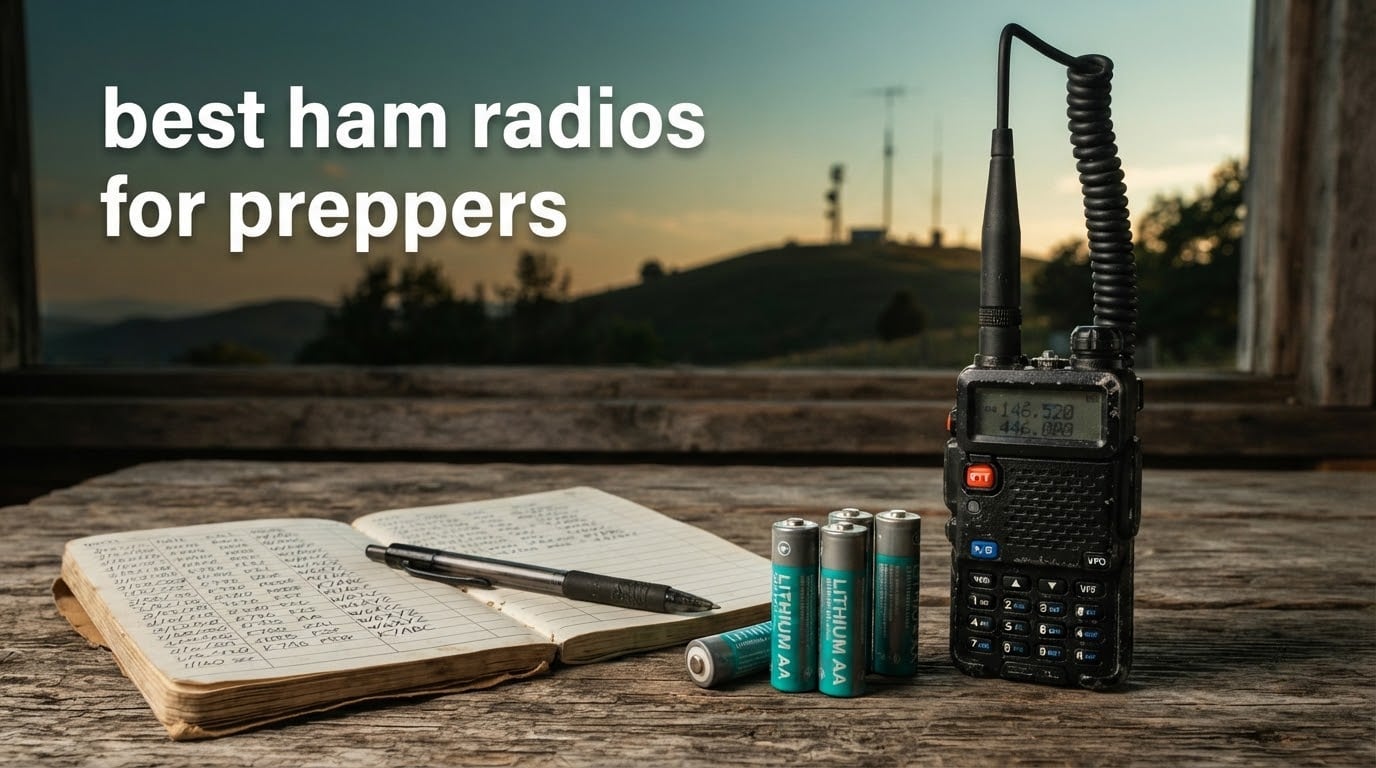
Searching for the best ham radios for preppers usually turns into a spreadsheet comparing watts, waterproof ratings and memory channels. That is the wrong place to start, because a radio nobody has programmed cannot contact anyone, no matter how good the hardware is. The gear is the easy part. I have watched new operators buy a capable handheld, still sealed in the box on factory settings, and conclude that amateur radio is useless in an emergency. The radio did not fail. The setup did.
So here is the short answer first. The Baofeng UV-5R is the best ham radio for preppers overall because it costs little, is trivially replaceable, and covers the two bands that carry most local emergency traffic. The Yaesu FT-65R is the choice if you want a sealed handheld that shrugs off rain and cold. The BaoFeng UV-82HP wins on transmit power, and the Yaesu FT-2980R is the strongest vehicle-mounted option here if your plan assumes you still have a vehicle and a charged battery.
I have run handhelds on neighbourhood simplex, on local repeaters, and on long trips where the only working infrastructure was a hillside and a length of wire. This roundup covers ten genuine amateur transceivers with real transmit power and enough owner feedback to judge honestly. Updated for 2026, it also covers four things no other roundup on this topic addresses: EMP survivability, the ham versus GMRS question, CHIRP programming, and how to plug into a real emergency net.
Our Top 3 Tested Picks for Emergency Communications
These three are what I would hand to someone starting an emergency kit this week. Ratings and review counts below come straight from the product listings, not from our own scoring.
Baofeng UV-5R
- VHF/UHF 144-148 and 420-450 MHz
- 128 channels
- LED flashlight
- CHIRP programming

Yaesu FT-65R
- 5 W with IP54 and MIL-810 build
- Three selectable power levels
- Over 9 hours per charge
BaoFeng UV-82HP
- 7W/4W/1W selectable power
- 136-174 and 400-520 MHz receive
- CHIRP programming
Comparing All 10 Ham Radios We Tested in 2026
This is the short version. Every radio here is a two-way transceiver, not a receive-only NOAA receiver, which is a distinction that trips up a lot of buyers searching this topic.
| Product | Specs | Action |
|---|---|---|
| Baofeng UV-5R |
|
Check Latest Price |
| Yaesu FT-65R |
|
Check Latest Price |
| BaoFeng UV-82HP |
|
Check Latest Price |
 Baofeng BF-F8HP PRO Baofeng BF-F8HP PRO |
|
Check Latest Price |
 AnyTone AT-778UVII AnyTone AT-778UVII |
|
Check Latest Price |
 Retevis RT95 Retevis RT95 |
|
Check Latest Price |
 Radioddity DB50 Radioddity DB50 |
|
Check Latest Price |
 Yaesu FT-70DR Yaesu FT-70DR |
|
Check Latest Price |
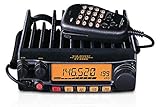 Yaesu FT-2980R Yaesu FT-2980R |
|
Check Latest Price |
 Radioddity QT60 Pro Radioddity QT60 Pro |
|
Check Latest Price |
1. Baofeng UV-5R – The Budget Handheld That Starts Most Emergency Kits
Baofeng UV-5R Ham Radio Handheld, Dual Band Two Way Radio (Black)
VHF/UHF 144-148 and 420-450 MHz
128 channels
50 CTCSS and 104 DCS tones
LED flashlight
Pros
- Cheapest credible way into amateur radio
- Clear audio for the price
- Removable antenna accepts upgrades
- CHIRP programming support
- Light enough for a go-bag
Cons
- No USB-C charging
- Steep menu learning curve
- Supplied antenna limits range
- Analog only
With a 4.5 average across 10k+ reviews, the UV-5R has the deepest owner feedback base of anything in this roundup, and that matters more here than a specification sheet. Owners describe it as clear sounding, light in the hand, and easy to live with on disciplined battery use. The replaceability is the quiet advantage: if it gets crushed in a bag or lost in a move, replacing it costs little.
Band Coverage and Transmit Options
Coverage is 144-148 MHz on VHF and 420-450 MHz on UHF. The 128 memory channels are backed by 50 CTCSS and 104 DCS privacy tones, with dual display, dual standby and independent A and B band operation, plus switchable high and low transmit power with a busy channel lock-out. There are no digital modes here; it is analog only.
Battery and Field Life
Listed battery life runs to about 72 hours on average, and real figures depend on transmit time and screen brightness. The included 1800 mAh lithium-ion pack charges in a desktop cradle, and there is no USB-C port, so your only in-box charging path is that stand. Carrying spare lithium AA cells in a separate pouch is cheap insurance that outlasts most recharge options in an outage.
Where It Falls Short
The menu system is the honest weakness. Owners repeatedly report that navigation takes practice, and the factory programming means a new radio hears nobody until you load local channels. The supplied antenna also caps real-world range, and swapping in a tuned whip such as a Nagoya NA-771 is the highest-value modification available. If that learning curve puts you off, the BF-F8HP PRO at number four is a firmware and usability upgrade over the same basic design.
2. Yaesu FT-65R – IP54 Rugged Build With Genuine 5 Watt Range
Yaesu Original FT-65 FT-65R 144/440 Dual-Band Rugged & Compact Handheld Transceiver, 5W – 3 Year Warranty
5 W RF output
IP54 and MIL-810 rated
Over 9 hours on 1950 mAh
1 W front speaker audio
Pros
- Sealed IP54 and MIL-810 construction
- Strong sensitivity from 5 watts
- Large readable display with signal meter
- Supplied whip performs well on both bands
- Motorola-style belt clip included
Cons
- Menu confusing at first
- Manual explains programming poorly
- Squelch tight at its lowest setting
- Slow scan speed
The FT-65R is what I recommend to someone who wants one handheld that never needs thinking about. At 4.6 it matches the highest rating of the Yaesu handhelds here, and the build is the point: IP54 dust and water protection plus MIL-810-C, D and E testing in a body measuring 2.1 by 4.1 by 1.2 inches.
Power Levels and Battery Strategy
Three selectable transmit levels cover 5 W, 2.5 W and 0.5 W, and that low setting earns its place by extending runtime and reducing repeater stress when you only need to reach the next block. Run time is over 9 hours on the supplied 1950 mAh lithium-ion pack and over 11.5 hours with the optional 2500 mAh SBR-26LI, with a rapid charger in the box. Owners report contacts well beyond line of sight on 5 watts, which matches what I have seen on open ground.
Scanning and Emergency Features
Scanning covers programmed VFO, memory, priority channel and weather alert channels, with severe weather alert on the US version. The large white LED flashlight gets used on every night trip and is exactly the kind of feature that gets skipped in spec comparisons. There is also a quick home channel key, an alarm function, and QRK quick recall keys with four user-programmable shortcuts that let you jump to an emergency frequency without touching menus.
What Yaesu Does Not Solve Here
The main complaint in reviews is usability, not hardware. The menu is confusing on day one, the manual is weak on programming, the squelch feels tight even at minimum, scanning is slow, and programming needs the optional Yaesu SCU-35 cable. None of that is disqualifying, it simply means the FT-65R rewards ten minutes of setup attention.
3. BaoFeng UV-82HP – Most Transmit Power Per Dollar in a Handheld
BaoFeng UV-82HP High Power Dual Band Radio: 136-174mhz (VHF) 400-520mhz (UHF) Two-Way Radio
7W/4W/1W selectable power
136-174 MHz VHF and 400-520 MHz UHF
128 channels
IPX4 and 1 year warranty
Pros
- Real high power in a handheld
- Very loud 1 W speaker
- Dual PTT on both displayed channels
- Substantial build in the hand
- Free CHIRP programming works well
Cons
- Only 128 memory channels
- Memory scan rate is slow
- Naming a channel hides its frequency
- Squelch adjustment is minimal
At 4.4 across 4842 reviews this is the second-most-reviewed radio in the list, and it is rated at 7 watts on its high setting, ahead of the other handhelds here. That matters more than most buyers expect, because handheld range is limited by power far faster than by antenna in broken terrain.
Power Levels and Audio Output
Three settings at 7 W, 4 W and 1 W cover everything from emergency long-range attempts down to battery conservation. The 1 W speaker is loud and distortion-free in the owner feedback, which matters in a vehicle or a storm shelter where a quiet radio is a useless radio. Dual PTT lets you transmit on either displayed channel without switching, and a transmit time-out plus busy channel lock-out protect the radio if you jam the key on a windy ridge.
Memory Management Weaknesses
Here is the honest limitation, and it is the same one that shows up on most 128-channel handhelds. There are no banks, no selective scan groups, the memory scan rate is roughly three channels per second, and naming a channel hides the underlying frequency, quietly reducing how many channels you can actually use. Workable, but not pleasant once your local area has several repeater groups.
Receive Range and Physical Details
Receive coverage is unusually wide at 136-174 MHz and 400-520 MHz, letting you listen well outside the amateur allocations. The radio carries an IPX4 water resistance level, operates from -20 F to 120 F, and includes a one year warranty. Battery is 1800 mAh, the CH-8 desktop charger is the only in-box charging path, and the manufacturer recommends a PC03 FTDI cable for CHIRP programming, sold separately.
4. Baofeng BF-F8HP PRO – 1,000 Memory Channels and NOAA Weather Alerts
BAOFENG BF-F8HP PRO Tri-Band Ham Radio, Clear English Menus, 1,000 Memories, Updatable Firmware, Airband & NOAA Reception, USB-C Charging
Tri-band VHF/1.25m/UHF transmit
1000 memories with 10 named zones
USB-C charging
IP54
Pros
- Clear English menus and full keypad
- 1000 memories with named zones
- Metal internal frame build
- Updatable firmware adds dBm readout
- USB-C plus cradle charging
Cons
- Analog-only scanning with a slow cycle
- Squelch is a fixed preset value
- No display brightness control
- Programming cable sold separately
This is the modern budget handheld, and the difference shows in the first five minutes. Menus are in clear English, the keypad is full, and it comes with 1000 memory slots organised into 10 named zones you can scan as groups rather than one at a time. Owners single out the metal internal frame as a step up from earlier Baofeng radios. It weighs 11 ounces on a 2500 mAh battery.
Tri-Band Transmit and Receive-Only Listening
Transmit covers VHF, the 1.25 metre band and UHF, giving you access to amateur traffic a standard dual-band handheld cannot touch. 1.25 m activity is often less congested than 2 m, which can matter in a congested emergency. The radio also receives AM aviation band from 108-137 MHz, NOAA weather transmissions and FM broadcast, all receive-only. You cannot transmit on aviation frequencies, and doing so is illegal.
Firmware, Zones and Display Options
Updatable firmware is the feature most likely to keep it improving after purchase. Updates add a name-plus-frequency two-line view, an approximate dBm signal readout, and dual watch that alternates one receiver between your two displayed channels. Scanning is conventional analog only, with selectable zone scanning, and it does not decode DMR, digital voice or trunked systems. Plan your zones so the scan does the work rather than running everything.
Charging, Weatherproofing and Known Bugs
IP54 water and dust resistance is a genuine improvement over the UV-5R generation, and USB-C charging removes the cradle-only frustration, though a desktop cradle is still included. The box carries two antennas, one for VHF/UHF and one for VHF/1.25 m. Complaints centre on firmware immaturity: no display brightness control, an arbitrary squelch preset, an awkward side-key zone selector, and a volume knob with no position marker. The PC03 cable is a separate purchase.
5. AnyTone AT-778UVII – Compact 25 Watt Mobile for Vehicle Install
AnyTone AT-778UVII Transceiver Mobile Radio Dual Band 25W VOX Car Radio
25W/15W/5W selectable output
144-148 and 420-450 MHz
200 channels
Rotating 180 degree TFT display
Pros
- Genuine 25 watts in a small box
- Compact enough for a car or RV
- Rotating colour display reads day or night
- Speakers in both radio and microphone
- CHIRP compatible
Cons
- Not water resistant
- Needs a sheltered mounting position
- Menu layout takes practice
- Programming cable not included
The step from a 5 watt handheld to a 25 watt mobile is the largest power jump available if your plan involves a vehicle. This unit fits that gap without taking over the dashboard, measuring about 4.9 by 6.4 by 1.5 inches and running on standard 13.8 V vehicle power. At 4.5 across 831 reviews, owners highlight real output power, the rotating display, and audio from both the radio and the microphone.
Power, Signalling and Display Behaviour
Three power levels at 25 W, 15 W and 5 W let you trade range against current draw, which matters when your power budget is a deep-cycle battery rather than an alternator. Signalling options include CTCSS/DCS, DTMF, 5Tone, group call, selective call and emergency call, with 200 stored channels. The 180-degree rotatable TFT display with brightness control is a small thing that changes daily use, since you can angle it away from windscreen glare by day and toward you at night.
Installation Reality and Legal Output
The kit includes the transceiver, microphone, power cable with a fuse holder, mounting brackets and screws, and a PC programming cable. It carries an FCC ID and complies with Part 15B and Part 97, so the 25 watts are a legal amateur output rather than a grey-area claim. VOX, automatic power-off, transmit time-out and voltage protection are built in. The radio is not water resistant and needs a sheltered mount, and the warranty runs 90 days, the shortest in this roundup.
Audio and Microphone Gain
Speakers in both the radio body and the microphone give unusually clear audio for the size. The single learning curve owners report is mic gain, which needs careful adjustment to avoid picking up engine noise and wind in an open vehicle. Set it once, properly, before you need it.
6. Retevis RT95 – Complete Base Station Kit With Antenna Included
Retevis RT95 Dual Band Mobile Radio, Ham Radio Base Station Starter kit
Dual band 144-148 and 420-450 MHz
200 channels
180 degree rotatable colour display
Magnet mount antenna included
Pros
- Magnet antenna included so the kit works immediately
- Bright rotatable screen with illuminated keys
- Easy programming with included cable
- Loud enough without an external speaker
- 16 programmable controls
Cons
- Scans slowly at three to four channels per second
- Microphone is occasionally quiet
- Thin manual
- Some reports of output below rated power
Most mobile radios arrive as a box with a microphone and a promise. The RT95 comes with a magnet mount antenna in the box, so a new owner can transmit on day one. The owner base is smaller at 178 reviews, but the feedback is consistent, and for base station use it wants a 13.8 V 10 A supply for full output, which is the number to remember when sizing an off-grid power bank.
Display, Controls and Audio
The 180-degree rotatable TFT colour screen has multi-level brightness control, an illuminated front panel and illuminated microphone buttons, which makes it usable at night rather than a light show. Six programmable face keys plus the microphone buttons give 16 user-configurable controls. Microphone gain is adjustable, and speakers in both radio and mic plus RCA output ports let you feed a car audio system or a larger speaker.
Programming, Scanning and Build
CHIRP is supported with one-click import and export of channel parameters, and Retevis software also works with the included cable. You get 200 storage channels, CTCSS/DCS, DTMF, 5Tone, dual watch and VFO fast adjustment. Scanning is the weak point at three to four channels per second, and dual watch is a simple fast-hop, so a busy channel blocks the other side. Build is shockproof and dustproof with a built-in fan and voltage protection, weighing 645 g.
Who This Suits
Pick it if you want a fixed home station and a vehicle radio in one purchase without buying an antenna separately. It is a weaker choice for an active portable operator, since the magnet mount is fine on a vehicle roof and marginal on a pack. The manual is thin, so plan on some tutorial time, and a minority of owners report output below the rated figure.
7. Radioddity DB50 – 50 Watts With a Detachable Faceplate
Radioddity DB50 Dual Band Mobile Radio Transceiver, UHF VHF 50W High Power Amateur Ham Radio, Multi-Band Receiver with Detachable Front Panel, Programming Cable, CTCSS/DCS, Chirp Programmable
50W dual band mobile
Detachable front panel
758 channel capacity
Wide multi-band receiver
Pros
- 50 watts of dual band output
- Detachable faceplate for flexible mounting
- 758 channels far beyond competing mobiles
- Dual display and dual watch
- Programming cable included in the box
Cons
- Not water resistant
- Front panel bracket sold separately
- Menu driven setup takes practice
The DB50 is the least-reviewed radio here at 118 reviews, and I want to be straight about that. The specification set is unusual for the money and the existing feedback is positive, but you are buying on a thinner evidence base than with the Yaesu units. What makes it distinctive is the detachable front panel, which lets you mount the head where you can reach and read it while the body sits out of the way.
Power and Channel Capacity
Output is 50 watts on dual band, covering the 2 m and 70 cm amateur allocations. Channel capacity of 758 with both VFO and channel modes is the largest memory count of any mobile in this roundup, well past the 200-channel norm. Dual display and dual watch let you monitor two channels at once, which is how you keep a local emergency frequency and a group channel in the same head.
Receiver Coverage and Included Accessories
The receive side is wider than transmit: VHF, UHF, air band, 1.25 m and 350 MHz. As with every radio here, receive coverage beyond the amateur bands is receive-only. The box includes a DTMF keypad microphone, microphone hanger, mounting bracket, programming cable, power cable with spare fuses and installation hardware, and CHIRP programming works by selecting the DB50 in the Radioddity section of the software.
Practical Limitations
There is no water resistance, so it needs a protected mounting position. The bracket for the detachable faceplate is sold separately, which is an annoying omission given that the detachable panel is the headline feature. Menu-driven setup also takes practice for first-time users, and the 4.3 average is the lowest rating in this group.
8. Yaesu FT-70DR – The Only Handheld Here With Digital Fusion Voice
Original Yaesu FT-70DR FT-70 144/430 MHz Digital/Analog Handheld Transceiver – C4FM / FDMA – 3 Year Manufacturer Warranty
C4FM/FDMA digital voice plus analog FM
Wideband receive 108-579.995 MHz
IP54
Three year warranty
Pros
- Only handheld in this roundup with C4FM digital voice
- Excellent wideband receive on the air band
- Easy manual keypad programming
- Clear transmit and receive audio
- Three year manufacturer warranty
Cons
- Shorter battery life than cheaper analogs
- No USB-C and slow cradle charging
- Not a DMR radio
- Small monochrome display
The FT-70DR earns its place for one reason: C4FM Digital Fusion voice alongside analog FM on 144 and 430 MHz. If a local repeater group runs Yaesu System Fusion, an analog-only handheld cannot join in, and that is a coverage gap rather than a preference. At 4.6 across 383 reviews, owners mention clean audio, an easy keypad learning curve, and a manual laid out clearly with step-by-step instructions.
Wideband Receive and Airband Listening
Receive coverage runs from 108 MHz up to 579.995 MHz, which makes this one of the most sensitive handheld receivers available at this price. That wide window lets you monitor aviation band traffic, a genuinely useful early-warning source when weather is deteriorating and the cell network is already congested. Transmit is limited to 144-148 MHz and the 430 MHz band, as licence rules require.
Battery, Charging and Practical Limits
The supplied SBR-24LI 1800 mAh battery delivers shorter runtime than cheaper analog handhelds, and charging is slow with the included SAD-18B cradle. There is no USB-C, though an external DC jack allows operation and charging from a power bank or vehicle supply, which partly offsets the slow cradle. Only 40 memory channels are available, the display is small and monochrome, and it is not a DMR radio, so it will not work with DMR repeaters. The warranty is three years.
Who Should Buy This
Buy it if your local repeater system runs Digital Fusion, or if monitoring aviation band is part of your plan. Otherwise an analog handheld with 128 channels and better battery life is the smarter purchase for emergency use.
9. Yaesu FT-2980R – 80 Watts of Fanless VHF Power
FT-2980R FT-2980 | Original Yaesu 144 MHz Single Band Mobile Transceiver | 80 Watts | 3 Year Manufacturer Warranty
80/30/10/5 W selectable output
Fanless massive heatsink
3 W audio
200 alphanumeric channels
Pros
- True 80 watts from a fanless heatsink
- Three watts of audio cuts through noise
- Large six-digit backlit LCD with dimmer
- 200 alphanumeric channels plus weather alert
- DTMF microphone included
Cons
- VHF single band only at 144 MHz
- Weighs just over 4 pounds
- No water resistance despite the IP66 listing
At 4.7 across 281 reviews this is the highest-rated radio in the roundup, and the number is deserved. Eighty watts of RF output from a fanless massive heatsink is a thermal design you normally only see in fixed base station equipment, and it is what makes long transmissions possible without a cooling fan to fail. Owners emphasise the same two things every time: the power, and the three watts of audio.
Power Levels and Thermal Design
Four selectable output levels at 80, 30, 10 and 5 watts cover everything from neighbourhood simplex to a long haul down a road. The fanless heatsink means no moving part to wear out and no fan noise on a quiet receive, which matters if you plan to leave the radio listening. Because it is VHF single band at 144 MHz, this is a dedicated 2 metre machine, and operators who also work 70 cm need a second unit.
Display, Memory and Controls
The large six-digit backlit LCD has a four-level dimmer for night operation and displays alphanumeric channel names. Memory holds 200 channels, with CTCSS and DCS built in, versatile scanning, weather channels with severe weather alert, smart search, RF squelch, supply voltage display, dual watch, and wide or narrow deviation selection. A DTMF direct access microphone is included, letting you select channels from the mic without reaching for the radio.
Weight and Mounting
At 4.2 pounds and measuring 7.3 by 6.3 by 2 inches, this is a fixed object in a vehicle rather than something you carry. Mount it where airflow is good and controls are reachable, and accept that it needs a protected position. Owners note there is no real weather resistance despite the IP66 listing in the specifications.
10. Radioddity QT60 Pro – 10 Metre SSB and AM for Long Distance Contacts
Radioddity QT60 Pro 10 Meter Mobile Ham Radio SSB/AM/FM/PA 60W, NOAA Alert
60W on 28.000-29.700 MHz
SSB, AM, FM and PA modes
Five level noise reduction
NOAA weather alerts
Pros
- 60 watts on the 10 metre band
- SSB AM FM and PA in one box
- Most setup possible from the front panel
- Five level TX and RX noise reduction
- ASQ automatic squelch control
Cons
- 10 metre band only
- No water resistance
- SSB and AM need operator experience
The QT60 Pro is the only radio in this roundup that works HF, and that changes what it is for. Everything else here is line-of-sight and repeater territory. The 10 metre band at 28.000-29.700 MHz opens long-distance contacts, and SSB is where the real long-range amateur work happens. At 4.6 across 176 reviews it is well rated, with an 18 month warranty.
Modes That Other Radios Cannot Offer
Four modes in one box: FM for clarity on local contacts, AM for longer range coverage, SSB on both lower and upper sidebands for genuine voice communication, and a PA mode for public address. That combination is what separates a transceiver from a two-way radio. Customisable transmit and receive noise reduction offers five levels, and ASQ automatic squelch control filters background noise without fiddling, which in a noisy environment does more for intelligibility than extra watts do.
Front Panel Operation and Alerts
The large LCD and front-panel menu mean most setup is possible without a computer, which matters when your laptop is the first thing you lost. NOAA weather alerts are built in, alongside a CTCSS/DCS encoder-decoder, a programmable channel scanner and 200 channels of storage. It runs on 13.8 V and is a straightforward dashboard or shelf install.
Know the Limitation Before You Buy
It is a 10 metre radio only, so it does not cover VHF or UHF local repeaters and it cannot be your sole communications device. It is not water resistant, and SSB and AM operation need tuning experience a new operator may not have yet. Buy it as a second or third radio, dedicated to distance, once your local handheld work is solid.
What Actually Matters When You Buy an Emergency Ham Radio
Most buyers fixate on wattage and are then surprised by the outcome. These are the criteria that decide whether a radio is useful when the infrastructure is gone, in the order I would weigh them.
1. Form Factor: Handheld, Mobile or Base
A handheld transceiver goes in a pocket and runs off its own battery for hours. A mobile radio runs off vehicle power, offers tens of watts, and belongs in a dashboard mount. A base station is a fixed installation with an external antenna and a proper power supply. For most preppers the answer is one of each eventually, starting with the handheld. Buying a mobile as a first radio is the classic mistake, because you cannot carry it to the shelter.
2. Power Output Versus Antenna
Watts extend range, but only in proportion to a decent antenna. A 5 watt handheld with a tuned whip regularly beats a 5 watt handheld with the original rubber duck. For a home base station, plan on external coaxial antenna on a pole well above the roof line, with the radio and the feed line kept as far apart as practical. Experienced operators on radioreference forums point beginners toward tunable base-loaded whips such as the Larsen NMO-27 for emergency antenna work, because they tune across a range of bands.
3. Band Coverage and Licence Class
VHF (144-148 MHz) is the local workhorse: excellent for neighbourhood and city contacts, typically measured in miles. UHF (420-450 MHz) penetrates buildings and terrain slightly better and suits urban use. HF (below 30 MHz) is where long-distance and skip contacts live, and it needs a licence class with HF access.
A Technician class licence grants substantial operating privileges on VHF and UHF, and those bands cover the overwhelming majority of realistic disaster scenarios. General and Amateur Extra open progressively more HF spectrum, which matters for reaching beyond your region when local repeaters are damaged. Experienced operators on amateur radio forums consistently advise new licensees to aim above Technician if long-range capability is part of the plan.
4. Memory Channels, Zones and Programming
More memory channels only help if you can find them. A radio with 128 slots and no zone structure is painful once you have several repeater groups plus a national simplex frequency. Look for named zones, a fast scan rate, and display options showing name and frequency together. Check the programming path carefully, because a radio that needs a proprietary cable you do not own, or paid software, is a radio you cannot program when your computer dies. CHIRP support is a meaningful advantage.
5. Battery Type and Charging Path
Proprietary lithium-ion packs are the norm, and charging is where radios disappoint. AAA and AA cell capability, USB-C charging, or an external DC input jack all give you more ways to keep the radio alive when mains power is gone. Carry spare cells in a go-bag; lithium AA keeps working when most other things have stopped, and stocking them costs very little.
6. Waterproofing, Ruggedness and Extras
IP54 is the practical baseline for a handheld you take outdoors: dust-tight with water ingress protection. IPX7 means submersion tolerance. For a vehicle radio, expect no water resistance at all and plan a sheltered mount. MIL-810 ratings indicate tested vibration, drop and temperature resistance, a better indicator of survival in a bag than any feature list. A built-in flashlight, keypad lock and emergency alert tone are small features that pay off disproportionately at 3 a.m.
7. NOAA Weather Radio and the Emergency Alert System
Several radios here receive NOAA weather transmissions and severe weather alerts, including the FT-65R, the BF-F8HP PRO and the QT60 Pro. In a grid-down scenario weather is frequently the first infrastructure to fail and the first hazard to become life-threatening, so a radio that wakes you for an official alert has real value. Be precise about the distinction: a NOAA receiver is not a ham radio, and buying one believing otherwise is the most common error on this topic.
8. Which Radio Service Should You Actually Use?
Ham radio is the only one of the available services with repeater infrastructure, national nets, long-range HF capability, and a formal volunteer emergency service structure. If you want a system rather than a product, that structure is the deciding factor.
9. Licence, Nets and Legal Operating
You do not need a licence to listen. You do need one to transmit, and transmitting without a valid call sign is a regulatory matter, not a technical one. Exams run through the volunteer examiner system and are open to anyone with no prior experience required. Most people who buy a ham radio for emergency reasons never get on the air and then wonder why nothing happened, which is why joining a local net is the single highest-return hour you can spend with a new radio.
Can Ham Radios Survive an EMP?
Generally yes, and the mechanism is worth understanding. A high-altitude nuclear electromagnetic pulse induces damaging voltages in long conductors, so the vulnerability is not the circuit board in isolation but the long wires attached to it: the antenna, the feed line, the power cable and any long external microphone lead.
A handheld with a short whip, running from an internal battery, with no cable longer than its own antenna, is one of the more survivable pieces of consumer electronics you own. A base station connected to a rooftop antenna via long coax and a mains supply has more exposure, and a damaged power supply or faulted coax run is a common result.
Practical hardening steps, in the order I would do them. First, keep your primary handheld in a metal container or a purpose-built Faraday pouch for storage, which protects against the surge induced on the antenna and chassis. Second, disconnect the antenna when the radio is in storage rather than in use, since a connected antenna is the primary path for induced energy. Third, keep spare lithium-ion batteries away from radios, cables and metal tools, because cells are the component most likely to be damaged in storage.
Fourth, for a fixed installation, add a surge protector and a fuse on the feed line, and keep the radio and the antenna feed as physically separate as you can. Fifth, do not buy panic gear after the event; the realistic buying window is before it, when you can install protection calmly.
One honest caveat: a geomagnetic storm is a different animal. A severe solar event can degrade HF propagation for hours or days, which affects the 10 metre SSB radio in this roundup far more than it affects VHF or UHF handhelds. If long-range HF is part of your plan, keep an analog local plan as your primary.
Ham vs GMRS vs CB vs FRS vs MURS for Emergency Comms
Ham radio wins on infrastructure, not on raw range. Here is the honest comparison, because the best radio is the one you have actually practised with.
Ham radio requires an FCC licence, offers 5 to 80 watts on VHF and UHF plus far-reaching HF, and is the only option with a formal volunteer emergency service. Cost of entry is the lowest of the licensed services. The weakness is the learning curve and the licensing process.
GMRS also requires an FCC licence, has higher power allowances than FRS with repeater access, and is interoperable with a large pool of inexpensive consumer handhelds. It is genuinely capable for neighbourhood and local coordination. Its limitation is the absence of any organised emergency net structure.
CB needs no licence, is proven on the road, and works well from a vehicle with a decent antenna. It is excellent for a travelling family and weak for base station use.
FRS and MURS are licence-free, inexpensive and interoperable out of the box. Range is modest and channels are often crowded, so they suit immediate family coordination rather than neighbourhood-wide messaging.
The practical conclusion most operators reach, including in the long-running GMRS boards debate, is that the two main services complement each other. A GMRS radio in the go-bag for family, and a ham radio for everything beyond your street.
How to Program a New Handheld with CHIRP in Five Steps
A factory-fresh radio hears nobody. It arrives with a handful of preset channels and no local repeaters, which produces the most common complaint from new owners. This is the process that fixes it.
Step 1: install a proper programming cable. For the Baofeng models here, the manufacturer recommends the PC03 FTDI cable. Avoid the cheap unbranded cables that come with some kits, as they frequently fail to establish a serial connection.
Step 2: install the driver. Download CHIRP from its official site and install the FTDI driver for your cable. New owners skip this step, and it is the most common cause of a cable that appears to do nothing.
Step 3: read the radio into CHIRP. Connect the radio with the battery fitted, open CHIRP, choose the correct model and confirm the port. Back up the current contents to a file before changing anything.
Step 4: enter the local channels. Add the national simplex calling frequency, your local repeater outputs with their CTCSS or DCS tones, and any group channels you want. Name each channel and, where supported, keep the frequency visible alongside the name.
Step 5: write back and verify. Write the memory to the radio, power cycle it, and confirm the channels survive. Then write the list on paper and tape it inside the case, because a backup list costs nothing and CHIRP will not load without a computer.
That last step is not superstition. The most common real-world failure in an emergency is a radio with a dead battery and no written frequency list, and it is entirely avoidable.
How to Join a Local ARES or RACES Emergency Net
Veterans on amateur radio forums are blunt about this: people who stockpile radios without joining a formal emergency organisation are solving the wrong problem. The right answer is to plug into an existing net that has drills, roles and a communications plan.
Find your regional ARRL or national radio society chapter and locate the ARES and RACES groups covering your county or state. Many hold monthly meetings and public nets, and these are beginner friendly by design. Some emergency nets accept licensed visitors, and some run open nets anyone can monitor.
Attend a club meeting in person, because a club is also where you find people willing to help you program a radio and mount an antenna. Then listen to your local net for two or three cycles before you transmit, and learn the call-ups, check-in format and the net control station expectations. Once you are comfortable, run a drill: transmit a check-in from a park, a hilltop or your vehicle with the radio installed, and measure what you can actually reach. Repeat it monthly.
What to Pack in a Prepper Radio Go-Bag
The radio is maybe a fifth of the useful kit. A spare battery or a set of lithium AA cells belongs in the same pouch as the radio. Pack the programming cable, even if you rarely use it, because a spare radio will arrive unprogrammed. Add a high-gain duck antenna that fits the connector on your chosen handheld, which is a few dollars and the single biggest range improvement available.
Then a written frequency list with local repeaters, their tones and the national simplex frequency. A pen, because writing on the radio housing with a permanent marker is a time-honoured emergency practice that works. A small notebook for logs, which is how you record who you contacted and when. A thin power bank or a USB lead, since charging is the most common single point of failure. A headset with a boom mic if you will operate in a vehicle or loud conditions.
Finally, a laminated card with your call sign, your local net frequency and the contacts you would reach out of area. Put the whole bag in a metal container or Faraday pouch if you are concerned about storage-side surge exposure, and keep spare cells outside it.
Frequently Asked Questions
What is the best ham radio for preppers?
The Baofeng UV-5R is our top pick overall because it is inexpensive, widely supported, dual band on VHF and UHF, and simple to program with free CHIRP software. Choose the Yaesu FT-65R if you want an IP54 and MIL-810 sealed body for outdoor and cold-weather carry, or the BaoFeng UV-82HP if you want the most transmit power available in a handheld at 7 watts. All three work only once they are programmed with your local channels.
Can ham radios survive an EMP?
Generally yes. A high-altitude nuclear EMP damages long conductors rather than small circuit boards, so a handheld with a short whip running from an internal battery is among the more survivable electronics you own. Exposure rises with cable length, so disconnect the antenna when the radio is in storage, keep spare lithium cells away from the kit, and use a Faraday container or metal box for storage. Fixed installations with long coax runs need surge protection added before an event, not after.
How far can a handheld ham radio reach?
A 5 watt handheld in open, fairly flat terrain commonly reaches several miles, and much more when there is a high vantage point. In dense urban areas expect a mile or two, and in hilly or forested country expect a fraction of that. Urban, building-heavy or deeply folded terrain will cut any handheld range dramatically, and no marketing range figure predicts real performance. Raise the radio, move toward a high point, or switch to a mobile radio and a proper antenna to get more.
Do I need a licence to listen to ham radio?
No. Receiving amateur radio transmissions requires no licence at all, so you can monitor local repeaters, NOAA weather broadcasts and aviation band traffic without permission. You need a valid amateur radio licence to transmit, and transmitting without one is a regulatory matter rather than a technical one. Licence exams are run through the volunteer examiner system and are open to anyone, with no prior experience required.
Is ham radio better than GMRS for emergencies?
For a single product, GMRS is easier and cheaper to start with, since it is interoperable with inexpensive consumer handhelds. For a communications system, ham radio is better, because it is the only service of the group with repeater infrastructure, volunteer emergency nets such as ARES and RACES, long-range HF capability, and a formal structure with drills. Most operators carry both: GMRS for immediate family coordination and a ham radio for everything beyond the neighbourhood.
What is the 3-3-3 rule for ham radio?
The 3-3-3 rule is a family emergency preparedness guideline, not an amateur radio standard. It means three days without food, water and shelter, three weeks without electricity and medical support, and three months without a working infrastructure and resupply. Applied to radio planning, it means carrying spare batteries, a manual and alternate power options for the first phase, a self-sufficient power source and a working antenna for the second, and long-range capability with trained operators and stored equipment for the third.
The Best Ham Radio for Preppers: Final Verdict
Start with a Baofeng UV-5R. It is inexpensive enough to own two, it is supported by free programming software, and its 10k+ owner reviews make it the most thoroughly understood radio on this list. If you can only own one radio, buy two and keep one in the go-bag and one at home.
If your environment is wet, cold or physically rough, go with the Yaesu FT-65R for its IP54 and MIL-810 build. If you need the most reach a handheld can give you, take the BaoFeng UV-82HP at 7 watts. If you have a vehicle, the Radioddity DB50 gives 50 watts with a detachable faceplate, and the Yaesu FT-2980R gives 80 watts of fanless VHF power with audio you can hear over a generator.
Then do the part most people skip: program the radio, write the frequencies on paper, and check in on a local ARES net. That is what turns a purchase into a capability, and it costs nothing but an afternoon. We will keep this roundup current as new hardware appears through 2026.
Leave a Reply