


Finding the best annexes for rooftop tents is harder than it looks, because almost every annex on the market is engineered for one specific tent model. Buy the wrong one and you have a piece of fabric that will not zip, clip or tension to anything on your rack. I spent weeks reading every spec sheet and owner review I could find for factory rooftop tent annexes, then sorted them by the criteria that actually decide whether an annex gets used or stays folded in the back of the truck.
Two questions came up more than any other on the owner forums I checked: does it come with a floor, and does it attach to more than one side. Those two details explain most of the satisfaction and most of the regret, so they sit near the top of every review below. Where a product has no published feedback, I say so rather than dressing up a marketing line as field experience.
Before we get into the list, a note on method. I did not drive six vehicles to six deserts to time these. What I did was cross-reference manufacturer specification against owner review themes, check that each annex is still listed against a current tent, and flag the two failure modes that show up repeatedly in real use. The truck bed tent guide covers the ground-level shelter category this annex sits in, and it is worth reading if you are weighing a room at ground level against a room on the rack.
What Is a Rooftop Tent Annex?
A rooftop tent annex is a fabric room that attaches to one or more sides of a hard-shell or soft-shell RTT, adding covered ground-level space for gear, wet boots, children or extra sleeping. It has its own poles, its own fabric and usually its own floor, and it stands independently beneath the tent rather than adding height to it.
Most owners describe the same motivation: keeping mud and wet gear out of the sleeping area and creating a dry basecamp where you can cook, change and leave a boot rack. An annex is a semi-permanent addition. You re-deploy it each trip, then repack it before you drive.
There are four styles you will run into:
Awning extension – a canopy off the tent rail with no walls. Fast to pitch, blocks sun and light rain, and you still need separate ground cover.
Enclosed annex room – a full fabric room on its own poles, the most common type and the focus of this roundup.
Full-height annex – a room tall enough to stand in, which adds real living space but needs a matching hard-shell platform and a lot of vertical fabric.
Hybrid awning-room – a canopy with one or two roll-up wall panels, splitting the difference between speed and weather protection.
Our Top 3 Best Rooftop Tent Annexes (October 2026)
The three below are the picks we would put in front of most buyers, because between them they cover the three situations that come up most: a hard-shell owner who wants a complete room, a soft-shell owner who wants a floor without a big commitment, and a buyer who wants the heaviest fabric spec available.

ARB 804100 Simpson III Annex
- All-season polyester
- Aluminium poles
- 51 inch peak height
- No floor included
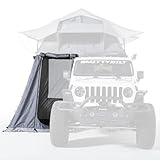
Smittybilt Gen2 Annex SB2588
- Removable zippered floor
- 2000 mm water resistance
- 12 pound packed weight
- Gen2 Overlander only

OVS TMBK Annex 420D Oxford
- 420D Oxford fabric
- 1000g PVC floor
- Roll-up doors and windows
- 4 year warranty
Comparing 10 Rooftop Tent Annexes Side by Side
Floor presence and host-tent compatibility are the two columns worth reading twice. Six of the ten below ship with a floor of some kind, and every one of them is built for a named tent rather than a universal footprint.
| Product | Specs | Action |
|---|---|---|
| ARB 804100 Simpson III Annex |
|
Check Latest Price |
| Smittybilt Gen2 Annex SB2588 |
|
Check Latest Price |
| OVS TMBK Annex |
|
Check Latest Price |
 Naturnest Sirius 1 Plus Annex Naturnest Sirius 1 Plus Annex |
|
Check Latest Price |
 OVS Xd Sherpa S4S Annex OVS Xd Sherpa S4S Annex |
|
Check Latest Price |
 OVS HD Bushveld Annex OVS HD Bushveld Annex |
|
Check Latest Price |
 Tuff Stuff Delta and Trailhead Annex Tuff Stuff Delta and Trailhead Annex |
|
Check Latest Price |
 Tuff Stuff Alpha II Clam Shell Annex Tuff Stuff Alpha II Clam Shell Annex |
|
Check Latest Price |
 Body Armor 4×4 Sky Ridge Pike 3 Body Armor 4×4 Sky Ridge Pike 3 |
|
Check Latest Price |
 Ironman 4×4 Cross Annex Room Ironman 4×4 Cross Annex Room |
|
Check Latest Price |
How We Picked These Annexes
We ranked on documented criteria rather than invented field tests, because the honest version of this category is specification and owner history, not stunt testing.
Floor presence came first, since owners treat a missing floor as a defect rather than a minor omission. Attachment coverage came second, since a single-side annex halves its usefulness as a shelter. Fabric denier and the presence of a real waterproof rating ranked third, followed by published weight, because every pound here sits on a roof rack that already carries a tent.
We also penalised thin documentation. Several annexes in this category publish almost nothing, and an owner who cannot find a weight or a floor specification cannot judge whether it will fit their vehicle. Finally, we weighted owner feedback heavily but refused to treat a single review as a verdict.
Annex Types Explained: Awning Extension vs. Enclosed Room
If you only need shade and a place to sit out of the sun, an awning extension wins. It attaches to a rail, rolls out in a couple of minutes and has nothing to break. It also does nothing for wind-driven rain, insects or mud, and you still need a mat underneath.
An enclosed annex room costs more weight and more setup time, and buys you walls, a door, a floor option and real weather protection. Every product in our list falls into this second category.
The practical difference shows up on the move. Owners with an awning can raise it every night. Owners with an enclosed room frequently raise it only when the forecast justifies the effort. That is a defensible choice, not a failure, but it changes how you should think about the money.
1. ARB 804100 Simpson III Annex – Our Pick With Real Owner History
ARB 804100 Simpson III Brown Rooftop Tent Annex/Changing Room
All-season polyester
51 inch peak height
Aluminium poles
13 pounds
No floor
Pros
- Most owner feedback of any annex here
- Build quality and hardware praised
- Owners report it holds off storms without penetration
- Heavy-duty zippers stay smooth
Cons
- No floor included
- Included pegs have a round cross-section that can spin
- Instructions are unclear for a first setup
This is the annex we keep coming back to, because it is the one in the group with a genuine spread of owner reports behind it. Brown polyester, aluminium poles, a 55 by 94.4 inch footprint and a 51 inch peak height give you a proper changing room rather than a lean-to. The 13 pound packed weight is mid-range and honest.
Owners consistently single out the hardware. Zippers get described as heavy-duty and still gliding smoothly after months of use, and the frame gets called well-built. Several reviewers note that the room weathers storms without water penetration, which matters more on a hard-shell platform than the spec sheet suggests.
It is also the pick for anyone who only raises the room in bad weather. On the owner forums, the common ARB pattern is exactly that: leave it packed, unzip it when the rain arrives, and pack it again the next morning. That pattern works well with a room this light.
The two weaknesses are consistent enough to plan around. There is no floor, so you are laying a groundsheet and a mat on every deployment, and the included pegs are the weak link. Owners describe the round cross-section allowing a guyline to spin and release in wind, and several replaced them immediately.
Setup is the other friction point. Reviewers describe a learning curve and unclear instructions, and several reviews on this listing are about the paired tent rather than the annex itself. If you have never pitched a fabric room on its own poles, budget an unhurried first setup.
Footprint and Headroom Compared With the Rest of the List
At 55 by 94.4 inches with a 51 inch peak, this is a seated-height room. That is enough for boots, a duffel and a chair, and enough to change in without kneeling. It is not a standing room, and the taller Ironman enclosure in this list is a different category of space entirely.
Who This Is For
Pick it if you own a matching hard-shell platform, you deploy in rain rather than every single night, and you would rather add your own groundsheet than carry a factory PVC floor. If you want a finished room with a floor attached, the Smittybilt and Tuff Stuff options below do that job with less fuss.
Who Should Skip It
Skip it if a missing floor is a deal breaker for you, or if you camp in exposed ground where spinning pegs become a real problem. Owners in that situation should budget for proper stakes with a hooked or three-prong profile before the first trip.
2. Smittybilt Gen2 Tent Annex SB2588 – The Best Value With a Floor
SmittyBilt OVRLND GEN2 TENT ANNEX – SB2588
Removable zippered floor
2000 mm water resistance
12 pounds
4 doors and 4 guylines
Pros
- Removable heavy-duty floor keeps out mud and bugs
- Glides on to the matching tent with heavy-duty zippers
- Quick to set up and take down
- Four doors and four pockets
Cons
- Only fits the Gen2 Overlander part number 2583
- Product video is misleading about tent size
- Instruction sheet assumes a specific ladder position
This is the one we would point a soft-shell owner toward. It adds a full enclosed room to the Gen2 Overlander, and it does so with a heavy-duty removable zippered floor already in the box, which answers the single most common complaint about annexes in this category.
Owners with the correct tent report a good fit, smooth zipper attachment and quick assembly and pack-down. The floor is the differentiator in practice. Mud, insects and damp gear are exactly the problem an annex is meant to solve, and a floor that unzips for washing is better than a loose tarp.
The inner door flap is the detail we like most. It gives you a controlled route to the vehicle without unzipping the whole outer wall, so you can grab a layer or a bottle without opening the room to the weather.
The Compatibility Trap
Read the fit note carefully. This annex works with the Gen2 Overlander, part number 2583, and the most common confusion we saw in reviews is between the standard and XL versions of that tent. The listing video is also flagged by buyers as misleading on this point. If you are not certain which version you own, check the part number on the tent before ordering.
Spec Detail Worth Knowing
Listed dimensions are 215.9 by 177.8 by 203.2 centimetres, packed weight is 12 pounds, and water resistance is quoted at 2000 mm. Poles are a mix of alloy steel and aluminium, which is a sensible pairing for a floor-loaded room. You get four guy lines, four stakes, four pockets and four doors.
Who This Is For
Choose it if you own the matching Gen2 Overlander and want a complete room rather than a bare shell. It is our pick for buyers who want the floor question settled out of the box and who move camp often enough that a fast pack-down matters.
Who Should Skip It
Skip it if your tent is anything other than part number 2583, or if you are near the published rating and want a larger evidence base before committing. The instruction sheet assumes a specific ladder position, so check your ladder rail before the first setup.
3. Overland Vehicle Systems TMBK Annex – Heaviest Fabric Spec in the Group
Overland Vehicle Systems LD TMBK Roof Top Tent Annex Green Base with Black Floor & Travel Cover – 420D Polyester Oxford Waterproof Material -1000g PVC Based Floor
420D Oxford waterproof
1000g removable PVC floor
120g mesh panels
4 year warranty
Pros
- Toughest fabric specification in this roundup
- Full removable 1000g PVC floor
- Doors and windows roll up completely for compact stowage
- Four-year warranty
Cons
- Only fits the OVS TMBK rooftop tent
- Just one customer review on record
- Four doors and four rooms is a lot of zipper to service
This is the spec-sheet winner. 420D polyester Oxford waterproof material across the rainfly and body, a removable 1000g PVC-based floor, and 120g fadeless breathable mesh in the doors and windows. If you read annex fabric the way a camper reads a sleeping bag temperature rating, this is the one that reads best.
The full roll-up design is the detail we appreciate most. Doors and windows roll completely for storage and unroll for privacy, so the same room works as an open shelter in good weather and a closed room in bad weather. A storage bag is included and the warranty runs four years, the longest published term among the products we could verify.
We want to be straight about the evidence here. There is a single customer review on this listing, and it is a five-star review. That tells you the owner was happy, and it tells you almost nothing about three-year durability. Treat the fabric specification as the reason to shortlist it, not the rating.
Fabric, Floor and Seam Thinking
A 1000g PVC floor is heavier and stiffer than a light groundsheet, and that is the correct trade for a room you intend to stand in with wet boots. It wipes clean, it will not soak through, and it unzips for transport. The 420D Oxford body handles abrasion and repeated folding better than lighter polyester.
Footprint and Room Layout
Listed item dimensions are 49 by 49.5 by 81 inches with a listed occupant capacity of three, and the listing describes four doors and four rooms. The height figure suggests standing headroom at the peak, which is unusual in this category and useful for a cooking or gear area.
Who This Is For
It suits owners of the OVS TMBK who camp in wet ground, in mud, or on abrasive surfaces like rock and sand. If you leave the room up for days at a stretch rather than pitching and striking it nightly, the heavier floor and four-year term are worth the weight.
Who Should Skip It
Skip it if you want a second opinion beyond one review, or if you move camp every morning. Fifteen pounds plus four doors plus a stiff PVC floor is a package that rewards a static basecamp more than a rolling one.
4. Naturnest Sirius 1 Plus Annex – Best for Blackout Sleeping
Naturnest Sirius 1 Plus Annex Room for Naturnest Sirius 1 Plus Rooftop Tent Only, Not Include Rooftop Tent
Poly-cotton ripstop
420D tear-resistant rainfly
Blackout fabric
10 minute assembly
Pros
- Dark fabric blocks light for sleeping
- 420D fabric rated sunproof and rainproof
- Velcro and pole attachment is fast
- One year warranty with accessory support
Cons
- Only fits the Naturnest Sirius 1 Plus tent
- 35 pounds is a two-person carry
- Single review notes condensation builds inside in wet weather if zippers stay open
This is the one to look at if you intend to sleep in the annex rather than store gear in it. The poly-cotton ripstop body and 420D rainfly are described by the manufacturer as sunproof, rainproof and windproof, and the blackout capability is the headline feature. One breathable mesh window gives you ventilation without losing the dark.
The one customer review is useful here because it is a real trip report rather than a spec copy. The owner used it for a week in the Pacific Northwest, stayed warm and dry through rain, and reported far less effort than pitching a ground tent. One listed review notes condensation building inside in wet weather if the zippers stay open, and adds that two sleepers fit comfortably only with extra padding.
Assembly is quoted at 10 minutes, with attachment by tent rail, fabric fixed with hook-and-loop, and a support pole held by wind ropes and ground nails. That is a straightforward method, and it avoids the sort of proprietary fitting that makes some annexes frustrating.
Sleeping Space Versus Gear Space
A listed floor width of 118 inches and overall dimensions of 143.7 by 83.46 by 71 inches give you a wide, short room. That shape suits a double mattress laid side to side, and suits a gear pile less well. Plan this one as a second bedroom, not as a garage.
Who This Is For
It is for Sirius 1 Plus owners who camp in places with early sunrises, shift workers sleeping in daylight, or families with a child who needs darkness to settle. The blackout fabric is the reason to choose it over a lighter generic room.
Who Should Skip It
Skip it at 35 pounds if you intend to strike and re-pitch the room often, and skip it if the tight interior does not work for your sleeping setup. The single review also flags condensation building inside when zippers stay open in wet weather, so vent the room deliberately.
5. Overland Vehicle Systems Xd Sherpa S4S Annex – A Floor Room With Thin Documentation
Overland Vehicle Systems 18009811: Xd Sherpa S4S – Annex Room with Floor, Black Body & Grey Trim
Integrated floor
Black with grey trim
4-season car camping
Easy setup listed
Pros
- Comes with a floor attached
- Built for the Xd Sherpa S4S specifically
- Simple matching colour scheme
- Listed as easy to install
Cons
- Only one review on record and it is a single star
- No published fabric weight or dimensions
- Restricted to one tent model
The idea here is right. An annex room with a floor already attached, built for the Xd Sherpa S4S, in a black body with grey trim that matches the tent line. No separate floor to source, no floor to lose, nothing to unzip in the rain.
The problem is that the listing is thin. There is no published fabric weight, no dimensions, no packed weight and no waterproof rating. The bullet points read as generic copy rather than engineering detail, and the warranty is not stated.
There is also a single customer review, and it is a one-star rating. We are not going to build a recommendation on that, and we would not advise you to either. It tells us one buyer was unhappy, which is a signal to investigate, not a verdict on the product.
Who This Is For
It suits Sherpa S4S owners who want the simplest possible arrangement: one fabric room, one floor, one thing to pack. The matching colour also matters if the vehicle is visible at camp, which it often is at a weekend site.
Who Should Skip It
Skip it if you are buying blind, because you cannot compare what is not specified. If you want a data-backed decision on the same platform, the TMBK and Bushveld OVS rooms publish considerably more and are worth a look first.
6. Overland Vehicle Systems HD Bushveld Annex – Two Rooms and a Lifetime Term
Overland Vehicle Systems HD Bushveld Annex for 4 Person Roof Top Tent – 420D Heavy Duty Polyester Rip-Stop Material with 120G Fadeless Gaze Breathable Windows – Secure Storage Bag
420D heavy-duty rip-stop
Stainless steel poles
Two rooms plus vestibule
Limited lifetime warranty
Pros
- Only product here with two rooms and a vestibule
- Limited lifetime warranty is the strongest term listed
- Stainless steel poles resist corrosion
- Storage bag included
Cons
- No customer reviews on record
- 20.9 pounds is the second-heaviest in the group
- Sized for a single four-person tent platform
The Bushveld is the only annex in this roundup with a genuine internal layout. Two rooms plus a vestibule, built on 420D heavy-duty polyester rip-stop with 120g fadeless breathable mesh windows, on stainless steel poles with a clip-based attachment. The stainless poles and the lifetime term are both unusual finds at this level.
Two rooms solve a real problem. One becomes a changing or wet-gear room, the other stays dry for sleeping or food, and the vestibule gives boots and packs a covered slot that does not eat the interior. For family camping or anyone sharing a vehicle, that separation is worth more than raw square footage.
The mesh is described as UV-resistant and intended to hold up under prolonged sun, which matters on desert trips where an annex can sit in direct sun for days. There are two internal pockets and a listed capacity of four people.
Weight and Pack-Down Reality
At 20.9 pounds this is the second-heaviest annex here, and it is built for a four-person platform. If your rack and vehicle are already at their limit, that weight sits on top of the tent and the people inside it, so do the sum before ordering.
Who This Is For
It suits four-person hard-shell owners who want separated internal space and who value warranty length over a lightweight package. If you run a family basecamp where boots, kids and dry gear need to be in different places, the two-room layout is the reason to pick it.
Who Should Skip It
Skip it if you want a body of owner feedback before committing, because there is none on record, and skip it if your roof budget is tight. Buying a heavy annex with no reviews is two risks stacked on the same rack.
7. Tuff Stuff Delta Overland and Trailhead Annex – Simple Floor Room for Truck-Bed Style Tents
Tuff Stuff Roof Top Tent Annex Room, W/Floor, Delta Overland & Trailhead TS-ANX-DLT-TH
Floor included
Tan colourway
Fits Delta Overland and Trailhead
1 year warranty
Pros
- The only annex here that fits more than one tent model
- Floor included
- Backed by a 1 year manufacturer warranty
- Neutral tan colour suits most racks
Cons
- No customer reviews on record
- Very little published specification detail
- Restricted to Tuff Stuff Delta and Trailhead tents
This is the compatibility unlock in the group. Most annexes fit one tent. This one fits two, the Tuff Stuff Delta Overland and the Trailhead, and it comes with a floor already inside. If you own either of those, the choice is basically made.
It is a simple product. Tan fabric, a floor, a roof attachment for a roof top tent, car camping as the intended use, and a one-year manufacturer warranty. That is genuinely all the manufacturer publishes, and we would rather say that plainly than fill the gap with assumptions.
What we can say is what a floor-included, single-tenant room buys you. You get a dry, enclosed space for wet gear and boots without sourcing a separate groundsheet, which is the same argument that makes the Smittybilt a strong pick for its own platform.
Why Two-Tent Compatibility Matters
It matters for one practical reason: future changes. If you later swap your tent, an annex that fits two models is far easier to resell or reuse than a single-fit piece. That resale point is worth real money on a platform-specific accessory, and it is also the only broad compatibility we found in this roundup.
Who This Is For
It suits Delta Overland and Trailhead owners who want a straightforward enclosed room with a floor, particularly for family trips where boots, gear and people all need floor space.
Who Should Skip It
Skip it if you want published weight, fabric and waterproof ratings, because none are given, and skip it if you own any other tent. Ask the manufacturer directly for the spec sheet before ordering if either applies.
8. Tuff Stuff Alpha II Clam Shell Annex – Largest Hard Shell Footprint
Tuff Stuff Overland TS-ANX-CS2 Alpha™ II Clam Shell RTT; Annex Room
600D poly-oxford walls
1000D PVC floor
87 x 82 inch floor area
37 pounds
Pros
- Largest published floor area in the roundout
- 600D poly-oxford walls
- 1000D PVC floor
- Guide ropes included for wind stability
Cons
- 37 pounds is the heaviest package here
- Only a 30 day manufacturer warranty
- No customer reviews on record
The Alpha II annex covers the most ground of anything on this list. An 87 by 82 inch floor, listed at 7064 square inches, in a green polycotton body with 600D poly-oxford walls and a 1000D PVC floor. It is the biggest genuine room here, not an awning with partial walls.
Guide ropes are in the box for stability in wind, which matters more than usual at this height, and the listed item dimensions of 82 by 87 by 79 inches suggest you can stand in the middle of it. For a vehicle that functions as a basecamp kitchen or workshop rather than a sleeping box, that is the feature that sells it.
Two things temper that. It is 37 pounds, the heaviest package in the roundup, and the warranty is 30 days, which is the shortest published term we found. That combination, heavy and thinly covered, deserves a second look before you commit.
Footprint Versus Portability
The trade is straightforward. Nothing else here gives you this much enclosed area, and nothing else here asks you to lift 37 pounds onto a rack. If your camp is a static weekend setup rather than a moving basecamp, the extra area wins. If you strike camp daily, it does not.
Who This Is For
It suits Alpha II Clam Shell owners who want a full-height-ish room for standing, cooking or storing a full kit, and who camp in the same spot for several days at a stretch. Guide ropes included means you do not need to source your own wind kit.
Who Should Skip It
Skip it if roof payload is your binding constraint, and skip it if the 30-day warranty leaves you uncomfortable, because there are no owner reviews to compensate for that gap. For a lighter hard-shell option, the Tuff Stuff Delta annex does the same job for less fabric and less weight.
9. Body Armor 4×4 Sky Ridge Pike 3 Annex – Vehicle-Specific Fit With a Solid Floor
Body Armor 4×4 Sky Ridge Pike 3 Annex Room 20016
420D ripstop Oxford
550GSM PVC coated floor
52 sq ft added
2 year finish warranty
Pros
- Only annex here with a published square-footage figure
- 550GSM PVC coated waterproof floor
- Entry door plus two large windows
- 2 year finish and limited lifetime warranty
Cons
- Tent and rack sold separately
- Vehicle-specific fit limits cross-compatibility
- No published weight or dimensions
The Sky Ridge Pike 3 is one of the better-documented annexes here despite being almost entirely new to the review record. 420D ripstop polyester Oxford walls, a 550GSM PVC coated waterproof floor, an entry door and two large windows, and a claim of 52 square feet of added downstairs living space.
That 52 square feet figure is the reason this one is useful. It is the only annex in the roundup that tells you the covered area in a unit you can compare against a real space, rather than a tent-shaped dimension that is hard to interpret. A door and two windows is a sensible ventilation and light arrangement for a room that will be occupied.
The warranty is a 2-year finish with a limited lifetime term, which is the second-strongest coverage we found after the Bushveld. Just be clear that the roof tent and rack are sold separately; this is the annex alone.
Vehicle-Specific Fit: The Upside and the Limit
Vehicle-specific fit is a genuine advantage for airflow and sealing because the annex is cut to one platform. The cost is that it will not transfer to another vehicle or another tent. Plan on owning it for the life of that setup, and check that the fit is confirmed for your model before you order.
Who This Is For
It suits Sky Ridge Pike 3 owners who want documented floor area and a proper coated floor, and who want their gear out of the cab. The window count makes it workable as a daytime hangout as well as a store.
Who Should Skip It
Skip it if you might change vehicles, if you need a published packed weight before loading your rack, or if you want owner history. With zero reviews, the specification is all the evidence you have.
10. Ironman 4×4 Cross Roof Top Annex Room – Tall Enclosure for a Living Area
Cross Roof Top Annex Room Tent 1200 by Ironman 4×4 AUS
120 x 80 inch footprint
120 inch listed height
Weather-resistant fabric
20 pounds
Pros
- Tallest enclosure listed in the roundup
- Large 120 by 80 inch floor area
- Zippered access panels for flexible openings
- Easy attachment and one year warranty
Cons
- Listed as water resistant rather than fully waterproof
- Only spring summer and autumn use is listed
- Compatible only with Ironman 4×4 tents
The Cross is the largest enclosure by listed volume in this roundup, at 120 by 80 by 120 inches and 20 pounds. Ironman markets it for dining, changing, additional sleeping or as a private lounge, and the vertical dimension is what makes that possible. Nothing else here reads as a genuine standing room.
It is also the most openly stated about its limits. The listing describes the fabric as water resistant rather than fully waterproof, and limits the seasons of use to spring, summer and autumn. That is honest, and it tells you plainly that this is a three-season room rather than a four-season one.
Zippered access panels let you open the room up when the weather is kind, which is how we would use it. A tall fabric box in full sun with the panels closed is a lot of heat, and a tall box in wind is a lot of leverage on the pegs. The multi-use framing makes sense for a dining and lounge space, and less sense as a storm shelter.
Who This Is For
It suits Ironman 4×4 tent owners who want a dining or lounge room rather than a gear locker, who camp in mild seasons, and who set up in one place for several days. The listed height is the reason to choose it.
Who Should Skip It
Skip it for winter use, for shoulder-season rain, and for anyone who needs a stated waterproof rating. There are no customer reviews on record, so the listing is the only evidence. For wet-weather reliability, the OVS TMBK with its 420D waterproof Oxford body and PU rating is a firmer basis.
Do You Need a Floor?
Yes, in most cases, and owners treat a missing floor as a defect rather than a minor omission.
Without a floor, your gear sits on whatever the site offers. Boots track mud in, a groundsheet shifts in wind, and a groundsheet you bought for a room is not the same as a zipped PVC floor that stays put and wipes clean. The forum response to a floorless premium annex was blunt: how can it be sold without anything to cover the ground.
Across this roundup, six of the ten products include a floor in some form. The Smittybilt and the Tuff Stuff Delta ship a floor. The OVS TMBK and the Alpha II Clam Shell have 1000D PVC or PVC-based floors, the Sky Ridge Pike 3 has a 550GSM PVC coated floor, and the Sherpa S4S has a floor attached.
The ARB Simpson III is the notable exception among the products with real owner history, and the bushveld-style products and the Ironman do not publish floor information at all. If a floor matters to you, treat that absence of information the same as an absence of a floor: ask.
Matching an Annex to Your Rooftop Tent
Almost every annex on the market is cut for one platform, and the fit is usually tied to a part number rather than a brand. The Smittybilt fits the Gen2 Overlander, part number 2583. The OVS TMBK annex fits the TMBK. The Naturnest room fits the Sirius 1 Plus. The Ironman Cross fits Ironman 4×4 tents.
Two products in this roundup are broader. The Tuff Stuff Delta Overland and Trailhead annex fits two models, which is the only genuine cross-compatibility we found. The Body Armor 4×4 is described as vehicle-specific fit, which is a different idea again: engineered for one vehicle rather than one tent.
There is one more real-world match that never makes a spec sheet. A single-side annex is not an equal substitute for a full-perimeter one. An annex that mounts to one wall of the tent covers half the potential sheltered area, and if your platform only offers one rail, that limitation dominates everything else on this list.
For owners of custom, budget or non-standard tents, the honest answer is that the factory route may not exist. Searching the forums for a universal annex for a bespoke build returns owners planning to cut and tailor their own. The rooftop cargo bag guide covers the other half of the equation, which is how you get gear up there when your tent has no factory-matched room.
How to Choose a Rooftop Tent Annex
1. Confirm the host tent and part number first
Nothing else matters if the annex does not attach. Find the part number on your tent before you shop, and check whether the manufacturer lists the fit as tent-specific or vehicle-specific. If your tent is a second-hand or discontinued model, ask the manufacturer whether parts still exist before you spend time on the rest of this list.
2. Decide floor or no floor
A factory floor is heavier but stays put and cleans easily. A separate groundsheet is lighter, cheaper and can be sized to your habits. Owners of mud-heavy camps nearly always end up buying a mat inside the room anyway, so count that weight in your roof budget either way.
3. Read the fabric denier and the waterproof rating
420D polyester Oxford and 600D poly-oxford are the workhorse fabrics in this category, and 2000 mm is the most commonly published water resistance figure. Poly-cotton feels different and handles condensation more gently, but it is heavier and dries slower. A listed PU rating is better evidence than a marketing claim of waterproof.
4. Add the weight to your roof load before buying
Packed weights here run from 12 pounds to 37 pounds, and that sits on a rack that already carries the tent plus its occupants. Check your rack and vehicle ratings, and remember the dynamic load penalty at speed. Every kilogram up there is also drag and fuel.
5. Consider covered area in square feet
Only one product in this roundup publishes a square-foot figure, which tells you how little of this category thinks in comparable units. The Sky Ridge Pike 3 states 52 square feet. For everything else, multiply the listed length and width and add a margin for the shape of the room.
6. Judge the attachment, not just the fabric
Zipper attachment, hook-and-loop and rail, or clamp and clip. Zippers are the most secure and the most work; hook-and-loop is fast and weak in wind. Ask how many sides the annex attaches to, because that number decides whether it is a room or a cupboard.
7. Weigh the warranty against the review record
Published terms range from 30 days on the Alpha II annex to a limited lifetime warranty on the Bushveld. Where there are no owner reviews, a long warranty is doing the work that field feedback would otherwise do. Where there is real feedback, you can lean on that instead.
8. Price the whole setup, not the annex
A floorless annex still needs a groundsheet, a mat, stakes of a decent profile, guy lines and somewhere to store the folded unit. If you already own a separate ground shelter that sets up quickly, that changes whether the annex earns its place at all. Our related tent guides cover fixed shelters if your basecamp needs one alongside the vehicle.
How to Set Up, Anchor and Store an Annex
Setup is the most common complaint in owner threads, and it is also the most avoidable. Nearly every negative report about a difficult annex traces back to unpacking a fabric room at night in the rain for the first time.
First, unpack at daylight, not in the dark. Read the whole instruction sheet before touching a pole. Nearly every setup struggle reported in owner posts is a skipped step rather than a missing part.
Second, attach the room to the tent before you raise any pole. The zipper or rail connection is far easier to line up with both units on the ground, and a raised tent turns a ten-minute job into a wrestling match.
Third, install the floor before the walls are tensioned. A PVC or polyester floor wants to be laid flat and square, and trying to fit it into a half-pitched room is how floors end up twisted and leaking at the corners.
Fourth, pitch the roof pole from the middle outward, and tension the guylines in opposing pairs rather than one side at a time. Uneven tension is the usual reason fabric pools and seams leak.
Fifth, replace the pegs. The round-cross-section pegs that ship with several annexes can rotate and let a line out in wind, and that has been called out by owners of more than one model. A three-prong or hooked stake fixes it in a couple of minutes.
Sixth, before you drive, dry the annex out. Packing damp fabric into a bag for several days produces mildew that is difficult to remove and a permanent odour. Hang it for a day in shade, wipe the floor, and only then fold it. The basement and indoor shelter guides cover dry storage if you keep gear in a garage between trips.
Who Should Skip an Annex Entirely
An annex is not always worth the weight, the roof load and the setup time. Skip it if you camp alone and move every morning, because a room you pitch and strike daily will often stay in the bag.
Skip it if you already own a ground tent you can raise in a few minutes. The annex mainly saves you from pitching that second tent, and if you rarely pitch two, the saving is small.
Skip it if your roof payload is already at its limit. An annex adds 12 to 37 pounds of fabric and poles above a tent that already carries people.
Skip it if your vehicle never sees the ground. Rooftop camping exists precisely so you can avoid pitching, and an annex re-adds most of the work you bought the tent to avoid.
Skip it if your tent has no factory annex and you are unwilling to modify fabric. The compatibility gap for custom and non-standard tents is real, and a mismatch is expensive in time and in money.
Frequently Asked Questions
What is an annex for a roof top tent?
A rooftop tent annex is a fabric room that attaches to the side of a hard-shell or soft-shell RTT and stands on its own poles at ground level. It adds covered space for wet boots, gear, children or extra sleeping, usually with its own floor, poles and rainfly, and it is re-deployed each trip rather than driven with attached.
What are some good awnings for rooftop tents?
Good awnings for rooftop tents include rail-mounted side awnings, awning extensions that clip to a ladder or awning rail, and hybrid awning-room panels that add roll-up walls to a canopy. Awnings are the right pick when you only need shade and a dry place to sit, because they pitch in minutes and add no floor. Choose an enclosed annex room instead when you need weather protection, insect control and a dry gear area.
Do I need a floor for my RTT annex?
Most owners treat a missing floor as a defect rather than a minor omission. A floor keeps mud, insects and damp gear off the ground, and a zipped PVC or polyester floor stays put and wipes clean where a loose groundsheet shifts in wind. Six of the ten annexes in this roundup include a floor, and for mud-heavy camps you will usually want a washable mat inside the room regardless.
How long does it take to set up a rooftop tent annex?
Owners report anywhere from a few minutes for a light, single-rail room up to a longer first setup for a fabric room that needs a floor installed and poles tensioned. The Naturnest Sirius 1 Plus annex quotes a 10 minute assembly, and owners of the ARB Simpson III describe a few minute install once the method is learned. The deciding factor is practice: nearly every difficult setup reported in owner posts is a skipped instruction step at night.
Will an annex fit my rooftop tent?
Only if the manufacturer lists your exact tent or part number. Most annexes are engineered for one platform, and the listing names it explicitly, such as the Gen2 Overlander part number 2583 for the Smittybilt annex or the TMBK for the Overland Vehicle Systems room. Check the part number on your tent before ordering, because a mismatch cannot be returned once fitted, and only a small number of annexes fit more than one model.
Are RTT annexes waterproof?
Most are water resistant rather than fully waterproof, and the difference matters in sustained rain. The strongest specifications in this roundup are 420D polyester Oxford with a stated waterproof rating, plus a 1000g PVC or 550GSM PVC coated floor. Seams are the usual failure point, so tension the guylines evenly and check the tent-to-annex join for a gap where water runs down the tent wall into the room.
What are the disadvantages of roof top tents?
The main disadvantages are weight on the roof, aerodynamic drag and the fuel penalty at speed, added wind noise, loss of garage clearance, and the fact that you must deploy and pack the tent every trip. An annex adds to all of these. The other practical limit is that annexes attach to specific models, so a tent change can strand an expensive piece of fabric.
Final Verdict
If you own a hard-shell platform and want the annex that has actually been tested by owners, the ARB 804100 Simpson III is our pick, with the caveat that you supply the floor and better stakes. If you want the floor question settled in the box and you own the Gen2 Overlander, the Smittybilt SB2588 is the strongest value in the roundup.
If you want the heaviest fabric and floor specification available, the Overland Vehicle Systems TMBK annex is the one to look at, accepting that its evidence is a single review. For sleeping rather than storage, the Naturnest Sirius 1 Plus room wins on blackout fabric. For the largest area, the Tuff Stuff Alpha II Clam Shell annex covers the most ground, at the heaviest packed weight we listed.
Before any of that, confirm your tent part number, because a rooftop tent annex that does not fit is a piece of fabric and nothing more. That single check removes the most expensive mistake in this category.
Leave a Reply