


Short answer: the best car battery chargers for winter storage are microprocessor-controlled battery maintainers, not constant-current trickle chargers. A maintainer reads the battery continuously, pushes current only until the cell is full, then drops to a float or pulse stage that offsets self-discharge and parasitic draw. Leave one connected from October to April and a healthy battery is still at cranking voltage when the weather turns.
That sounds simple, but the gap between a good maintainer and a bad one is where most winter failures come from. Cold reduces a battery’s available cranking capacity sharply, and a parked vehicle keeps draining through alarm systems, clock circuits and onboard computers even with the ignition off. My team compared ten mainstream units on amperage, charge-stage logic, cold-weather voltage handling, chemistry support, cord reach and warranty length, then read through thousands of buyer reviews on each.
Ten chargers, one winter’s worth of attention, and a lot of forum reading about people whose batteries died anyway. That last group turned out to be the most useful data set of all, because a battery dying under a maintainer is almost never the maintainer’s fault. It is usually a parasitic draw bigger than the maintenance current, an unsealed flooded cell that boiled off electrolyte, or a lithium pack being charged below freezing.
Battery Maintainer vs. Trickle Charger: The Difference That Matters Most
A battery maintainer measures voltage continuously and adjusts current to match the battery’s state, which is why it is safe to leave connected for months. A trickle charger pushes a fixed small current forever without knowing whether the battery is full, and over a long winter that constant pressure can boil electrolyte out of a flooded cell. Forum consensus on classic-car and Corvette boards is emphatic on this point: use a maintainer, not a trickle charger.
Think of it like a phone charger. A wall wart keeps pumping current until you unplug it because it cannot read the phone. A smart charger reads the device, fast-charges to full, then drops to a trickle that only replaces what the battery spends. The maintainer is the smart charger. That is the whole difference, and it is the difference between a battery that survives winter and one that does not.
Most people who misuse the term “battery tender” are not actually describing a trickle charger. Battery Tender is a brand, and the units it sells are smart float-maintainers. When forum regulars say “just get a tender,” they usually mean “get a smart float charger that understands when the battery is full.”
One safety note deserves its own paragraph. Never charge a LiFePO4 battery below 32 degrees Fahrenheit. Lithium iron phosphate cannot accept a charge while it is frozen, and forcing current into a sub-zero cell plateaus permanently. Owners posting to r/Porsche with lithium-swapped builds simply disconnect the pack for winter and leave it alone. If your vehicle has a lithium battery, check that the charger has a lithium or LiFePO4 setting and keep it in a heated space until the temperature is above freezing.
Our Top 3 Battery Maintainers for Winter Storage in 2026
We picked these three after weighing rating against verified review volume, because a 4.7 average built on a few hundred reviews tells you much less than the same score across twenty thousand. The Battery Tender Plus takes the top slot on longevity and warranty coverage, the CTEK MXS 5.0 owns the cold-weather category, and the NOCO GENIUS2D solves the install-and-forget problem in a way nothing else here does.

Battery Tender Plus 12V 1.25A
- 1.25A float maintenance
- 10-year warranty
- Quick disconnect harness
- 4-step smart program
NOCO GENIUS2D 2A Onboard
- Onboard under-hood mount
- Integrated thermal sensor
- Force Mode from 1V
- 3-year warranty
Comparing All 10 Car Battery Chargers for Winter Storage in 2026
Every unit below is a smart maintainer suitable for months-long storage duty. The differences that actually matter in an unheated garage are charge-stage logic, cold-voltage compensation, cord reach from the nearest outlet, chemistry support and warranty length. Full specs for all ten are in the table, followed by an individual verdict on each.
| Product | Specs | Action |
|---|---|---|
| Battery Tender Plus 12V 1.25A |
|
Check Latest Price |
 MOTOPOWER MP00205A 800mA MOTOPOWER MP00205A 800mA |
|
Check Latest Price |
| NOCO GENIUS2D 2A Onboard |
|
Check Latest Price |
 Schumacher SC1280 15A Schumacher SC1280 15A |
|
Check Latest Price |
| CTEK MXS 5.0 4.3A |
|
Check Latest Price |
 TowerTop TP108MB 2/10/25A TowerTop TP108MB 2/10/25A |
|
Check Latest Price |
 Battery Tender 3 AMP Battery Tender 3 AMP |
|
Check Latest Price |
 Clore Automotive PL2320 20A Clore Automotive PL2320 20A |
|
Check Latest Price |
 GOOLOO S4 4A GOOLOO S4 4A |
|
Check Latest Price |
 CRAFTSMAN CMXCESM258 12A CRAFTSMAN CMXCESM258 12A |
|
Check Latest Price |
1. Battery Tender Plus 12V 1.25A – The Ten-Year Standard
Battery Tender Plus 12V 1.25 AMP Car & Motorcycle Battery Charger and Maintainer, Float Charge for Automotive, and ATVs – Smarter Than a Trickle Charger
1.25A output
12V
10-year warranty
4-step float program
Pros
- Float switchover prevents overcharging over months of storage
- Quick disconnect harness with clips and ring terminals
- Handles cars motorcycles ATVs and mowers
- Compact 1.5 lb body with 10-year warranty
Cons
- 1.25A is maintenance-only current
- No temperature compensation
- Very slow recovery of a deeply discharged battery
The Battery Tender Plus has been the default recommendation in the classic-car world for roughly two decades, and the forum longevity claims back that up. Owners on enthusiast boards describe running the same unit through eight, ten, even fifteen years of winters, which is the kind of track record no newer smart charger can match. The 10-year manufacturer warranty is the longest in this group by a wide margin, and it is treated as a real value signal rather than a marketing line.
What you get is a 1.25 amp, 12-volt unit running a four-step smart program that ends in float maintenance. Once the battery reaches full charge the current drops to a maintenance level and a two-color LED tells you the state. If voltage falls under load, the unit automatically resumes full output. That behaviour is exactly what makes months-long connection safe.
The included quick disconnect harness is the detail that matters most in daily use. Rather than clipping onto the terminals every evening, you bolt the ring terminal harness to the battery once and then snap the charger on and off. It weighs 1.5 pounds and measures just under 5 inches tall, so it fits in a tool cabinet or on a shelf without dominating the wall.
The honest limitation is amperage. At 1.25 amps, this is a maintainer and not a recovery tool, and it will do nothing for a battery that has already dropped well below its open-circuit voltage. Owners on classic-car forums also point out the absence of temperature compensation, which matters more in an unheated garage than the spec sheet suggests.
Best for the majority of people reading this. If you have a car, one or two motorcycles, maybe a mower, and an outlet within reach of the battery, this is the unit to buy. It is the most-reviewed product in the roundup with more than 21,000 ratings, and the 4.7 average reflects a very large sample rather than a small enthusiastic one.
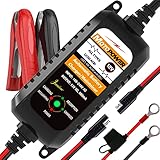
2. MOTOPOWER MP00205A 800mA – The Smallest Budget Tender
MOTOPOWER MP00205A 12V 800mA Automatic Battery Charger, Maintainer, Trickle and Desulfator
800mA output
Pulse desulfation
Zero-output standby
2-year warranty
Pros
- Combines charger maintainer trickle and desulfator
- Automatic float switchover at the 24-hour timer
- Zero output in standby so it never drains the battery
- Works across cars motorcycles boats and tractors
Cons
- 800mA cannot recover a discharged car battery
- Case runs hot on large high-capacity batteries
- No on/off switch so AC must be pulled to stop it
- Several long-term owners report failure around four years
This is the most straightforward way to do the job properly, and by properly I mean a real multi-stage program rather than a dumb constant current trickle. The MOTOPOWER charges to 14.4 volts, then maintains at 13.6 volts, and a 24-hour timer terminates the charge stage and drops into maintaining mode. That cutoff is the safety mechanism that keeps it from cooking a battery over a long winter.
It also runs automatic pulse-current desulfation, which is a mild conditioning cycle aimed at surface sulfate buildup on a battery that has been sitting. Reviewers across the US, Canada, Germany and the Gulf states use it almost exclusively as a long-term tender for garaged cars, motorcycles and tractors rather than for fast charging, and satisfaction is high when expectations match that use.
Two things to know before you commit. There is no on/off switch, so the only way to stop it is to unplug it from the wall, and several reviewers note the case runs hot when it is working on a deeply discharged high-capacity battery. There is also a recurring durability complaint, with a number of long-term owners reporting the unit failing after roughly four years of daily service.
Warranty coverage is two years, which is fine for a unit expected to sit in a garage, and multi-level protection covers overcharge, short circuit and reverse polarity. With 16,631 ratings at 4.5, this is one of the most-reviewed maintenance devices in the category.
Best for a second vehicle, a motorcycle, a boat or any piece of equipment with a small battery where a more capable charger would be overkill. If your car battery is currently dead and you want it back, this is the wrong tool.
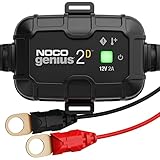
3. NOCO GENIUS2D 2A – Built to Stay Mounted Under the Hood
NOCO GENIUS2D 2A 12V Onboard Battery Charger, Trickle Charger & Maintainer
2A onboard output
Thermal sensor
Charges from 1V
3-year warranty
Pros
- Snaps permanently into the engine bay so nothing gets clipped on each week
- Integrated thermal sensor adjusts charge for ambient temperature
- Force Mode recovers batteries down to zero volts
- Handles AGM gel SLA VRLA flooded deep-cycle marine and RV
Cons
- 2A is slow for reviving a dead battery
- Supplied AC and DC leads are short
- Mounting bracket is reported to crack at the screw holes
The GENIUS2D is the only onboard unit in this roundup, and that single design decision changes the winter story. You drill or screw a bracket to the engine bay or firewall, run the fixed leads to the battery, and the charger becomes part of the car. No clamps, no quarterly reminder, no wondering whether you disconnected it before a road trip. Owners in cold climates across Canada and the northern US describe it as insurance on vehicles that sit for weeks.
Its integrated thermal sensor is the winter-specific feature. It measures ambient temperature and adjusts the charging voltage accordingly, which prevents the undercharging that happens when a cold battery is given a charge profile tuned for a warm room. Precision pulse charging also targets sulfation and acid stratification, so a lightly sulfated battery can be brought back rather than written off.
Force Mode is the recovery feature that distinguishes it. Most maintainers refuse to work below a threshold voltage, so a deeply discharged battery simply gets a light and no action. The GENIUS2D will start on a battery down to zero volts with Force Mode engaged, which turns it from a storage accessory into an occasional rescue tool.
The complaint that comes up repeatedly is cable length. The supplied leads run 24 inches on both the AC and DC side, which in a large garage often means reaching for an extension cord. The snap-fit bracket is also reported to crack around the screw holes, so drill mounting points yourself rather than trusting the plastic clip alone.
Best for drivers who install once and forget, and for anyone with several vehicles who wants the same permanent-installation approach on each. Note the chemistry warning: if the pack is lithium, it must be kept above freezing while charging.
4. Schumacher SC1280 15A – Recovery Amps for a Neglected Battery
Schumacher Electric 15A Car Battery Charger & Maintainer, 6V/12V – SC1280
15A rapid charge
6V and 12V auto detect
4-in-1 functions
1-year warranty
Pros
- 15A output actually recovers stored or neglected batteries
- Automatic 6V and 12V detection removes setup guesswork
- Works as charger maintainer tester and restorer
- Supports standard AGM gel and deep-cycle chemistries
Cons
- Trickle output is only 1A for maintenance
- No temperature compensation or winter mode
- Only a 1-year warranty
- 2.7 lb bench unit takes up shelf space
The SC1280 is not a dedicated maintainer, and pretending otherwise would be a mistake. It is a 15 amp bench charger with a maintenance function bolted on, and that is precisely what makes it useful in a specific winter scenario: a vehicle that has already sat for a month or two with no maintainer connected, where the battery needs a real charge before it needs a float.
Microprocessor control handles the charging, with automatic 6V and 12V voltage detection so you do not have to guess at a selector switch. It also tests and restores, making it four devices in one chassis. Buyers typically pair the fast recovery amps with the trickle function for seasonal vehicles, which is a sensible pattern if you accept the unit is doing double duty.
Two real limitations. The trickle output that takes over after full charge is only 1 amp, which is on the low side for offsetting parasitic draw in an unheated garage over five months. And the warranty is one year, among the shortest in this group, which is a notable contrast with the ten-year coverage on the Battery Tender Plus.
There is also no explicit temperature compensation. In a cold garage, a charger with no cold-weather adjustment can finish a charge slightly under target, which is one reason some owners pair it with a proper maintainer rather than leaving it to do the whole season.
Best as a rescue and bench tool for someone with a workshop, a classic car, or a vehicle that regularly sits long enough to go flat. For pure storage duty, one of the float-first maintainers is the better buy.
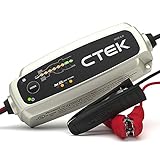
5. CTEK MXS 5.0 4.3A – The Cold-Weather Specialist
CTEK – 40-206 MXS 5.0 Fully Automatic 4.3 amp Battery Charger and Maintainer 12V
4.3A output
8-step program
IP65 rated
5-year warranty
Pros
- Fully automatic 8-step program optimized for cold-weather charging
- Patented float and pulse charging for months-long set-and-forget use
- IP65 splash and dustproof with spark shock and short-circuit protection
- Recovers underperforming batteries with a recondition mode
- Works with lead-acid and AGM without unplugging the battery
Cons
- AGM mode must be selected manually
- Included eyelet lead is short for some vehicles
- Lead acid and AGM only with no gel or lithium support
The MXS 5.0 is the unit working technicians name first for winter storage, and the reasons are visible in the design rather than in marketing language. Its eight-step program starts with a conditioning phase and works through soft start, bulk and absorption before analysis, then float and pulse maintenance. The company also supplies it as an OEM charger on several European marques, which tells you something about how the charging curve was validated.
For cold garages specifically, the patent is on float and pulse maintenance that can run for months without overcharging. It also automatically returns to the correct stage after a power outage, which matters more than it sounds: a blip that leaves a cheaper charger in the wrong mode is one of the most common reasons a battery still dies over winter.
Unlike the maintainers with no chemistry awareness, this one has a dedicated AGM mode, and many of the cheaper maintainers simply do not offer one. That matters if your vehicle has an AGM battery, because the correct absorption voltage for AGM is higher than for a flooded cell, and a charger that treats them the same will never fully charge it.
Physical protection is unusually thorough. It carries an IP65 rating for splash and dust, plus spark, shock and short-circuit protection, and reverse polarity protection on the clamps. The included Comfort Connect clamps and eyelets detach, and a drawstring storage bag is in the box. It is 1.3 pounds, which makes it easy to carry out to a car parked at the far end of a driveway.
The complaints are narrow: it does not auto-detect battery type, so you must select the AGM mode yourself, and the included eyelet lead is short enough that some vehicles need an extension. If you are asking whether CTEK is better than NOCO for a stored car, this is the side of the argument that wins on cold-weather charge logic and build protection.
6. TowerTop TP108MB 2/10/25A – The Only Charger With a Winter Mode
TowerTop 2/10/25 Amp 12V Smart Car Battery Charger, Fully Automatic Battery Maintainer with Engine Start, Auto Desulfator, Battery Repair, Winter Mode, for AGM, STD, Gel, Deep Cycle Batteries
2A 10A 25A and AUTO
Winter Mode adds 0.2V
HD LCD
Engine start boost
Pros
- Winter Mode adds 0.2V in low temperatures for cold-weather charging
- Four selectable current settings plus AUTO
- HD LCD shows charging stage and parameters
- Separate desulfurization and repair buttons have revived neglected batteries
- Restores settings and restarts after a power outage
Cons
- Requires at least 3V in the battery before it will start
- Clamp plastic covers clip loosely and break off
- Defaults to a low 2A gel setting that confuses new users
- Cannot repair a fully drained battery
The TowerTop is the only unit in this roundup with an explicit Winter Mode, and that distinction is worth explaining. In low temperatures the charger adds 0.2 volts to the charging voltage, compensating for the fact that a cold battery needs a higher driving voltage to reach full charge. Any charger that targets a fixed 14.4 volt ceiling will finish short on a cold morning, and that shortfall repeated every cycle is exactly what sulfates a battery.
Four current settings give it unusual flexibility: 2 amps, 10 amps, 25 amps and AUTO. The eight-stage program is fully automatic once started, and the HD LCD screen shows the charging stage rather than leaving you guessing from a single LED. Owners in Canada, the US and Mexico use the higher rates to bring back batteries on stored ATVs, side-by-sides, boats and travel trailers.
The 3 volt minimum is the most important limitation. If the battery is deeper than that, the charger will not begin, and no amount of button pressing changes that. The interface can also show a slightly inaccurate state-of-charge reading, and it defaults to a low gel-cell setting that catches out first-time users, so spend five minutes in the manual on mode selection.
There are smaller gripes too: the protective plastic covers on the clamps clip on loosely and tend to snap off, and the warranty runs 18 months. The engine start function delivers 100 amps for 100 seconds, which is a useful bonus rather than a replacement for a real jump pack.
Best if you specifically want adjustable cold-weather voltage behaviour and a visible readout, and if you will read the manual before operating it. It is the broadest tool here and the most likely to confuse someone who just wants to clip it on and walk away.
7. Battery Tender 3 AMP – Switchable 6V and 12V With Real Reach
Battery Tender 3 AMP Battery Charger and Maintainer – Automotive Switchable 12V or 6V Smart Automatic for Cars SUVs and Trucks – Lead Acid, AGM, Gel, & Lithium Battery Charger – 022-0202-COS
3A output
6V and 12V switchable
11 ft reach
5-year warranty
Pros
- 3A is a meaningful step up from 1 to 2A maintainers
- Automatic float mode after full charge with ISM adaptive recovery
- 11 ft combined cord reach solves awkward engine bay layouts
- Handles lead-acid flooded sealed AGM gel and lithium
- Push-button 6V and 12V switching
Cons
- No temperature compensation or winter mode
- Higher amperage than a small battery strictly needs
- Fixed DC lead that cannot be swapped
This is the general-purpose family tender, and the reason is the 11 feet of total reach: a 6 foot AC cord plus a 5 foot DC output cord. Cable length is a top complaint in charger reviews and it deserves to be a buying criterion, because a unit that cannot physically reach the battery from the nearest outlet is useless no matter how good its charge logic is. In a two-car garage where one vehicle is parked nose-in at the back, that reach is the difference between using the charger and not.
Three amps sits in a useful middle ground. It is enough current to top off a moderately discharged car battery reasonably quickly, and it is still gentle enough for smaller batteries without excessive stress. After full charge it drops automatically into float, and ISM adaptive charging resumes full output if voltage falls under load.
It is also switchable between 6 and 12 volts with a push button, which covers older 6-volt vehicles and golf carts alongside modern cars, and the manufacturer lists lithium compatibility alongside lead-acid, flooded, sealed, AGM and gel cell. Two-color LED status and a five-year warranty round out a well-balanced spec sheet at 1.4 pounds.
The gap is temperature compensation. There is no cold-weather adjustment, so in a genuinely unheated garage the float target is not modulated for ambient conditions. For most people that is a minor issue, but if your storage space regularly drops well below freezing, it is worth paying attention to.
Best for a household with a mixed fleet, an awkward garage layout, or a mix of 6-volt and 12-volt machines. It is the compromise unit, and compromise is exactly what most families need.
8. Clore Automotive PL2320 20A – Temperature Compensation and Shop Output
Clore Automotive PL2320 20-Amp Fully-Automatic Smart Charger, 6V and 12V Battery Charger, Battery Maintainer, and Stable Power Supply with Temperature Compensation
20A output
2A 10A 20A rates
Temperature compensation
Stable power supply mode
Pros
- Explicit temperature compensation adjusts charging to ambient conditions
- Stable power supply mode substitutes for a bench supply during diagnostics
- 2A maintains while 20A recovers neglected batteries
- Fully automatic multi-phase operation needs no supervision
Cons
- No lithium or LiFePO4 chemistry support
- Only a 1-year warranty
- Roughly 2000 ratings which is a thin evidence base for a unit this capable
- Feature set is aimed at shop use rather than simple storage
The PL2320 is the most workshop-oriented unit here, and its standout feature is a stable power supply mode. That is not marketing fluff for the diagnostic crowd: when you are working on a vehicle with the battery disconnected, holding system voltage steady prevents control modules from resetting and throwing codes. For a working technician, that alone justifies the unit.
Charge rates are selectable at 2, 10 and 20 amps, so the same box can maintain a stored battery at 2 amps in November and recover a neglected one at 20 amps in March. It also has explicit temperature compensation, which adjusts charging to ambient conditions, one of only a few units in this roundup to say so plainly.
It is a lightweight 1.3 pound box with a one-year warranty, and the review base of roughly 2,000 ratings is modest next to the units that have been in the category for two decades. Buyers who also work on vehicles tend to gravitate to it precisely because the power supply mode removes a separate piece of bench equipment.
The chemistry gap is worth flagging clearly. There is no lithium or LiFePO4 support, so if your fleet includes modern vehicles with lithium auxiliary or starter packs, this unit will not serve them. For conventional 6V and 12V lead-acid work it is a capable, well-focused tool.
Best for people who work on vehicles rather than just store them. If you only need a float maintainer for one car, the extra capability here goes unused and a simpler unit is the better purchase.
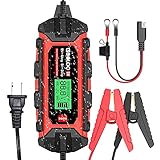
9. GOOLOO S4 4A – Native LiFePO4 Support With an LCD Readout
GOOLOO S4 4A Car Battery Charger, 6V/12V Smart Trickle Charger Maintainer
4A output
LiFePO4 support
10-stage program
3V minimum
Pros
- Native 12V LiFePO4 support alongside WET SLA GEL AGM and VRLA
- Adapts charging to ambient temperature to reduce overcharge and undercharge
- 4A is a strong maintenance and recovery compromise
- Compact at 0.74 kg with a live LCD readout
- Accepts clamps or a cigarette lighter plug
Cons
- Display reads 000 on very low-voltage batteries
- Not optimized for full deep-cycle recovery
- Only an 18-month warranty
The GOOLOO S4 is one of very few mainstream chargers here with genuine 12V LiFePO4 support listed in the compatibility spec, and that is the reason it appears on this list. Most maintainers in the budget and mid tiers are lead-acid only, and feeding a lithium pack with a lead-acid charge profile is a real problem rather than a technicality.
Remember the freeze line though. LiFePO4 support means correct voltage setpoints, not permission to charge a frozen pack. Keep a lithium-equipped vehicle in a heated space until temperatures rise above freezing, and treat the chemistry support as a reason to choose this unit, not as a safety licence.
At 4 amps it also handles temperature adaptation, adjusting charging to ambient conditions to prevent overcharging in heat and undercharging in cold. The ten-stage program includes pulse current devulcanization for sulfation, and it will charge down to 3 volts. The LCD shows live charging voltage, mode and battery level, with a blinking V indicating maintenance mode, which is far more informative than a single LED.
Owners in cold Canadian winters use it on vehicles that sit outdoors for weeks and report no dead batteries across a full season. Motorcycle owners like the LiFePO4 and AGM coverage. The quirk to know about is the display reading 000 on a very low resting voltage, even when the battery is recoverable; owners work around it by briefly paralleling a charged battery.
Best for motorcycles, modern vehicles with lithium packs, and anyone who wants to see actual voltage and mode rather than infer it from a light. The 18-month warranty is shorter than the five and ten year coverage on the Battery Tender units.
10. CRAFTSMAN CMXCESM258 12A – Big Recovery Output With Lithium Support
CRAFTSMAN 12A Car Battery Charger & Maintainer, 6V/12V – CMXCESM258
12A output
12V LiFePO4 support
4-in-1 functions
12 ft reach
Pros
- Supports 12V lithium alongside standard AGM and deep-cycle batteries
- 12A output revived a fully dead battery in roughly 3.5 hours for owners
- Digital progress meter gives clear charge-state feedback
- 4-in-1 design covers charging maintaining testing and restoring
- 12 ft total reach from the 6 ft AC cord and 6 ft battery cables
Cons
- Documented report of a case arriving with missing screws and separating
- Only a 1-year warranty
- Bulkiest and heaviest charger here at 3.4 lb
- No temperature compensation or winter mode
The CRAFTSMAN is built by Schumacher Electric and it is the biggest box in the group at 3.4 pounds and 12 by 16 inches, so plan shelf space before buying. What you get for the bulk is 12 amps of real recovery output combined with a maintenance function, and owners report bringing fully dead batteries back in about three and a half hours, which no sub-2-amp maintainer in this list can do.
It is also one of only two chargers here that explicitly lists 12V lithium support alongside standard, AGM and deep-cycle chemistries. The microprocessor is controlled with a digital progress meter, automatic 6V and 12V detection, reverse hook-up protection and an advanced desulfation mode, and cord reach totals 12 feet.
There is a documented quality control problem worth taking seriously. One buyer reported a unit arriving with missing case screws and a case that separated while being handled, exposing live components. That is an isolated report rather than a widespread pattern, and its small review base of 820 ratings makes it hard to judge frequency, but it is a documented safety concern on a mains-connected device and worth considering before buying.
Warranty coverage is one year, and there is no temperature compensation or winter mode, so for pure cold-climate float duty a purpose-built maintainer is the better answer. At 3.4 pounds with no lithium freeze protection built in, treat it as a recovery tool rather than a seasonal companion.
Best for diesel trucks, large-displacement engines and storage buildings where several neglected batteries need rescuing at once. Check the case screws on arrival and do not leave it connected overnight on the first charge.
How to Hook Up a Maintainer and What to Do Before You Store the Car
Start with the pre-storage checklist, because no charger fixes a battery that was already compromised when you parked it. Take a voltage reading across the terminals before connecting anything; a rested healthy 12V battery sits at 12.6 volts or above, and anything under about 12.2 suggests a battery that already needs attention. Clean the terminals with a wire brush and a baking soda solution, then dry them, because a corroded connection is a high-resistance connection and the charger will fight it all winter.
Next, decide connect or disconnect. A maintainer connected in place is the better option when parasitic draw is modest, because it offsets the alarm, clock and onboard computer loads continuously. Disconnecting and removing the battery is the better option when the vehicle has an aftermarket alarm with a known heavy draw, or when the battery is lithium and the vehicle will sit in sub-freezing conditions.
Now hook it up. Attach the positive clamp first, then the negative. Plug the unit into the wall. If it has a chemistry selector, set it now and confirm the choice against your battery type rather than guessing. Watch the indicators until the unit reaches float or maintenance, then check again a few hours later to confirm it stayed there rather than cycling.
Two safety habits matter for months-long connections. Do not run the charging cable under a car door or through a window where it can be pinched or where a rolling door can catch it, and keep the unit itself off the floor in a dry spot where condensation cannot reach it. Any unit rated IP65, like the CTEK MXS 5.0, tolerates a splash; the rest are safer indoors.
If the storage location has no power at all, this is where a solar maintainer comes in. The category exists specifically for sheds and carports, using a small panel to feed a trickle controller so a battery that is never hooked to mains still holds its charge through the season. None of the ten chargers above are solar models, so this is a separate purchase for off-grid storage, and for lithium packs the freeze rule still applies.
What to Look for When Buying a Battery Maintainer
Float mode with a real cutoff. The single most important feature. A charger that pushes constant current into a full battery for months will boil electrolyte out of a flooded cell and shorten its life. Look for an automatic transition to float, and treat a fixed-current unit as a temporary tool only.
Temperature compensation. A battery needs a higher charging voltage to reach full when it is cold, so a charger that targets a fixed ceiling finishes undercharged in an unheated garage. Only a few models here say so explicitly: the NOCO GENIUS2D has an integrated thermal sensor, the GOOLOO S4 adapts to ambient temperature, the Clore PL2320 compensates explicitly, and the TowerTop has a dedicated Winter Mode that adds 0.2 volts.
Battery chemistry support. At minimum the unit must handle flooded, AGM and gel. AGM needs a higher absorption voltage than flooded, and a charger that does not know the difference never fully charges an AGM battery. If your vehicle has a 12V LiFePO4 pack, only pick from units that list lithium support, and remember the freeze prohibition.
Maintenance current versus parasitic draw. This is why batteries still die with a maintainer attached. Alarm systems, clock circuits and onboard computers can draw more than a small maintainer replaces, particularly on older vehicles with aged modules. A 0.8 to 1.25 amp unit is adequate for a healthy modern vehicle but marginal for a classic with a fuel-injection pump that is not fully asleep. If you know the draw is heavy, either use a 3 amp or higher unit or disconnect the battery for the season.
Cable reach. Measure from the wall outlet to the battery terminal before you buy, and add a margin. Most complaints about chargers are really complaints about short leads, and a unit you cannot physically connect is the most expensive thing you can buy. Cord length is the same buying criterion we apply to cordless tools in our 12 best battery chainsaws for long runtimes, where a short lead limits the tool exactly the same way.
Recovery threshold and modes. Maintainers top off healthy batteries. Recovering a neglected one needs higher amperage, desulfation or reconditioning pulses, and sometimes a lower voltage threshold. The NOCO GENIUS2D charges from 1 volt, the GOOLOO S4 from 3 volts, and the TowerTop also requires 3 volts. Check that number before you plan a rescue.
Warranty length as a durability signal. Coverage ranges from one year on the Schumacher, CRAFTSMAN and Clore units up to ten years on the Battery Tender Plus, with CTEK at five and Battery Tender 3 AMP at five. Long coverage on a device nobody expects to fail quietly tends to track real build quality, and forum owners treat the 10-year warranty as a decisive factor when choosing between otherwise similar maintainers.
For vehicles that sit outdoors through winter, our other cold-weather reading covers why cold months change how everything in your garage behaves, including battery chemistry choices and moisture control. If your winter garage clear-out also involves equipment cleanup, our battery leaf blower picks for car drying cover the neighbouring corner of the garage.
Frequently Asked Questions
What is the best battery charger for winter?
The best battery charger for winter storage is a smart battery maintainer with microprocessor float control, not a constant-current trickle charger. Look for automatic float mode, temperature compensation, support for your battery chemistry, and a maintenance current of at least 1 amp. Our top pick is the Battery Tender Plus 1.25A for its 10-year warranty, with the CTEK MXS 5.0 leading for unheated garages.
Is there a difference between a battery tender and a battery maintainer?
Functionally, a quality battery tender and a battery maintainer are the same device: a smart charger that reads battery voltage and drops to float maintenance once full. The confusing part is that trickle charger is also used for these products even though a real trickle charger pushes constant current with no cutoff. The dangerous product is the constant-current one, because it can boil electrolyte out of a flooded cell over a long winter.
Is it okay to leave a CTEK charger on all the time?
Yes. The CTEK MXS 5.0 uses a patented float and pulse maintenance stage specifically designed to stay connected for months, and it will not overcharge a battery. It also returns to the correct charge stage automatically after a power outage. The same set-and-forget behaviour applies to the other microprocessor maintainers in this roundup, including the Battery Tender Plus and the NOCO GENIUS2D.
Is CTEK better than NOCO?
For cold-climate storage, CTEK has the edge: the MXS 5.0 optimises charging in cold conditions, carries a dedicated AGM mode, and is rated IP65 for splash and dust with a five-year warranty. NOCO leads in recovery features, since the GENIUS2D charges from 1 volt and has a Force Mode, and it is the only onboard permanent-mount unit here. Neither is strictly better; pick on storage conditions and features.
How do I stop my car battery from draining in cold weather?
Connect a smart maintainer rated at least 1 amp to the battery terminals, and confirm it reaches and stays in float mode. If the battery still dies, the cause is almost always parasitic draw from an alarm system, clock circuit or onboard computer rather than self-discharge. On older vehicles that draw can exceed what a small maintainer replaces, so use a 3 amp or higher unit or disconnect the battery for the season.
How should I store car batteries for the winter?
Clean the terminals, record a baseline voltage reading, and check the water level on flooded cells. A rested healthy 12V battery reads 12.6 volts or higher. Then either connect a smart maintainer in place if parasitic draw is modest, or disconnect and remove the battery if the vehicle has a heavy aftermarket alarm. Never charge a LiFePO4 battery below 32 degrees Fahrenheit.
The Verdict: Which Charger Matches Your Winter Storage
If you want the single most dependable answer to what is the best car battery charger for winter storage, the Battery Tender Plus 1.25A takes it. More than 21,000 ratings, a 4.7 average, a ten-year warranty and a float stage that forum owners have run through more than a decade of winters without complaint. For most households that is enough, and it asks nothing of you beyond a clean terminal connection.
If your garage is genuinely unheated, choose the CTEK MXS 5.0 instead. Its eight-step program, dedicated AGM mode, IP65 housing and automatic recovery after a power outage are built for exactly that environment. If you want the charger permanently installed under the hood, the NOCO GENIUS2D is the only unit here designed for it, with a thermal sensor and a 1 volt recovery threshold. If your vehicle has a 12V LiFePO4 pack, start with the GOOLOO S4, and keep the battery above freezing while charging.
For a second vehicle, a motorcycle or anything with a small battery, the MOTOPOWER MP00205A does the job with less to go wrong. For a battery that has already gone flat, the Schumacher SC1280 or the CRAFTSMAN CMXCESM258 supply the recovery amps that no maintainer can. And if the outlet cannot reach the car, look at a solar maintainer built for off-grid storage.
Whichever one you pick, the habits around it matter as much as the unit. Clean terminals, a baseline voltage reading, a decision about connect versus disconnect, and a check that the charger reached float rather than sitting in a bulk stage. Get those right in October and you will not be standing in a frozen driveway in 2026.
Leave a Reply