


There is no single best percolator for camping, because the answer changes with your fire source, your group size and how much water you have to clean with. The most dependable all-round choice for a car camp or RV is the Farberware Classic Stainless Steel Yosemite 8-Cup: gas stovetop compatible, dishwasher safe, backed by 29653 reviews, and built from heavy-gauge stainless with a permanent filter basket. Everything else in this roundup is either lighter, bigger, cheaper or built specifically for open flame.
Before you read further, here is how I narrowed ten percolators down. I weighed five things: whether the brewing path is stainless steel or has aluminum and plastic in it, whether the pot is rated for a campfire and not just a camp stove, how heavy it is relative to the number of people it serves, how it behaves with the limited water you have at a site, and whether the manufacturer’s warranty and replacement terms are realistic for gear that gets dropped in the dirt.
This is a criteria-based roundup rather than a lab test report. Where a number matters, it comes from the manufacturer specification or from the pattern in thousands of owner reviews, and I say which. I also flag the one drawback per pot that keeps coming up, because a percolator that looks perfect on a spec sheet usually has exactly one recurring problem.
One clarification first, because the search results for this topic get it wrong constantly. A percolator recirculates hot water through a basket over and over, driven by a pump rod, for ten to twenty minutes, and it makes a full pot. A moka pot uses steam pressure to force a small batch of concentrated coffee in three to five minutes. They are different devices, and only one of them belongs on this list.
Our Top 3 Best Percolators for Camping (October 2026)
Three pots cover most people’s needs: a stainless standard for car camping, an all-stainless model for people who do not want metal taste compromises, and a light aluminum pot for pack-weight budgets. The Farberware Yosemite takes the top slot on the strength of its review volume and its gas stovetop rating, the COLETTI Bozeman is the cleanest brewing path, and the Primula is the one that fits in a pack without costing you arm strength.

Farberware Classic Yosemite…
- Stainless steel body
- Permanent filter basket
- Gas stovetop compatible
- Dishwasher safe

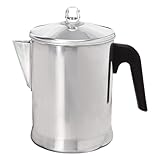
Primula 9-Cup Aluminum…
- 12 ounces total
- Works on campfires and grills
- Stay-cool handle
- Reusable basket
Comparing the Best Percolators for Camping in 2026
Every pot below is a genuine stovetop or campfire percolator, ordered by how much evidence sits behind it. Capacities are the manufacturers’ own coffee-cup figures, which run five to six fluid ounces rather than a normal twelve-ounce mug, so treat the numbers as relative rather than literal.
| Product | Specs | Action |
|---|---|---|
| Farberware Classic Stainless Steel Yosemite 8-Cup |
|
Check Latest Price |
| COLETTI Bozeman Percolator 9 Cup |
|
Check Latest Price |
 GSI Outdoors 8-Cup Enamelware Percolator GSI Outdoors 8-Cup Enamelware Percolator |
|
Check Latest Price |
| Primula Today Aluminum 9-Cup Percolator |
|
Check Latest Price |
 Coleman Stainless Steel 12-Cup Percolator Coleman Stainless Steel 12-Cup Percolator |
|
Check Latest Price |
 Stansport Aluminum 9-Cup Percolator Stansport Aluminum 9-Cup Percolator |
|
Check Latest Price |
 GSI Outdoors Glacier Stainless 3-Cup GSI Outdoors Glacier Stainless 3-Cup |
|
Check Latest Price |
 Stansport Enamel 8-Cup Percolator and 4 Mugs Stansport Enamel 8-Cup Percolator and 4 Mugs |
|
Check Latest Price |
 COLETTI Classic 12-Cup Blue Enamel Percolator COLETTI Classic 12-Cup Blue Enamel Percolator |
|
Check Latest Price |
 COLETTI Scoutmaster 24-Cup Percolator COLETTI Scoutmaster 24-Cup Percolator |
|
Check Latest Price |
1. Farberware Classic Yosemite 8-Cup – The Stainless Standard for Car Camp
Farberware Classic Stainless Steel Yosemite Coffee Percolator, 8-Cup
8 cups
2.3 lb
Stainless steel
Permanent filter
Gas stovetop
Pros
- Heavy-gauge stainless polished to a mirror finish
- Clear glass knob shows when percolation starts
- Permanent filter so no paper filters to pack
- Fully immersible and dishwasher safe
Cons
- 8 cup label overstates real yield
- Mirror finish scuffs and discolors with campfire use
This is the pot I would hand to a friend who asked me to pick one and did not want to think about it. Around 76% of its owner reviews are five-star, and the recurring theme is that it asks almost nothing of you. Fill the lower chamber, add a basket of grounds, put it on the burner, and wait.
The clear glass knob on top is the feature that gets mentioned most. Percolation is invisible inside an opaque steel pot, and the moment the water starts bubbling up through the basket you know the heat is right. That single signal removes most of the guesswork that leads to burnt, over-extracted camp coffee.
It also runs on gas, which matters more than it sounds. The listed power source is a gas stove, and 29653 reviews is the largest evidence base of any percolator here, so if a design flaw exists, owners have almost certainly named it by now. The one they name most is capacity labelling rather than build quality.
Why the 8-cup label undersells the real yield
Owner reviews repeatedly note that a percolator cup is five to six fluid ounces, not a twelve-ounce mug, so an 8-cup pot produces a genuine pot rather than eight large drinks. Plan on serving smaller mugs than you would at home, or plan on a 12-cup model if your group drinks in real mugs.
For two or three people that is generous. For a family of five who each want a full mug, it is short, and that is the single reason to step up a size rather than a reason to avoid this pot.
What the mirror finish does to a campsite pot
Polished stainless looks superb in a kitchen and shows every scratch. Owners mention campfire discoloration and scuffing specifically, which does not affect brewing but does mean the finish will not stay factory-fresh through a season of trips.
The steel itself is the durable part. A lifetime limited warranty covers the Farberware Classic cookware against defects in material and workmanship under normal household use, and the pot is fully immersible, so field rinsing is genuinely easy.
Where this pot falls short
Eight cups is the constraint. It is a two-person-to-small-family pot, and forcing six cups of coffee into three drinkers is how you get a second pot of bitter coffee an hour later.
The second drawback is the cosmetic one. If a scuffed mirror finish bothers you, the COLETTI Bozeman below gives you the same brewing approach in a brushed body with a glass top instead.
2. COLETTI Bozeman 9-Cup – A Brewing Path With No Aluminum or Plastic
COLETTI Bozeman Percolator Coffee Pot — NO Aluminum or Plastic [9 cup]
9 cups and 45 fl oz
2 pounds
Pure stainless
Glass view top
Pros
- No aluminum or plastic touches the coffee
- Glass view top shows the whole brew cycle
- Handle and wood grips stay warm rather than scalding
- Dishwasher safe and rinses clean in seconds
Cons
- Cup counts overstate real yield
- Glass top must sit slightly loose
- Lighter lid and hinge over long-term use
This is the pot for the person who has read that aluminum in a percolator can taste metallic and believes it. The entire brewing path is pure stainless steel, from the lower chamber through the pump stem, and the glass view top lets you watch percolation from the first bubble to the last without lifting the lid.
It also holds the top spot in Camping Coffee and Tea Pots, which is a category position rather than a marketing claim, and it carries a one-year warranty with US-based support. The company is veteran-owned, and the pot is designed explicitly for campfire, campsite and home stovetop brewing rather than adapted from a kitchen model.
Owners rate it at 72% five-star, and the flavor praise is consistent: a steady percolation heat pulling a fuller, heavier cup than you would expect from camp gear. The practical advice that recurs most is not about the pot at all. It is about the glass top and the filters.
Leave the glass view top a quarter turn loose
Thermal expansion is the issue. A tightened glass top on a hot pot can crack, and the fix owners give is simple: back it off slightly so it can move. It is a two-second adjustment before every brew and it removes the only genuinely fragile part of an otherwise steel design.
Do not lift the lid while the pot is perking. Vapor escaping is what forces water down through the grounds, and lifting it stalls the cycle and cools the pot at exactly the wrong moment.
Paper or reusable filters are not optional here
The reusable basket is fine for coarse grounds, but owners consistently recommend adding a filter so fines do not end up in the cup. A pack of filters is included, and the coffee tastes noticeably cleaner with one in place.
This pot is also the only one in the roundup with no induction model confusion in the box. It does not work on induction, and the manufacturer sells a separate induction version, so check your RV or home burner before you buy it for a dual-purpose pot.
Where this pot falls short
The slim metal handle and the lid hinge are the wear points flagged in reviews. They feel lighter than the rest of the pot, and over years of hard use they are what you will notice first.
Capacity labelling repeats the industry problem, most visibly on the smaller 6-cup version. A 9-cup pot here means 45 fluid ounces of coffee, not nine mugs.
3. GSI Outdoors 8-Cup Enamelware – Enameled Steel With a Silicone Handle
GSI Outdoors Percolator Coffee Pot | Enamelware Campfire Coffee Boiler Kettle for Outdoor Camping Cookware, Cabin, RV, Kitchen, Hunting & Backpacking
8 cups
1.3 lb
Enameled steel
Silicone handle
Pros
- Enameled steel resists corrosion and campfire abuse
- Silicone handle stays safe to pour with
- Clear PercView knob monitors brew strength
- Disassembles easily with no paper filters needed
Cons
- Lowest average rating here at 4.2 with 8 percent one-star
- Enamel can chip at the rim after repeated fire use
At 1.3 pounds this is one of the lighter stainless-look pots in the roundup, and the construction is heavy-gauge steel with an enamel finish rather than bare polished metal. GSI states it withstands campfires, stoves and grills, and it carries a lifetime warranty against material and workmanship defects.
The handle is the reason to look here first. It is a heat-resistant silicone handle rather than a wire bail or a bare metal loop, which means you can lift and pour without a cloth. The PercView knob on top gives you the same visual percolation cue as the Farberware at 1.3 pounds instead of 2.3.
I am flagging this one honestly because its rating is the lowest here. At 4.2 with 11539 reviews, it runs about 66% five-star and carries an 8% one-star share, which is the widest unhappy group of any stainless-look pot in this roundup. The complaints cluster around long-term enamel wear and slightly less even heat distribution than solid stainless.
Enamel gives you fire tolerance and a wear limit
Enamelled steel handles direct flame better than bare steel because the surface is glass-fused rather than metallic, and it wipes clean after fire blacking. The trade is that enamel is a coating, and coatings chip at the rim. Owners who use it heavily over flame report the rim as the first place to show wear.
Heat distribution is a little less even than a solid stainless wall, which in practice means slightly more attention to heat control during the brew. This is one of the two pots here that does not carry a dishwasher specification, so plan on hot-water field cleaning.
What the PercView knob is actually for
It is a clear window to the top of the pot that lets you watch the water column rise and fall. That cycle is how you judge brew strength: the first weak perking is thin, and each subsequent pass through the basket darkens it.
Owners use it to back off the heat at the first real percolation rather than running a rolling boil. That single habit is the difference between camp coffee that tastes clean and coffee that tastes scorched.
Where this pot falls short
The 8% one-star share is real and it is the widest here. Most of it points at enamel chipping and uneven heating, both of which are wear-and-technique issues rather than manufacturing faults.
If you want the visual brew monitoring but not the enamel, the Farberware at number one gives you a glass knob on solid stainless, at nearly a pound more.
4. Primula 9-Cup Aluminum Percolator – The 12-Ounce Lightest Option
Primula Today Aluminum Stove Top Percolator Maker Durable, Brew Coffee On Stovetop, 9 Cup, Silver
9 cups claimed
12 ounces
Aluminum
Stay-cool handle
Pros
- Lightest pot in this roundup at 12 ounces
- Works on propane stoves grills and open campfires
- Matching lid with a lipped spout and stay-cool handle
- Brews better than a drip machine for very little money
Cons
- Thin aluminum dents if you leave it on high heat
- Basket holes let fine grounds into the brew
- Plastic knob and lid can soften near a campfire
Twelve ounces is the number that matters here. That is lighter than a full bottle of water, and it is the lowest pack weight of any percolator in this roundup, which makes it the only one I would consider for a trip where the coffee kit shares a pack with sleeping gear and food.
Aluminum conducts heat well and evenly, which is why this pot brews quickly, and Primula lists it for every stovetop type including propane, plus grills and campfires. The stay-cool black handle and the lipped spout are the two design touches that keep it pleasant to use at 12 ounces.
The honest framing is that this is a durability trade. Thin aluminum dents, bends and distorts if you leave it on high heat, and several reviewers describe the denting as an accepted compromise for the weight. Owner reviews also call it a pot of last resort that nevertheless produces genuinely good coffee when the technique is right.
The heat control rule for thin aluminum
Bring the pot up to temperature, then drop the heat the moment percolation starts. Owners repeat this instruction more than any other in the reviews, and it is not optional with a thin-walled pot: a rolling boil against that wall is what causes the warping.
Set it on a camp stove or grill rather than hanging it over a fire. Direct flame is where thin metal deforms fastest, and the plastic knob and lid parts on this model are the components most likely to soften near a campfire.
Add a filter, because the basket holes are coarse
The reusable basket has holes large enough to pass fine grounds into the brew, and that is the most common complaint in the reviews alongside the weight. A paper or reusable filter solves it, and once you add one the cup tastes noticeably cleaner.
Use a medium-coarse grind rather than a fine one. Coarser grounds stay above the basket holes, and they extract faster, which matters when you are brewing over a camp stove in the cold.
Where this pot falls short
The 9-cup claim is generous. Reviews describe the real yield as closer to three standard mugs, so treat this as a two-to-three person pot and use a bigger label to keep the numbers straight.
The plastic knob and lid are the campfire concern, and the dent-prone aluminum is the durability concern. If you are boiling over open flame, read the next section before you commit.
5. Coleman 12-Cup Stainless Percolator – A Wide Mouth That Scrubs Clean
Coleman Stainless Steel Coffee Percolator, 12-Cup Capacity
12 cups
2.2 lb
Stainless steel
Reusable filter
Pros
- No moving mechanical parts to break
- Wide top opening makes internal cleaning easy
- Brews a full group in one pass
- Also works as a hot-water pot for tea or washing up
Cons
- Basket and stem sit loose and can knock the glass cap
- Slow basket drainage lets grounds boil over
- No fill measurements on the pot
There is no electronics here and nothing that cycles mechanically, which is the argument for a percolator over any powered brewer at a site without power. This Coleman holds a 4.5 rating across 4120 reviews with roughly 76% five-star, and the stainless body wipes down and resists corrosion.
The wide top opening is the practical feature. You can get a hand and a brush inside the pot, which is the difference between a thirty-second field rinse and a ten-minute job with a narrow-necked vessel. It also doubles as a hot-water pot for tea or washing up, which earns its pack weight twice in a week.
One review documents a leaking spout that Coleman replaced at no cost, which tells you something about how the brand handles the kind of problem a ceramic-cap pot eventually develops. The recurring troubleshooting theme is not the body, though. It is the glass knob and the basket drainage.
The loose basket is the one real problem
Owners report that the internal basket and stem sit loosely inside the pot and can knock the glass cap during boiling. A slow-draining basket also lets grounds boil over into the finished brew, which is the same complaint that shows up on aluminum models but is worth solving here.
The fixes owners use are a stainless French-press filter or a gasket in the basket, both of which slow drainage and stop the grounds from moving. Any of them works better than running the pot as shipped.
No fill lines, so learn the pot once
There are no fill measurements inside or outside the pot, and there is no marked basket line. The first time you use it, fill the lower chamber to where the water sits just below the basket, and remember that number rather than guessing each morning.
At 2.2 pounds and 12 cups of capacity, this is the group-camp workhorse. It is also the most expensive pot in this roundup, which we will come back to in the conclusion.
Where this pot falls short
Loose internals and a slow-draining basket are genuine fit-and-finish issues rather than technique problems. Budget for a gasket or a French-press filter from the first brew.
The lack of any fill marking means the pot teaches you slowly. That is a small annoyance in a kitchen and an irritation at 6am in the rain.
6. Stansport 9-Cup Aluminum Percolator – The Wire Bail Hangs It Over Coals
Stansport Camper’s Percolator Coffee Pot 9 Cups (277) Silver
9 cups at 5-6 fl oz
Polished aluminum
Wire bail handle
Pros
- Very light aluminum body for a camp kitchen
- Heats fast on a consistent camp-stove flame
- Wire bail handle lets it hang over an open fire
- Basket and stem disassemble in seconds
Cons
- Basket and stem dent and can be hard to reseat
- No lip on the basket so the lid can misalign
- Aluminum sheds heat fast on weak or non-gas sources
This is the pot you hang. The wire bail handle is the difference between a percolator that sits on a grate and one that can be suspended a few inches above coals or an open flame, and the polished aluminum body is rustproof and high gloss, so it survives being rained on and packed damp.
At 4.4 stars across 4009 reviews with 67% five-star, it is the most budget-friendly stainless-look style pot in the roundup, and owners buy it specifically as lightweight backcountry kitchen kit. The basket and stem disassemble in seconds for a field rinse, and a one-year warranty covers the basics.
The most-upvoted review in the set is a field guide rather than a testimonial, and it is worth more than the star rating. Coarse grind, heat down at the first perc, never lift the lid while hot, and expect grounds unless you add filters. That is the whole operating manual for a percolator on a campfire in four lines.
Hanging it over fire is a different heat curve
Aluminum sheds heat faster than steel, so a pot suspended over coals loses temperature quickly. That is a virtue when you want a gentle, slow percolation and a problem if you want a rolling boil for a fast brew before work.
It also struggles on weak or non-gas heat sources, which includes a low-fuel wood fire late in the evening. If your heat comes from a dying fire rather than a stove or fresh coals, expect a long brew and use more water than you think.
Internals are the wear point
The basket and stem bend and dent easily and can be hard to reseat once deformed. There is also no lip on the basket, so the lid does not always seat properly, and grounds frequently end up in the cup without a filter in place.
Owners who get years out of this pot treat the internals as consumable. Coarse grinds and a filter solve the taste problem; gentle handling solves the denting problem.
Where this pot falls short
The wire bail handle drops flat against the body and gets hot, so pouring from it over a fire needs a cloth. It is a hanging handle, not a cool-touch one.
Aluminum is also the least durable material in this roundup. If you are rough on gear or buying for a season of hard use rather than a few trips, the steel models are a better bet.
7. GSI Outdoors Glacier 3-Cup – Built for One Person and a Small Stove
GSI Outdoors 3 Cup Percolator Coffee Pot Glacier Stainless Steel with Silicone Handle for Camping, Backpacking, Travel, RV & Hunting – Stove Safe
3 cups
0.80 lb
Glacier stainless
Cool-touch handle
Pros
- Silicone handle stays cool enough for bare-handed pouring
- Glacier stainless resists corrosion and ground impacts
- Available from 3 to 12 cups
- Clear PercView knob to read brew strength
Cons
- Smallest capacity here at 3 cups
- The 3-cup size is slow to reach a full perking boil
Most people who should not buy a percolator buy one anyway and then drink the same pot for two days. The Glacier series exists for the opposite problem, and this is the 3-cup version at 0.80 pounds. The same model runs from 3 to 12 cups, so the brand is not forcing a solo camper into a family pot.
Glacier stainless is a corrosion-resistant steel rated to withstand rough handling and ground impacts, which is the right material for a pot that gets dropped on rock. The silicone handle stays cool to the touch, so you pour bare-handed, and the PercView knob shows the brew developing.
Owners give it 73% five-star and specifically credit the size ladder as a reason to choose the brand for solo or two-person camping. The 0.80-pound weight is the second-lowest here and the heaviest is 3 pounds, so the range across the roundup is genuinely wide.
Why a percolator cup is not a mug
GSI states the measurement plainly: percolators count a cup as 5 oz. A 3-cup pot is about 15 fluid ounces, which is two real mugs rather than three. Know that before you buy, because it is the number one reason small percolators feel like they under-deliver.
For a solo camper the trade is favorable anyway. Two mugs of properly perked coffee beats a 12-cup pot you will be drinking for three days, and the small pot reaches temperature far faster on a pocket stove.
Small pots percolate slowly, and that is fine
The 3-cup size takes longer to reach a full percolating boil, which owners flag as the main caveat. A small volume of water has less thermal mass, so a small burner overshoots more easily. Keep the flame low once it starts.
The advantage is recovery. Less water means the pot comes back to temperature faster after you pour a cup, so a second round mid-morning is quicker than it would be from a big pot sitting on cooling coals.
Where this pot falls short
Three cups is genuinely small. It suits one person or a couple, and it will not serve a group without two batches, and two batches means two perking cycles of cleaning.
The slow approach to a full boil is the second limitation. On a windy site with a small burner, give it more time than you expect before deciding something is wrong.
8. Stansport 8-Cup Enamel Set – A Percolator and Four Mugs in One Pack
Stansport Enamel Percolator Coffee Pot & 4 Mug Set (11230),Blue
8 cups
Enamel and stainless
Four 12 oz mugs
Bail handle
Pros
- Complete set with four matching 12 oz mugs
- Kiln-hardened blue enamel resists chipping
- Works over a campfire or on a camp stove
- Fire blacking on the enamel washes off easily
Cons
- Lid latch is thin metal that can pop off
- Basket holes very small with slugs sometimes not punched out
- Cannot fill to 8 cups without boiling out
Most of the reason a percolator feels like a big purchase is the mugs. This set is an 8-cup blue enamel percolator plus four matching 12 oz mugs, which removes the awkward arithmetic of drinking five-ounce percolator cups out of whatever camp mug you happen to own.
The enamel is kiln-hardened specifically to resist chips and scratches, each mug has a stainless steel rim, and the pour handle is sturdy with a cool-touch bail. It works directly over a campfire or on a camp stove, and owners like that fire blacking on the enamel washes off rather than staining permanently.
At 4.3 across 3200 reviews with 70% five-star, it is bought mostly for the bundle. One reviewer tells a story of two defective replacements before the third unit was sound, which is the honest caveat on a set priced as a bundle: inspect the stem and the spout the moment it arrives.
The boil-over ceiling is below 8 cups
Owners consistently report that filling this pot to the full 8 cups causes it to boil out of the spout and over the lid. Treat 8 cups as the label, not the working capacity, and fill to somewhere below it until you have calibrated your own heat source.
Because the percolator cups are 5 to 6 fluid ounces while the included mugs are 12 oz, a full pot gives you roughly 20 to 24 ounces of coffee, which maps neatly onto four mugs at two ounces each. That is a weaker brew than the mug size suggests.
Quality control is the thing to check on arrival
The recurring complaints are the thin bendable lid latch that can pop off immediately, a percolator stem that arrives crooked and does not stand straight, and small basket holes with metal slugs that were not fully punched out. None of these are fatal, and all of them take five minutes to sort before the first trip.
The upside is that the enamel is easy to live with. Wash it with warm water, let it dry, and the cosmetic wear of a season of fire is on the surface rather than in the metal.
Where this pot falls short
The lid latch is the part to watch. It is thin metal that bends, and once it is deformed the lid no longer stays closed through a boil.
Quality control is inconsistent enough that you should open the box and check the stem and the basket holes before you rely on it in the field.
9. COLETTI Classic 12-Cup Blue Enamel – Nostalgic Looks With a Real Flame Handle
COLETTI Classic Percolator Coffee Pot — The Most Nostalgic Camping Coffee Pot, Now Modernized [Blue Enamel, 12 Cup]
12 cups and 60 fl oz
2 pounds
Enameled steel
Hanging handle
Pros
- Stainless internals with no aluminum or plastic in the brewing path
- Over-the-fire hanging handle and heat-toughened glass top
- Kiln-hardened twice at 1000F
- Includes medical-grade filters to keep fines out
Cons
- Widest rating spread here with 9 percent one-star
- Enamel darkens with repeated campfire use
This is the one that looks like the coffee maker in a 1960s travel trailer. Heavy-gauge enameled steel, kiln-hardened twice at 1000F, with an over-the-fire hanging handle and a heat-toughened glass top, and the brewing path is stainless internals with no aluminum or plastic touching the coffee.
It is also genuinely practical in an RV or campervan, which is why it earns this spot. The 12-cup size is 60 fluid ounces, the spout pours into a carafe, and the whole thing wipes down rather than needing a sink. It is also electric and gas stovetop compatible, so it doubles as a kitchen pot when you are home.
You get a pack of medical-grade filters in the box, which is more than most competitors include, and COLETTI states it brews full-flavored coffee in about 10 minutes over a grill or open flame. That is faster than the community-typical perking cycle and it is worth testing on your own heat source.
Double kiln-hardening is the durability story
Kiln-hardening enamel twice at 1000F produces a finish rated to resist chipping, and that is what separates this from a painted steel pot that flakes after one season. Owners credit the vintage enamel look and the all-stainless internals, and a 18-cup version exists if your group is larger.
The heat-toughened glass top and the over-the-fire handle mean this is a genuine flame pot, not a stovetop-only model with a fabric loop. Suspend it or set it on a grate, and keep the handle out of the flame path when you do.
Where the 9% one-star share comes from
This has the widest rating spread in the roundup: 70% five-star against 9% one-star. The complaints point at enamel wear and scuffing from repeated campfire use, and at the 12-cup label overstating practical yield once you account for the spout.
Enamel also darkens with heat over time. That is cosmetic rather than functional, but if a pristine kitchen pot matters to you, buy the stainless options instead and accept the weight.
Where this pot falls short
The 9% one-star share is the highest here and it comes from durability expectations rather than brewing failure. If you buy it expecting it to look new after a season of fire, you will be disappointed.
Real yield is closer to four 12-ounce mugs than twelve, because a percolator cup is 5 to 6 fluid ounces. That is the category rule, not a defect in this model.
10. COLETTI Scoutmaster 24-Cup – One Batch for a Whole Camp
COLETTI Scoutmaster Coffee Percolator Camping — The Ultimate Camping Coffee Maker [24 Cup]
24 cups
3 pounds
18/8 stainless
20 filters included
Pros
- Food-grade 18/8 stainless with no aluminum or plastic
- 24 cups covers a whole camp in one batch
- Heat-resistant rosewood handle stays comfortable when full
- Reinforced wire handle suspends it over open flame
Cons
- Heaviest pot here at 3 pounds
- Recessed base will not sit flat on a glass cooktop
- Glass knob is fragile and must be kept loose
Twenty-four cups is a group pot, and the only real reason to buy one is that your brew count demands it. A scout troop, a hunting party, a race crew or a family reunion camp all fit. For a couple it is absurd, and no amount of good coffee fixes that.
The construction is 100% food-grade 18/8 stainless with zero aluminum or plastic, and it is thick, corrosion-resistant steel. Owners run it for hunting parties, canoe trips and work crews, and it scores 4.5 across 1614 reviews with 77% five-star. Flavor is regularly described as equal to or better than a comparable Farberware pot.
The box includes 20 filters plus a spare glass top, which tells you the manufacturer expects the original to crack eventually. It is compatible with electric and gas stovetops, and it carries a one-year warranty with US support plus a lifetime replacement guarantee through registration.
A percolator cup here is about 6 fluid ounces
COLETTI states the measurement, and it matters at this size. Twenty-four cups is about 144 fluid ounces, which is twelve real 12-ounce mugs of properly weak camp coffee, or a full pot for a dozen heavy drinkers.
That volume needs a big heat source. A 3-pound pot of water takes a long time to come to a full perking boil on a small camp stove, and on a grill or grate over coals the size is an advantage because the larger surface heats more evenly.
Two physical limits to plan around
The base is recessed by about a quarter inch, so it will not sit flat on a glass cooktop. If you planned to use it at home on smooth glass, that is a genuine non-starter and a separate induction-style model is the answer.
The glass preview knob is fragile. Owners advise keeping it slightly loose, buying a spare, and storing it off the pot. The rosewood handle stays comfortable to grip even when the pot is full, which is the detail that makes pouring a 3-pound vessel manageable.
Where this pot falls short
Three pounds is the heaviest pot in this roundup and it is heavy before you add water. Carrying it 200 feet from the truck is fine. Carrying it up a trail is not.
1614 reviews is the smallest evidence base here as well, so the long-term durability record is shorter than for the models above it.
Campfire vs Camp Stove: Which Percolators Can Take Direct Flame?
Fire source is the first question to settle, and it is the one the shopper most often gets wrong. On a camping forum thread ranking near the top of the results for this topic, the poster put it plainly: most percolators seem built for stove tops, and pieces melt or coatings melt near a flame. That is a fair criticism of the category, and the honest answer is that it depends almost entirely on the handle, the lid and the material.
The rules are simple. Any pot with a plastic knob, a plastic lid or a fabric-covered handle should stay on a stove or a grate. Any pot with a metal bail, a steel hanging handle or a silicone handle can go near flame, and any pot with a glass top wants that top kept slightly loose for the same thermal-expansion reason it matters on a stove.
The pots rated for open flame
The COLETTI Scoutmaster is built for it, with a reinforced steel wire handle designed to suspend the pot over an open flame, and a glass preview knob. The COLETTI Classic 12-Cup has an over-the-fire hanging handle and a heat-toughened glass top described by the manufacturer as built for a campfire.
The Stansport 8-Cup Enamel Set is documented as working directly over a campfire as well as on a camp stove, and the Stansport 9-Cup Aluminum has a wire bail that can hang the pot over an open fire. The Primula is listed for grills and campfires, but its plastic knob and lid are the components most likely to soften, so treat it as a grate pot rather than a hanging one.
The GSI Outdoors 8-Cup Enamelware is rated by the manufacturer to withstand campfires, stoves and grills, and the COLETTI Bozeman is designed for campfire, campsite and home stovetop brewing. The Stansport 8-Cup Enamel Set and the Farberware are solid stainless and handle heat well, though the Farberware is specified for gas stovetops rather than open flame.
The two to keep off an open fire
The GSI Outdoors Glacier 3-Cup is a stove-top pot in its own description, with a silicone handle designed to stay cool, which is a feature rather than a flaw. Its position is a small burner or a grate, not a fire ring.
The Coleman 12-Cup is listed for a camping stove or grill, and its loose internals knock the glass cap more readily over a rolling boil. Give it a grate and a moderate flame rather than direct coals.
How to Brew Better Coffee in a Percolator
Most of the complaints about percolator coffee are technique complaints, not product complaints. Campers report bitter, burnt and bland coffee, then assume the pot is at fault. In the same forum threads, experienced users describe the same pot producing good coffee once the heat is managed.
Give it time to reach a real boil
The number that surprises people: a percolator can take about 12 minutes to start perking from a cold fill. Owners describe waiting that long, then dropping the heat and brewing on low for another ten. Budget roughly 20 minutes from fill to pour, and use the wait to build the fire rather than cranking the burner.
For the faster route, the COLETTI Classic is specified as brewing full-flavored coffee in about ten minutes over a grill or open flame. Both numbers are real; the difference is the starting state of the pot and the size of the heat source.
Drop the heat the moment it starts perking
This is the instruction that appears in nearly every experienced account. Once the water begins bubbling up through the basket, cut the heat and let it perk gently for 3 to 5 minutes. A percolator can make good coffee, and the condition is that it does not perc too violently once it starts.
Running a rolling boil extracts bitterness from the grounds and scorches the base. A gentle perking cycle gives you a cleaner cup and it is far less likely to boil over the spout.
Grind coarse, add a filter, and never lift the lid
Medium-coarse grounds are the standard. Fine grounds pass through the coarse basket holes on most models here and land in the cup, which is the single most common complaint in the reviews across every brand.
Adding a paper or reusable filter fixes it on models that do not include one, and the COLETTI Classic and Scoutmaster ship with filter packs for exactly this reason. As for the lid, vapor escaping is what pushes water down through the grounds, so lifting it mid-brew stalls the cycle.
One popular workaround from a camper, for when the pot is brewing badly rather than when you have a technique problem: add hot water to the grounds, stir immediately, then give the top a single gentle stir after two minutes. It is a patch on a pot that is too hot, and reducing the heat is the real fix.
How to Choose a Percolator for Your Trip
Six decisions account for almost every mistake people make with these pots. Work through them in order and the right model becomes obvious, because your fire source and your group size narrow the list faster than brand preference does.
Match capacity to how many people actually drink coffee
Percolator cups are 5 to 6 fluid ounces, not 12-ounce mugs, so a labelled 8-cup pot is roughly 40 to 48 ounces. Two to three real mugs, not eight. Manufacturers state this openly, and buyers who want eight full mugs need to step up a size or two.
Match the pot to your drinkers, not your group. Plenty of campers drink tea or water and never touch coffee, and a 24-cup pot for six people is a week of reheated coffee. A quick matching guide: one or two drinkers means the 3-cup Glacier, three to four means an 8-cup, five to eight means 9 or 12 cups, and a genuinely large camp means the 24-cup Scoutmaster.
Stainless, enamel or aluminum: what the material actually changes
Stainless steel is the default for a reason. It resists corrosion, distributes heat evenly, tolerates dents, and often carries a longer warranty. The Farberware, Coleman, GSI Glacier and COLETTI Bozeman and Scoutmaster all sit here.
Enameled steel gives you a non-stick surface and better fire tolerance, and the kiln-hardened versions hold up well, at the cost of chipping at the rim and cosmetic darkening over time. Aluminum is the lightest option and the least durable, denting and distorting if you leave it on high heat.
There is one more material question that only matters if you care about taste: whether aluminum or plastic touches the coffee. The COLETTI Bozeman, Classic and Scoutmaster are explicitly free of both, and owners who care about a clean cup report a difference they can taste.
Handle safety is the campfire question
Look at the handle before anything else if you plan to use fire. Silicone and cool-touch bails let you pour bare-handed. Wire bails and steel hanging handles are flame-rated but get hot, so you need a cloth.
Anything with a plastic knob, plastic lid or fabric loop should stay on a stove or a grate. This is exactly the failure the top-ranking forum thread describes, and it is a fire-safety issue before it is a convenience issue.
Cleaning with the water you actually have
Boondock campers raise this as a dealbreaker in forum threads, and rightly. A percolator has a pump stem, a basket, a lid and a pot, and rinsing all of it takes real water, and grounds in a grey tank are unpleasant to deal with.
Field cleaning takes three steps: let the pot cool, lift the basket and stem out and rinse them separately, then pour hot water through the empty pot to flush the path. Hot water does most of the work on coffee oils, and a brush on the basket holes prevents scale from setting.
For scale, a descaling tablet used sparingly at home between trips keeps mineral buildup from closing up the percolation path. Never do this at the site with scarce water. If your campsite has a genuine water constraint, a French press or a pour-over brewer simply uses less of it, and that is worth weighing honestly.
When a percolator is the wrong tool
Four situations where you should skip this category entirely. Solo backpacking, where a 12-ounce pot of coffee is more weight than the rest of your kitchen combined, and where a pour-over cone or a press brews a better cup for a fraction of the bulk.
Boondocking with a strict water limit, because cleanup volume is a genuine, forum-documented reason people defect to presses. Motorhome travel where a power source exists, because electric brewers exist for that case and no percolator competes on convenience once you have 120 volts available.
Cold-weather trips where you want coffee fast, because a percolator is a 20-minute commitment. And quiet mornings in a campground where a percolator’s audible bubbling will wake everyone. In each of these cases an AeroPress, a pour-over cone or a good travel press is the correct purchase, and the coffee will be at least as good.
Frequently Asked Questions
What is the best percolator for camping?
For most car campers and RV travellers the Farberware Classic Stainless Steel Yosemite 8-Cup is the safest all-round answer: gas stovetop compatible, heavy-gauge stainless, dishwasher safe and a permanent filter basket, with 29653 reviews behind it. People who want no aluminum or plastic in the brewing path should pick the COLETTI Bozeman 9-Cup, and backpackers should pick the 12-ounce Primula instead.
Which brand of percolators is considered the best?
It depends on group size and fire source rather than on one brand. GSI Outdoors and COLETTI between them cover the widest range of camping use here, GSI for lighter steel weights and a 3-cup solo size, COLETTI for pure stainless or enamel pots rated for open flame from 9 to 24 cups. Coleman is the durable all-stainless group workhorse, and Farberware is the most widely reviewed of all.
Why don’t we use percolators anymore?
Three honest reasons. They are slow, taking roughly 12 minutes to start perking and about ten more at low heat. They do not hold coffee at drinking temperature without a separate thermal carafe, which adds one more thing to pack and clean. And cleanup uses more water than a press or a pour-over, which is the deciding factor for many boondocking campers.
Are percolators good for camping?
They are excellent for car camping, RV and campervan travel, and group camps where you want a full pot from one heat source and no electricity. They are poor for solo backpacking, for trips with a strict water limit, and for cold mornings when a 20-minute brew is too long. They also need a heat source, so a pot alone is not a coffee system.
How do you use a percolator while camping?
Fill the lower chamber to just below the basket, add a medium-coarse grind above a paper or reusable filter, and heat. Expect about 12 minutes to the first perking, then drop the heat and perk gently for 3 to 5 minutes rather than boiling hard. Do not lift the lid mid-brew, and pour into a thermos if you want to hold the coffee hot.
The Best Percolator for Your Kind of Trip
If you want one pot and no deliberation, the Farberware Classic Yosemite 8-Cup is the pick. It is the most reviewed percolator in this roundup, gas stovetop compatible, dishwasher safe and simple enough that a first-timer will get good coffee from it.
If you care about what touches the coffee, the COLETTI Bozeman 9-Cup keeps aluminum and plastic out of the brewing path entirely and adds a glass view top. For open flame, the COLETTI Scoutmaster hangs from a reinforced steel wire handle, and the COLETTI Classic 12-Cup does the same in vintage blue enamel.
If pack weight decides it, the 12-ounce Primula is the lightest option here, and the GSI Outdoors Glacier 3-Cup at 0.80 pounds is the right size for one person who does not want to drink the same pot for three days. For a group of six or more, the Coleman 12-Cup is the wide-mouthed stainless workhorse, and a genuinely large camp needs the 24-cup Scoutmaster.
Whichever you choose, the technique matters more than the model. Give it time to reach a real boil, drop the heat the moment it starts perking, keep the lid shut, and use a filter. That is where good camp coffee comes from.
Leave a Reply