


Short answer: the Survivor Filter PRO is the best water purification pump for most backpackers, the Katadyn Hiker Pro is the best value hand pump, and the MSR MiniWorks EX is the one to buy if you want a ceramic element that survives silty water. Those three cover the overwhelming majority of trail situations, and the seven picks behind them earn their place for a specific reason each.
I have spent more seasons than I care to admit filling bottles at cold, silty creek junctions in the Rockies, the Sierra and the southern Appalachians, and the thing that separates a good pump from a frustrating one is rarely the brand on the housing. It is how much water the pump actually moves once the water is cold and the source is turbid, how much total weight ends up in your pack once you add the hoses and reservoir, and whether you can fix it with a coffee filter and a backflush syringe at 7pm with numb fingers.
A backpacking water pump is a handheld or foot-operated device that pushes untreated creek, lake or snowmelt water through a membrane and puts safe water on demand. It removes bacteria and protozoa such as giardia and cryptosporidium, and on the models rated at 0.01 micron it also claims virus removal. It does not remove every chemical, every heavy metal or every agricultural runoff, and no pump of this size is a substitute for judgment about where you are drawing from.
That distinction between filter and purifier is the one thing worth understanding before you spend anything, and it is exactly where most buyers go wrong. In North America, Western Europe, Australia and Japan, a hollow fiber filter that strips bacteria and protozoa is the correct tool. If you are heading into parts of Asia, Africa or Latin America where waterborne viruses are a documented risk, you want a genuine purifier and a backup method. If you are drawing from a desert spring or an agricultural valley, neither category is the real answer, because sediment and dissolved contaminants are a different problem entirely.
This roundup is organized around pump mechanism rather than brand, because that is the axis that actually changes how a pump behaves. I logged liters pumped per minute against the advertised rate, weighed complete systems rather than bare filter heads, and flagged where the honest drawback sits for each one. Everything here is a pump, so there is no gravity bag or squeeze bottle padding out the list. If you are setting up a fixed camp instead of carrying water on your back, our guides to water transfer pumps for ponds and sprinkler pumps for lake water cover a different job, and the same is true of moving stored rainwater around a garden.
One more thing up front, because it saves more pack weight than any of these picks: for one or two people drinking clear water from reliable sources, a squeeze filter will usually serve you better than a pump. A pump earns its ounces when you are moving real volume, when you doubt the water, or when you are treating for viruses. The rest of this guide is about knowing which of those situations you are in.
Our Top 3 Tested Water Purification Pumps for Backpacking
Comparing the Best Backpacking Water Pumps in 2026
| Product | Specs | Action |
|---|---|---|
 Survivor Filter PRO Portable Water Filter Survivor Filter PRO Portable Water Filter |
|
Check Latest Price |
 Katadyn Hiker Pro Transparent Hand Pump Katadyn Hiker Pro Transparent Hand Pump |
|
Check Latest Price |
 MSR MiniWorks EX Backcountry Water Filter MSR MiniWorks EX Backcountry Water Filter |
|
Check Latest Price |
 Katadyn Vario Dual Mode Hand Pump Katadyn Vario Dual Mode Hand Pump |
|
Check Latest Price |
 BKLES BK2000 Portable Electric Water Filter BKLES BK2000 Portable Electric Water Filter |
|
Check Latest Price |
 Purewell Hand Purifier Pump 0.01 Micron Purewell Hand Purifier Pump 0.01 Micron |
|
Check Latest Price |
 FS-TFC 4-Stage Portable Water Filter Pump FS-TFC 4-Stage Portable Water Filter Pump |
|
Check Latest Price |
 LACUCINO 3-Grade Backpacking Water Filter Pump LACUCINO 3-Grade Backpacking Water Filter Pump |
|
Check Latest Price |
 SurviMate 5-Stage Water Purifier Pump SurviMate 5-Stage Water Purifier Pump |
|
Check Latest Price |
 Greeshow Electric 0.01 Micron Water Filter Greeshow Electric 0.01 Micron Water Filter |
|
Check Latest Price |
What a water purification pump is: a hand-cranked or electric device that pushes untreated water through a membrane rated between 0.1 and 0.01 micron, removing bacteria and protozoa and, on finer models, viruses. Fill a reservoir, pump until it empties into your bottle or bladder, repeat. No electricity, no chemicals, no waiting on a gravity feed.
1. Survivor Filter PRO – The Best All-Rounder for Backcountry Water
Survivor Filter PRO Portable Water Filter for Camping, Survival & Emergency
500 ml per minute
3-stage 0.01 micron filtration
12.8 oz
100000 liter rated capacity
Pros
- Fast 500 ml per minute output
- Compact 12.8 oz body that fits a side pocket
- Every stage replaceable individually
- Carbon stage improves taste and cuts heavy metals
- Backflush syringe included
- Backed by a lifetime manufacturer defect warranty
Cons
- Intake hose end floats on the surface in moving water
- No true mesh pre-filter so silty water can clog the element
- Carbon cartridge life is much shorter than the hollow fiber
The Survivor Filter PRO is the pump I hand to friends who tell me they just want one and do not want to think about it. It weighs 12.8 ounces, measures a little under seven inches tall, and pushes a documented 500 milliliters per minute through three stages: a 0.1 micron pre-filter, a carbon element for taste and heavy metals, and a 0.01 micron ultra filter. That rating is fine enough that the manufacturer claims virus reduction alongside bacteria and protozoa.
What separates it from cheaper three-stage clones is the after-sales structure. Every element in the stack is replaceable on its own, the backflush syringe ships in the case, and the unit carries a lifetime manufacturer defect warranty. With close to 4,900 reviews averaging 4.6 stars, it is also the most thoroughly road-tested pump in this group, which matters when you are four hours from a trailhead.
Flow Rate and Pumping Effort in Real Conditions
The headline number is 500 ml per minute, which fills a 32 ounce bottle in about four minutes of steady pumping. In practice that figure holds on clear, cool creek water and falls off on cold silty sources, because viscosity and sediment load both fight the membrane. Owners who pump for a full bladder for a two-person camp describe it as sustained rather than sprint work, which is the honest comparison against the twin-piston designs further down this list.
It is also worth saying plainly what this pump is not. It is not a 2 liter per minute group pump, and if you are running four people plus a cooking pot, you will be pumping for a while at the end of the day.
Filtration Stages and What Each One Handles
The three-stage stack is what earns this unit its place. The 0.1 micron pre-filter catches grit and algae first, protecting the expensive element behind it. The carbon stage is there for taste, chlorine reduction and heavy metals, not for microbes. The 0.01 micron ultra filter is the actual barrier, and it is the stage that determines whether the pump can handle algae-heavy sources that leave other filters green and foul-tasting.
Working range is 32 to 120 degrees Fahrenheit with a supported TDS level up to 1000 ppm, and the body is BPA-free ABS. Rated capacity is listed at 100,000 liters, which is a laboratory ceiling rather than a realistic trail figure.
Pre-Filtering and the Clogging Workaround
The most repeated complaint from owners is the same one: there is no real mesh screen on the intake, so the hollow fiber clogs in silty water unless you add one. The fix is cheap and takes ten seconds. Slip a disposable coffee filter over the intake, or wrap it in a layer of clean bandana, and swap it when it turns brown. Several owners report this single habit turning a marginal pump into a reliable one on desert and snowmelt sources.
The other recurring note is that the intake hose end tends to float on the surface in moving water, which means you are pulling air until you weight it down. A pebble in the clip solves it.
Who It Suits and Where It Falls Short
This is the pump for a solo hiker or a pair, one to three trips a season, drawing mostly from clear creek water in temperate zones. It is small enough to live in a side pocket, fast enough to fill a bottle while you make coffee, and cheap enough in complexity that nothing about it will surprise you.
The honest drawback is the carbon element. It does not have the service life of the hollow fiber behind it, so on mineral-heavy water you will replace it sooner than you expect. If your trip profile is mostly desert, alkaline or heavily mineral water, look at a ceramic option such as the MSR MiniWorks EX instead.
2. Katadyn Hiker Pro – Best Value Hand Pump for Everyday Trail Use
Katadyn Hiker Pro Transparent Hand Pump Water Filter
1 liter per minute
0.2 micron glass fiber cartridge
11.2 oz
Transparent housing
Pros
- A full liter per minute of real output
- Lightest of the mainstream hand pumps at 11.2 oz
- Transparent body shows the cartridge so you can see fouling
- Intake pre-filter keeps sediment off the cartridge
- Quick-connect fittings suit bottles and hydration bladders
Cons
- Replacement cartridges cost a large share of the original unit price
- Flapper valve inside the housing can fail without warning
- Hoses add bulk and take practice to route
The Katadyn Hiker Pro is the pump that shows up most often in thru-hiker kit lists, and after a season with one I understand why. It pumps a full liter per minute through a 0.2 micron pleated glass fiber cartridge with activated carbon granules for taste, and the transparent housing lets you watch the cartridge darken so you know when it needs cleaning instead of guessing.
At 11.2 ounces it is the lightest weight-for-output of the mainstream hand pumps here, and the quick-connect fittings mean it goes straight into a wide mouth bottle, a Nalgene-style bottle or a hydration bladder without an adapter. The modular pre-filter on the intake hose is cleanable, which extends cartridge life noticeably on trail sources where sand and organic material are common.
Output, Stroke Feel and Hand Fatigue
One liter per minute is roughly double the Survivor Filter PRO figure, and the difference is felt in the number of strokes rather than in any dramatic change of pace. Filling a two-liter bladder takes about two minutes of steady work. Long-term owners describe the pump action as durable and consistent, with a handle that still feels the same after a season of daily use.
Hand fatigue is the honest weakness of any single-acting hand pump, and the Hiker Pro is no exception. The lever design keeps the wrist in a natural arc, which reduces strain compared with a crank, but the forearm still accumulates fatigue across several liters at the end of a long day.
Cartridge Life, Backflushing and Field Service
The cartridge is rated at 1150 liters, and the cleanable filter protector is the piece that decides whether you approach that figure or blow through it early. Service is straightforward: backflush with the syringe, pop the protector off and rinse it, inspect the cartridge for visible cracks or fiber separation, and reassemble. The pump shaft and cartridge are both user-replaceable.
Katadyn has been making water treatment equipment since 1928, and the ecosystem of replacement parts is the deepest in this category, which matters more than spec sheets when you are three days from a town with a post office.
Who It Suits and Where It Falls Short
This is the right pump for a regular backpacker who draws from clear to moderately silty water in North America or Western Europe, and who wants a fast, serviceable, repairable primary filter. Reddit camping users frame the decision in cost per gallon of water treated, and on that measure the Hiker Pro performs well because of cartridge longevity.
The drawback owners complain about loudest is cartridge cost, which many long-term users note is a large share of what they paid for the unit. The second is the flapper valve inside the housing, which can fail without warning and effectively ends the pump until it is replaced. Plan on carrying a spare cartridge and an O-ring kit, and treat the housing as consumable rather than permanent.
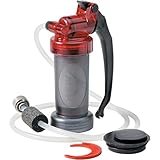
3. MSR MiniWorks EX – The Ceramic Benchmark for Dirty Water
MSR MiniWorks EX Backountry Water Filter
Ceramic core with carbon cartridge
1 liter per minute
1 lb
2000 liter cartridge life
Pros
- Ceramic element resists clogging in silty water
- Carbon and ceramic stack cuts bacteria protozoa taste and odors
- One cartridge treats up to 2000 liters
- Limited lifetime manufacturer warranty
- Made in the USA
Cons
- One of the heaviest hand pumps here at about 1 lb
- Slower and more effortful than twin-piston designs
- Cartridge replacements are costly
- Bulky profile for an ultralight pack
The MiniWorks EX is the oldest idea in this list and still the one I trust when the water is ugly. Instead of a hollow fiber cartridge it uses a ceramic core paired with a replaceable activated carbon cartridge, and ceramic does not respond to sediment the way fiber does. On desert washes, glacier melt and silty lowland creeks, it keeps producing water after fiber-based pumps on the same source have started to choke.
It meets NSF protocol P231 for bacteria at 99.9999 percent and protozoa at 99.9 percent, moves a liter per minute, and one cartridge is rated at up to 2000 liters. The supported TDS ceiling is 500 ppm, lower than most of the hollow fiber pumps here, which matters if you are working in mineral-rich desert water.
Why Ceramic Changes the Maintenance Picture
Ceramic is a surface filter. Contaminants lodge in the outer layer rather than inside a mat of hollow fibers, and because it can be scrubbed, a fouled element often comes back with soap, a bottle brush and some patience. The carbon cartridge sits in front of it to catch organics, and both pieces are user-replaceable.
That durability is why long-term owners treat this as a purchase rather than a consumable. BackpackingLight forum users cite the MiniWorks EX specifically for being easy to use and maintain in the field, with speed as the trade-off, and that is the correct summary of the whole pump.
Weight, Packing and Pump Feel
At 0.45 kg, this is one of the heaviest hand pumps in the roundup, and the bulkier 10 by 4 by 7 inch profile makes it a pack-volume decision as much as a weight decision. The pump handle itself measures 7.5 by 2.75 inches, which is manageable in hand.
The pumping action is slower and requires more effort than a twin-piston design, and the housing takes up more space than anything else in this roundup. For a hiker who resamples every liter at a bad source, that cost is worth paying. For someone who tops up once a day from a reliable creek, it is dead weight.
Who It Suits and Where It Falls Short
Buy this pump if you travel desert, high desert or sediment-heavy terrain, if you are a base camp hiker treating large volumes, or if you simply want the longest cartridge service interval in this list. The limited lifetime manufacturer warranty reduces the risk of the highest entry price in the group.
The drawbacks are weight, effort and cartridge cost, all three of which are the same drawback in different clothing. If pack weight is the binding constraint on your trip, choose a lighter pump and carry a pre-filter for the silty sources instead.
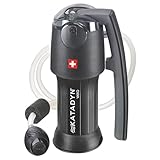
4. Katadyn Vario – Fastest Twin-Piston Hand Pump for Groups
Katadyn Vario Dual Mode Hand Pump Continuous Water Filter for Backcountry
Up to 2 liters per minute
Dual piston pumps on both strokes
15 oz
Ceramic pre-filter mode
Pros
- Twin-piston design filters on up and down strokes
- Longer Life mode guards the cartridge in turbid water
- One dial switches between clear and dirty sources
- Integrated base screws onto Nalgene-style bottles
- Intake float keeps debris out
Cons
- Bulky and spill-prone body
- Slow to dry out between trips
- Glass fiber cartridge wears quickly in harsh water on the long-life setting
The Vario is the fastest hand-driven pump in this roundup, and the reason is mechanical: a twin-piston design that treats water on the up stroke and the down stroke, so output reaches up to 2 liters per minute instead of the roughly 1 liter a single-acting pump manages in the same time. For a group of four filling bladders at the end of a 20 mile day, that difference is the whole argument.
Its second trick is the mode dial. In Faster Flow mode you run the 0.2 micron glass fiber cartridge alone for maximum output. In Longer Life mode a cleanable ceramic pre-filter sits in front of it, slowing things down but protecting the expensive cartridge in questionable water. Three stages overall: glass fiber, ceramic pre-filter, activated carbon granules, rated up to 530 gallons.
What the Mode Dial Actually Changes
For clear alpine tarns and fast-moving streams, Faster Flow mode is the right setting and nothing else matters. For shallow ponds, silty tributaries and anything with algae, Longer Life mode is the setting that determines whether your cartridge survives the trip. Owners who have used competing pumps tend to run Longer Life as the default and treat Faster Flow as a bonus for known-good sources.
The intake hose has a float that sits at the surface and keeps the submerged section from pulling in debris, which is a small feature that saves you from clogs on wide, weedy water.
Group Capacity and End-of-Day Ergonomics
At 2 liters per minute, filling six liters for a group takes about three minutes, and the continuous flow means there is no awkward cycling of a single-acting pump. That is the honest answer to the most common forum complaint about hand pumps, which is fatigue after several liters at camp following a long day.
The twin-piston action still costs forearm effort over that volume, and the 15 ounce weight is mid-range. What it buys back is time and attention, and at camp after dark that is worth more than an ounce or two.
Who It Suits and Where It Falls Short
This is the group and family pump: three to six people, base camp or multi-day trips where you are treating cooking water, drinking water and a wash water load from the same source. The integrated Nalgene-compatible base means the whole thing stands on a bottle at camp, which is genuinely convenient. Bushcraft communities name the Katadyn Vario among the rotation of pumps they carry for exactly this reason.
The drawbacks are physical. The body is bulky and spill-prone compared with every other pump here, it retains water after pumping and takes days to dry fully, which matters for long storage in a damp vehicle or pack, and the glass fiber cartridge has a short life in harsh water even on the protective setting. Reports of minor seal weeping around the mid-body and occasional pump mechanism failures are also worth knowing about.
5. BKLES BK2000 Electric Filter – No Arm Effort, Battery Dependence
BKLES Portable Electric Water Filter for Survival, Camping & Emergencies
Electric 700 ml per minute
0.01 micron 6-stage system
12 oz
168000 ml per charge
Pros
- One-button electric pumping with no arm fatigue
- Battery covers two to three days of heavy use for two people
- 1.5 m intake hose reaches awkward water sources
- Built-in light is genuinely useful at night
- Long-term owners report years of service
Cons
- O-rings are hard to seat and leak on some units
- Motor can run away and overheat if left unattended
- Only one replacement filter set included
- Third-party lab results are not readily published
The BK2000 solves the single biggest complaint about hand pumps, which is effort, by removing the hand from the equation entirely. A high-torque magnetic motor pushes roughly 700 milliliters per minute through a six-stage stack: two 0.01 micron ultrafiltration membranes, PP cotton, KDF and activated carbon. One charge purifies up to 168,000 milliliters, which is comfortably a weekend of water for two heavy drinkers.
At 350 grams, including the 1.5 meter intake hose and the multifunction storage bag, it is the same weight as the Survivor Filter PRO with far more water per minute. The built-in emergency light is a small touch that gets used more than you would expect during an early start or a late camp.
Battery Endurance and the Charging Question
Run time depends entirely on how much water you treat, and the honest framing is that a two-person weekend is one charge, not two. Long-term owners describe it as a device you refill without thinking, which is the main behavioral difference from a hand pump: you turn it on, walk away, and come back to full bottles.
That convenience creates its own risk. One owner reported the motor running away and overheating after the unit was filled and left, so prime it, run it to the end of a reservoir, and drain it before you pack it away. Charging from a solar panel or a small power bank handles the trip; charging from a wall does not, so carry a cable.
Filtration Stages and Certification Questions
Six stages is a deeper stack than most hand pumps in this list, and the double 0.01 micron membranes are what support the virus claim. The KDF and carbon stages handle taste, chlorine and heavy metals, and PP cotton protects the membranes from sediment.
The caveat is documentation. Reviewers consistently note that independent third-party lab results for this unit are not readily published, which means the removal claims rest on manufacturer testing alone. If you are traveling to a virus-risk region, that distinction matters more than the extra stages.
Who It Suits and Where It Falls Short
This pump is for someone who treats a lot of water and does not want to pump it. Vehicle camping, base camp, hunting trips where you haul water from a lake, and go-bag use where the device sits in a kit for months between deployments. The long intake hose also helps when the nearest clean water is under a bank or behind deadfall.
The drawbacks are mechanical and honest. O-rings on some units will not seat properly and leak until you reseat them, the motor needs supervision, and only one replacement filter set comes in the box. Adding a battery to a filter also creates a failure mode a hand pump simply does not have: a flat battery at the one stream you need.
6. Purewell Hand Purifier Pump – Mineral-Tough Value Pick
Purewell Water Hand Purifier Pump with Replaceable Carbon 0.01 Micron Water, Stages, Portable Outdoor Emergency and Survival Gear – Camping, Hiking, Backpacking(Green)
Up to 1400 ml per minute
0.01 micron 4-stage ultrafiltration
1 lb
3000 liter capacity
Pros
- Holds up in mineral-heavy northern water where straws plug in days
- Replaceable carbon cartridge avoids buying a whole new unit
- Clean tasteless output with no aftertaste
- Transparent lid doubles as a drinking cup
- Rubberized base and side grips for rough ground
Cons
- Bulky and heavy for a pack
- Soft silicone hoses kink and restrict flow
- Cotton pre-filter clogs quickly in turbid sources
- Slow when filling several bottles or a large group bladder
The Purewell is the pick for hard water. Its four stages are a medical grade hollow fiber ultrafiltration membrane, activated carbon fiber, a coconut shell carbon rod and PP cotton, and the combination holds up in mineral-laden northern water where bottle filters and straws plug up within days. Owners in that country report weeks of service from the same unit that flattens cheaper gear in a weekend.
Claimed output reaches up to 1400 milliliters per minute, with a rated capacity of 793 gallons before the reusable carbon needs replacing. The food-grade ABS shell, stainless steel components, rubberized base and side grips are built for being set on wet rock, and the transparent lid doubles as a drinking cup with a compass in the base.
Output Claims Versus Pumping Reality
The 1400 ml per minute figure is a headwater number measured on clean, low-viscosity input. On a cold, silty source, or when the supplied hoses kink under load, real output drops noticeably, and users describe it as slow for filling multiple bottles or a large group bladder. The soft silicone tubing is the main culprit: the hoses kink wherever they bend sharply, and the fix is to route them in long, loose curves rather than tight folds.
The cotton pre-filter clogs faster than the other stages, particularly in turbid water, and needs repeated tapping or swapping to clear. Adding a coffee filter over it extends life considerably for very little effort.
Carbon Stages and Service Life
Two separate carbon stages here, one fiber and one rod, handle taste, chlorine, fluoride, arsenic, lead and heavy metals. They are replaceable on their own, which is the main economic argument for this pump: you are not replacing a housing, you are replacing a cartridge.
Replacement carbon life drops sharply on dirty water, so on a trip where you are pulling from the same silty source daily, budget for an extra carbon rather than assuming the 793 gallon figure applies.
Who It Suits and Where It Falls Short
This pump suits hikers in hard or high-mineral water regions, and anyone who wants purifier-class pore size without paying for a premium brand. The stainless steel and ABS construction tolerates abuse, and the drinking cup lid makes it pleasant at camp.
The drawbacks are pack bulk at a full pound, kinking hoses, and a pre-filter that needs attention. It is a good value unit and a poor ultralight one, and it is not the pump to take on a long solo fastpack where every ounce is spoken for.
7. FS-TFC 4-Stage Filter Pump – Fastest Flow With a Sand Filter Head
FS-TFC Water Purifier Survival Gear 4-Stage Portable Water Filter 1.5L/Min Fast Flow for Personal or Small Group Hiking, Camping, Travel, and Emergency Preparedness
1500 ml per minute
Sand filter head plus 8000 L UF prefiltration
10.88 oz
SUS 304 stainless piston rod
Pros
- Very fast 1500 ml per minute
- two to three times typical hand pumps
- Smooth action that does not tire the arm
- Sand filter head handles gritty lake water
- Light enough for a go bag at about 11 oz
- Lab tested by SGS
Cons
- Pumping handle reported to detach after a month of daily use
- Silicone tubing is awkward to route and needs securing
- Unit can lose prime and pull air after extended use
- Replacement filter is a separate purchase
The FS-TFC is the flow rate leader among hand pumps here at a claimed 1500 milliliters per minute, achieved with a stainless steel SUS 304 piston rod and an ergonomic handle that stays smooth even for smaller users pumping several liters in one sitting. Buyers report filling a 2 liter bottle in about a minute, and one owner filtered for nine people over five days with it.
What makes it interesting for problem water is the sand filter head at the inlet, backed by a cleanable prefiltration stage rated at 8,000 liters, then KDF and activated carbon fiber. Owners repeatedly mention that it cleaned sandy, gritty lake water that left other filters with visible grit in the output.
Handling Sand and Grit Compared to Other Pumps
The inlet sand filter head is a passive mechanical stage that intercepts grit before it reaches the membrane, and it can be rinsed clean without opening the unit. That is the single most useful feature here for anyone drawing from shallow, silty lakes or beach-shore water, and it is the reason this pump earns a place in a roundup otherwise built around membrane technology.
It is not magic. The head still needs regular rinsing, and the supported TDS ceiling of 300 ppm is the lowest in this roundup, so it suits relatively clean water rather than heavy mineral loads.
Prime, Air Locking and Setup
Non-slip undercut details at the inlet and outlet support backwashing, and the whole unit goes from bag to running in a few steps. The recurring problem is losing prime after extended use, where the pump pulls air instead of water. Owners who backflush and check the seals after each trip report this rarely becomes a real issue, and those who ignore it tend to blame the pump.
The silicone tubing is the other setup niggle, because it is awkward to route and needs securing to keep it from kinking or from lifting out of the source.
Who It Suits and Where It Falls Short
Choose this pump if you are pumping for other people, if you work around sandy or silty lake margins, or if you want the fastest hand output per stroke in this list. At 10.88 ounces it also stays close to ultralight territory, and the BPA-free food grade ABS body is safe for drinking water contact.
The honest drawback is durability of the handle, with reports of detachment after a month of daily use, plus the fact that a lost prime is confusing until you understand it. Check the handle threads and the seals the first few times you use it, and treat the replacement filter as a separate purchase to plan for.
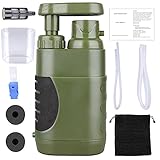
8. LACUCINO 3-Grade Hand Pump – Best for Emergency and Bug-Out Kits
Portable Hand Pump Water Filter,100000Gallons Camping Water Filter Survival,3-Grade Backpacking Water Filter System 0.01μm Camping Water Purifier for Family-Outdoor,Emergency
1400 ml per minute
3-stage 0.01 micron filtration
0.43 kg
Heavy-duty sand isolating pre-filter
Pros
- Simple to operate and easy to store
- Fast 1400 ml per minute for a hand pump
- Buoy-fitted hoses resist kinking and aid pumping
- One owner ran it nearly two years off grid and found replacement O-rings
- Useful as a bug-out bag and family camping backup
Cons
- Replacement filters and parts are hard to source
- Reliability reports of breakage after a small number of uses
- Slower than expected for large groups
- Not ideal as the sole filter on a long trek
The LACUCINO is built for a different job than the rest of this list: sitting in a go bag, a truck, or a storm kit and working perfectly well twice a year. Its three stages are activated carbon fiber, a coconut shell carbon rod and a medical grade hollow fiber ultrafiltration membrane rated at 0.01 micron, with a heavy-duty pre-filter that isolates sand to reduce clogging.
The design detail I like most is the pair of large buoys on the two hoses, at 15.7 and 31.5 inches, which keep the tubing from collapsing and make one-handed pumping at a water source far less frustrating. Rated capacity is listed at 100,000 gallons, which is a marketing ceiling rather than a real figure, and weight is 0.43 kg.
No verified customer photos exist for this unit, so what follows comes from owner reports and the manufacturer specification sheet.
When an Emergency Kit Is the Right Use
Value here is about readiness, not throughput. One owner reported nearly two years of off-grid use with obtainable O-ring gaskets, which is the strongest durability signal in the reviews. For households preparing for outages, or as a secondary filter alongside a primary unit, it does the job at a fraction of the cost of a premium brand pump.
It is also a reasonable second device for a family camping trip, where one filter covers drinking water while another covers a washing station or a dog bowl.
Throughput Reality for Groups
The 1400 ml per minute claim sounds fast until you account for the pre-filter, and owners report slower than expected throughput for larger groups. There is no second mode, no ceramic fallback and no twin-piston action, so the flow curve is what it is. Treat it as a capable two-person unit rather than a camp pump for six.
Supported TDS tops out at 1000 ppm, which is more permissive than several pumps here, and the food-grade ABS body has non-slip rubber and a thickened handle that resists slipping with wet hands.
Who It Suits and Where It Falls Short
This pump suits preparedness kits, vehicle storage, and anyone who wants a second layer of water treatment that does not depend on a cartridge ecosystem they cannot resupply in a crisis. Simple to operate, easy to store, and quick when you need it.
The drawback is parts. Replacement filters and O-rings are hard to source, which is a serious problem for a device whose entire purpose is to work when normal supply chains are not working. There are also reliability reports of breakage after a small number of uses, so test it thoroughly before you rely on it, and do not make it your sole filter on a long trek.
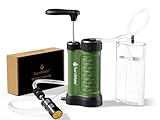
9. SurviMate 5-Stage Purifier Pump – Compact Choice for Families
SurviMate Water Purifier Survival Pump,0.01 Micron 5-Stage Water Purifier System,Hand Pump Water Filter Portable Outdoor Emergency,Camping, Hiking, Backpacking
Up to 1500 ml per minute
5 stages including metal pre-filtration
318 g packed
Cup-style lid
Pros
- Worked for a group of seven on a backpacking trip
- Light and compact with a storage case that doubles as a cup
- Good value for trucks and go bags
- Clean tasting water after filtering
- Works on rain lake river and tap water
Cons
- Pump clogs repeatedly in silty or spring water and loses prime
- Small carbon element shortens effective service life
- Buys time in clean sources rather than long survival scenarios
- Replacement parts are hard to locate
The SurviMate is a five-stage hand pump built around a 0.01 micron hollow fibre ultrafiltration membrane, with pre and post PP cotton, activated carbon fibre and a metal pre-filtration stage in front of it. Claimed output is up to 1500 milliliters per minute, and one reviewer reported filtering successfully for a group of seven on a backpacking trip.
One owner took the trouble to weigh the unit fully packed with pre-filter, tubes and floats and got roughly 318 grams, which is lighter than most of the hand pumps in this roundup. The transparent lid doubles as a drinking cup and the rubberised base and metal handle survive being dropped on rock, which is the normal way these things get used.
Silt, Springs and Where It Struggles
This is the pump’s clear weak point, and reviewers say it plainly. In silty spring water the pump clogs and slows within gallons, and it can lose prime, which is the same failure pattern that shows up in generic pumps generally. The metal pre-filtration stage helps, but it is not enough to make this a desert or sediment-water tool.
There is also a first-pull issue: the handle is stiff on the initial draw, which reads as a fault if you are not expecting it. A few priming strokes resolve it.
Certification, Weight and Packing
Unlike several generic pumps in this category, this one states SGS and NSF/ANSI lab testing alongside FDA food grade and BPA-free materials, which is a meaningful difference for anyone buying a purifier for virus-risk travel. Rated capacity is 793 gallons, or 3000 litres, before the reusable carbon is replaced.
At 318 grams packed it packs better than the one-pound hand pumps, and the cup lid means you do not carry a separate mug for the first liter.
Who It Suits and Where It Falls Short
This is a family and group pump for clear water on normal trail: a trip where sources are reliable and you want something lighter than a pound with a documented lab test behind the pore size claim. Owners also like it in trucks and go bags as a compact, cheap second device.
Its honest drawback is that it buys you time in clean sources rather than reliability in bad ones, and the small carbon element gives you a shorter effective service life than the carbon stages in the Katadyn and MSR pumps here. Replacement parts are also hard to locate. If your route involves silty springs, pick a pump with a ceramic pre-filter instead.
10. Greeshow Electric Filter – Best When You Cannot Count On a Wall Socket
Greeshow Portable Electric Water Filter for Camping & Emergency
Automatic 700 ml per minute
0.01 micron 5-stage
Solar hand crank and USB-C
480 g
Pros
- One-button automatic pumping removes manual effort
- Three charging paths including solar and hand crank
- Built-in 3000 mAh power bank and LED with SOS strobe
- Cartridge rated up to 264 gallons
- One charge can fill several jugs unattended
Cons
- 480 g is heavy for ultralight backpacking
- External pre-filter clogs quickly on collected rainwater
- Marketed as a purifier but behaves as a filter and certification is hard to verify
- Only USB-C with no standard USB-A
The Greeshow is the most self-sufficient powered pump here. Its fully automatic electric pump delivers up to 700 milliliters per minute through a five-stage system built around a 0.01 micron hollow fiber ultrafiltration membrane, and it recharges three ways: an integrated solar panel, a hand crank, or USB-C. In a week where you never pass a wall socket, that hand crank alone changes the calculus.
The built-in 3000 mAh power bank will charge a phone, and the LED flashlight has an SOS strobe mode. The filter cartridge is rated at up to 264 gallons, or 1000 litres, and an electric backwash function clears debris to hold flow. Working range is 41 to 104 degrees Fahrenheit with a supported TDS ceiling of 500 ppm.
Purifier Claim Versus Filter Reality
Reviewers raise a fair point: despite the purifier wording, this behaves as a filter, and published certification reports are hard to verify independently. The stated testing is SGS against NSF/ANSI standards, but a 0.01 micron hollow fiber membrane cannot physically be assumed to deliver on a virus claim the way a documented purifier test can. If you are heading somewhere with a real virus risk, treat this as a filter and carry tablets as backup.
That same caution applies to several pumps in this roundup, and it is the reason the pore size number alone should never be your deciding factor.
Rainwater, Pre-Filters and Running Costs
The external pre-filter is the weak link for rainwater collection, where it clogs quickly and is hard to clean, and that drives up replacement costs over time. If you are drawing from tanks, cisterns or open rain barrels rather than a moving stream, that is the relevant test for you.
Replacement parts are separate purchases, and the unit ships with only USB-C, so bring your own cable and a USB-A adapter if your kit relies on it.
Who It Suits and Where It Falls Short
Pick this pump for off-grid vehicle camping, extended base camp, or emergency kits where charging infrastructure is unreliable. The power bank, the hand crank and the automatic pumping make it a genuine one-device solution for washing hands, coffee water, dog bowls and drinking water, and one charge can fill several gallon jugs while you do something else.
At 480 grams it is the heaviest unit in this roundup, which rules it out for backpacking, and the purifier-versus-filter gap means it should not be your only line of defense in high-risk regions. For a vehicle or a cabin, those are acceptable trade-offs. For a pack, they are not.
How to Choose a Backpacking Water Pump
Choosing between these ten comes down to four questions: what are you treating for, how much water do you need, how dirty is it, and how much total weight can you live with. Here is how each one maps to a decision.
Filter, Purifier or Sterilizer: What Each One Actually Removes
A microfilter removes bacteria and protozoa, which is what you need in North America, Western Europe, Australia and Japan. A purifier adds virus removal and is required in much of Asia, Africa and Latin America, or anywhere your local public health guidance says untreated natural water carries a viral risk. A sterilizer is a different category, used for lab and medical water, and no backpacking pump in this list is one.
Two habits on forums reflect real caution: people check their destination guidance before leaving rather than at the stream, and people carry a second method when viruses matter. Doing both costs almost nothing and removes the single worst outcome of a water treatment mistake.
Pump Mechanism: Single-Acting, Twin-Piston, Ceramic and Electric
Single-acting piston or lever pumps treat water on one stroke only, which is why the Katadyn Hiker Pro and MSR MiniWorks EX sit at roughly 1 liter per minute. Twin-piston designs such as the Katadyn Vario filter on both strokes, which is where the 2 liters per minute class comes from. Electric pumps move around 700 milliliters per minute with no arm effort at all, at the cost of a battery.
Ceramic is not a pump mechanism but it changes the equation: a ceramic element tolerates sediment that chokes hollow fiber, at the cost of weight and price. Choose ceramic when your sources are consistently silty, and hollow fiber when they are not.
How Much Flow Rate Your Group Actually Needs
Work backward from liters. A solo hiker drinking three liters a day is fine with half a liter per minute, because you are filling one bottle. Two people filling bladders want at least a liter per minute. Four or more people, or anyone treating a cooking pot and a wash water container, wants the 1.5 to 2 liter per minute class.
Forum hikers consistently ask how many liters per minute is enough, and the pattern in the answers is that group size matters far more than trip length. Cold water reduces flow on every hollow fiber design in this roundup, so treat advertised rates as a ceiling rather than a plan.
Total System Weight, Not Just the Filter Head
Manufacturers quote the bare pump, and the difference between that number and what you actually carry is frequently several ounces of hoses, floats, adapters, a backflush syringe and a reservoir bag. One reviewer in this roundup weighed a fully packed unit at roughly 318 grams rather than relying on the listing figure.
Weigh the whole system, then compare that against the bare filter head of a squeeze system, which is typically lighter. A pump only wins the weight comparison when you are moving enough water per day to justify the extra ounces. This is the same reasoning behind our guides to water transfer pumps for rain barrels versus garden hoses, where the whole system, not the pump alone, is the cost.
Pre-Filtering Silty Water in Three Steps
First, carry a coffee filter or a cut bandana and a small rubber band. Second, stretch it over the intake and secure it so it does not blow off, and swap it the moment it darkens. Third, backflush after every session rather than at the end of the trip, because sediment that sets into a hollow fiber element is far harder to remove once it has consolidated.
If water is only lightly silty, filling the reservoir and letting it sit so the heaviest sediment settles before pumping is also effective, at the cost of time.
Freeze Damage and Winter Storage
Freeze is the number one deal breaker reported on forums, and the mechanism is simple: water trapped inside a hollow fiber element, a cartridge or a hose expands when it freezes and can crack fibers permanently. After a freeze, a pump can appear to work and then leak bacteria, which is worse than an obvious failure because you do not notice.
Before you store any pump for the season, pump it dry, pull the hoses, remove the cartridge if the design allows it, and store everything in a dry bag in a heated space. Never leave a unit in a pack, a vehicle or a shed through a winter. Forum users who have lost filters to freeze treat this as settled advice rather than a preference.
When You Do Not Need a Pump at All
For one or two people drinking clear water from reliable sources on a trail with frequent water, a squeeze filter is faster, lighter and simpler than anything in this roundup. A gravity system wins when you are at camp for a night, want to filter four liters while you make dinner, and would rather not pump at all.
A pump becomes the right tool when you are moving volume, when the water is questionable enough that you want a dirty reservoir to pre-settle silt, or when you are treating for viruses and want a known, serviceable membrane. A UV pen is another category entirely: instant, no moving parts, but dependent on a battery and on clear water.
Frequently Asked Questions
What is the best water filtration system for backpacking?
For most backpackers the best water filtration system is a hollow fiber hand pump around 0.1 to 0.2 micron that removes bacteria and protozoa, because it is serviceable, fast enough for one to two people and has a deep parts ecosystem. The Survivor Filter PRO, Katadyn Hiker Pro and MSR MiniWorks EX are the strongest general choices. A squeeze filter beats any of them on weight for a solo hiker on clear water, and a purifier rated for virus removal plus a backup method is required in parts of Asia, Africa and Latin America.
Can you really drink any water with LifeStraw?
A LifeStraw or similar bottle filter removes bacteria and protozoa from clear water, which is enough in most of North America, Western Europe, Australia and Japan. It does not remove viruses, and it is not intended for silty or sediment-heavy sources, which is where pump filters with pre-filtration and larger capacity do better. A straw also treats a few hundred milliliters at a time, so it suits trail sipping rather than camp volume.
How do I purify water while backpacking?
Choose the method for the risk and volume. Scoop and pre-settle, then pre-filter turbid water through a coffee filter or bandana. Fill a reservoir, pump through the membrane until it empties into your bottle or bladder, and repeat. For viruses, use a purifier and carry tablets as backup. When no treatment is available, boil for one minute, or three minutes above 6500 feet, and filter afterwards to improve taste.
Which backpacking water filter is better, the MSR or the Katadyn?
The MSR MiniWorks EX uses a ceramic element that resists clogging in silty water and lasts longer, at the cost of about a pound of weight and more pumping effort. The Katadyn Hiker Pro is lighter, pumps about a liter per minute and is easier to service in the field, but its glass fiber cartridge wears faster in dirty water and replacement cartridges cost more. Pick MSR for desert and sediment-heavy trips, Katadyn for clear water and lower pack weight.
How long does a backpacking water filter last, and how do I maintain it?
A quality hollow fiber cartridge commonly delivers several hundred to a few thousand liters before pore fouling slows it noticeably, and rated figures such as 1150 or 2000 liters assume clear water. Ceramic elements last longer. Backflush after every use, clean the pre-filter when it discolors, and store the pump drained and dry. Replace the carbon element on its own schedule, and never store a filter where it can freeze.
Which Backpacking Water Pump Should You Buy in 2026?
If you want one pump and you are not sure, choose the Survivor Filter PRO. Three replaceable stages, 0.01 micron, 12.8 ounces, 500 milliliters per minute and a lifetime defect warranty make it the most complete answer to the question of which water purification pump is best for backpacking in 2026. Add a coffee filter over the intake and it handles water that would clog most of the field.
If pack weight rules the trip, the Katadyn Hiker Pro gives you a full liter per minute at 11.2 ounces. If your water is consistently silty or desert-hard, the MSR MiniWorks EX ceramic element outlasts fiber and forgives bad sources, if you can carry the pound. For four or more people, the Katadyn Vario twin-piston action fills bladders in minutes rather than a quarter of an hour. If you would rather not use your arm at all, the BKLES BK2000 and Greeshow electric pumps move 700 milliliters per minute on a battery, with the Greeshow adding solar and hand-crank charging for trips far from a wall socket.
And if you are one person on clear water with sources every few hours, skip the pump entirely and carry a squeeze filter instead. All ten of the best water purification pumps for backpacking are in the guide above, with the trade-offs stated plainly, so you can pick on your water, your group and your pack rather than on a logo.
Leave a Reply