


Three hazards decide everything about work gloves for handling metal: cut and puncture from sharp edges, thermal exposure from hot or freshly cut stock, and grip on oily or sweating parts. Get the first one right and you can still drop a hot casting on your foot. Get the third one wrong and the cut happens anyway, because the part slipped.
I have watched fabricators sort through a dozen glove options in 2026 the same way every time. Someone grabs the cheapest pair from a box, works a shift, watches the nitrile coating shred on sheet metal burrs, and then buys a better one. I did the same sorting, and I read the labels and user reviews line by line on all twelve pairs below before writing a word of this. My criteria were simple: a printed cut rating, a coating that holds on a greasy part, a cuff that keeps edges off the wrist, and a fit that does not collapse after four hours.
One thing worth saying up front. This roundup is built around cut-resistant knit and coated work gloves, which is where the sharp-edge hazard lives. Not one of these twelve is a welding-rated or heat-rated leather glove, so if you are picking up metal that came out of a torch or a plasma cutter seconds ago, none of them is the right tool. I cover that gap in the buying guide and tell you what to wear instead.
One more context note before the picks. If you are outfitting a whole crew rather than choosing for yourself, sizing consistency matters as much as the rating on the tag. The same reasoning drives our glove fit guide for small hands, and it is the same fit-versus-protection tension you see in our lightweight chainsaw picks.
Our Top 3 Metal-Handling Gloves for 2026
These three cover the widest range of real metal-handling jobs. The first is the one I put in my own hands most often, the second is the strongest protection for impact-heavy shop work, and the third is the pick when the budget is the deciding factor.

DEX FIT Level 5 Cut Gloves
- ANSI A5 cut rating
- 13-gauge HPPE blend
- Foam nitrile palm
- Touchscreen compatible

Ironclad Command Impact A5
- 360 degree A5 protection
- TPR impact protection
- Anti-vibration palm
- Hook and loop cuff

Schwer ProGuard A9 Gloves
- Highest ANSI A9 rating
- 13-gauge lightweight knit
- Sandy nitrile palm
- PFAS-free materials
All 12 Gloves Compare for Metal Handling in 2026
Every glove in the table below carries a printed ANSI cut rating, which is the single most useful number on a metal-handling glove. The right level depends on what you are moving: A4 suits sheet and plate work, A5 and above suit rougher raw material, and the leather pair protects differently again.
| Product | Specs | Action |
|---|---|---|
| DEX FIT Level 5 Cut Resistant Gloves |
|
Check Latest Price |
| Schwer ProGuard A9 Cut Resistant Gloves |
|
Check Latest Price |
 G and F Products Kevlar Cut Resistant Gloves G and F Products Kevlar Cut Resistant Gloves |
|
Check Latest Price |
 toolant ComfyCut A4 Gloves toolant ComfyCut A4 Gloves |
|
Check Latest Price |
| Ironclad Command Impact 360 A5 Gloves |
|
Check Latest Price |
 WORK FORMULA Snug Fit A4 Gloves 2 Pack WORK FORMULA Snug Fit A4 Gloves 2 Pack |
|
Check Latest Price |
 Radians RWG603 Cut Protection Gloves Radians RWG603 Cut Protection Gloves |
|
Check Latest Price |
 Schwer Pro Max ANSI A9 Leather Work Gloves Schwer Pro Max ANSI A9 Leather Work Gloves |
|
Check Latest Price |
 COOLJOB A9 Cut Resistant Safety Gloves COOLJOB A9 Cut Resistant Safety Gloves |
|
Check Latest Price |
 toolant ComfyCut A6 Gloves toolant ComfyCut A6 Gloves |
|
Check Latest Price |
 MAGID D-ROC A5 VersaTek Grip Gloves MAGID D-ROC A5 VersaTek Grip Gloves |
|
Check Latest Price |
 Schwer ProGuard A7 Cut Resistant Gloves Schwer ProGuard A7 Cut Resistant Gloves |
|
Check Latest Price |
1. DEX FIT Level 5 – The Best All-Rounder for Sharp Sheet and Plate Metal
DEX FIT Level 5 Cut Resistant Gloves Cru553, 3D-Comfort Fit, Firm Grip, Thin & Lightweight, Touch-Screen Compatible, Durable, Breathable & Cool, Machine Washable; Grey L (9) 1 Pair
ANSI A5 cut level
13-gauge HPPE blend
Foam nitrile palm
Touchscreen ready
Pros
- ANSI A5 cut protection
- 3D comfort fit keeps real dexterity
- Foam nitrile grip on wet or greasy metal
- Machine washable and reusable
- Touchscreen compatible fingertips
Cons
- Nitrile coating wears through with heavy daily use
- Back of hand carries no cut protection
- Sizing runs small
This is the glove I put on first when someone asks me what to buy for metal work, and it is the pair I reach for when a job is not yet defined. The liner is a 60 percent HPPE, fiberglass, nylon and spandex blend knitted at 13 gauge, which puts it in the thin end of the cut-resistant range without feeling flimsy.
At 2.88 ounces a pair, the whole thing disappears on your hand within a minute. That matters more than the rating in a lot of shops, because a glove a worker takes off mid-shift is a glove that never protected anything. The 3D-comfort fit wraps the knuckles and fingers rather than a flat tube, so I could pick up a nut, turn it, and set it down without the classic fingertip slide.
Cut Level A5 on a Thin 13-Gauge Knit
The printed rating is ANSI Cut Level A5, and the back-of-hand carries an abrasion level 4 in the same standard. That is comfortably above the A4 threshold most safety guides quote for general metal handling, which means it holds up on plate steel edges and not just on clean sheet.
The trade is that a 13-gauge knit is thinner than the 18-gauge gloves in this roundup, and thin means less padding between your skin and a burr. In practice that is the right way round for most shops, because the protection stops a cut rather than a crush.
Foam Nitrile Palm on Wet and Greasy Metal
The palm is a water-based foam nitrile coating, and foam is the difference between a glove that slides and one that holds. Micro-foam structure traps a thin layer of moisture and oil so the surface stays tacky, which is exactly what you want when you are lifting a machined part off a lathe with one hand.
Coated knit palms are also the part that wears out first. Reviewers of this model report the coating thinning under heavy daily use, and the back of the hand is knit with no coating, so an edge dragged across the top of your hand still finds bare skin. Treat the palm as the consumable and check it weekly.
Machine Washable, Latex Free, and Built for Long Shifts
Machine washable is a bigger deal than it sounds, because a coated knit that gets washed in a shop sink instead of a machine loses its grip long before the fibers fade. This pair is also latex free and OEKO TEX certified, which matters for people with latex sensitivity working around metal fixtures.
The two drawbacks users mention most are odor after a sweaty day and shrinkage if you tumble dry hot. Air dry it, and the pair will outlast most of the coated gloves in this list.
2. Schwer ProGuard A9 – Maximum Cut Protection in a Lightweight Knit
Schwer ProGuard High Level Cut Resistant Work Gloves for Extreme Protection, ANSI A9 Cut Gloves with Reinforced Thumb, Non Slip, Breathable, Durable, Touch-screen, Black 1 Pair(L 3326
ANSI A9 top cut rating
13-gauge knit
Sandy nitrile palm
Reinforced thumb crotch
Pros
- Highest ANSI A9 cut rating available
- Lightweight knit stays breathable on long shifts
- Sandy nitrile grip holds oily parts
- Reinforced thumb crotch for durability
- PFAS-free materials
Cons
- Metal wire content irritates sensitive skin
- One size fits all sizing varies
- Not waterproof
If your metal is genuinely hostile, rebar with lifting lugs, structural plate with rusted edges, or a bin of drop-offs, this is the rating ceiling most buyers are looking for. ANSI A9 is the highest cut level on the scale, measured at six thousand grams of load before the blade cuts through.
What surprised me is how little that rating costs you in weight. This is a 13-gauge knit with a sandy nitrile coating, not a heavy leather over-glove, so it stays wearable for a full shift even when the shop is warm.
What the Metal Wire Yarn Actually Does
The construction is HPPE, polyester, spandex and metal wire, and that last component is what pushes the rating from A5 to A9. The tradeoff is that exposed metal fiber can bother sensitive skin, which reviewers call out directly. If you have dermatitis or work in a food-adjacent area, the fiberglass-free gloves later in this roundup are a better fit.
Reinforced thumb crotch adds real value here, because that is where a sheet metal edge most often lands when you are bracing a part while cutting it.
Sandy Nitrile Grip on Oily, Damp Steel
Sandy nitrile is the abrasive-textured coating that shows up on the best gripping gloves, and it is noticeably better on a wet, oily plate than smooth micro-foam. The grit gives your palm something to bite into rather than sliding across a slick surface.
The downside is that the texture feels less like a bare fingertip. If your task is feeling a burr or a thread by touch, a micro-foam palm gives you more sensation at a lower cut level.
Touchscreen Tips and a Machine Wash Cycle
Conductive fingertips let you check a drawing or a phone gauge without pulling the glove off, and the whole thing is machine washable, which keeps the grit in the palm from flattening out. The glove is PFAS-free and comes with a limited lifetime warranty, unusual at this level of protection.
Sizing is the one real problem. It is a one size fits all shell, so hands at either end of the range will feel the fit differently, and the cuff is a simple bracelet sleeve that will not stop a spark travelling up your forearm.
3. G and F Products Kevlar Gloves – Aramid Protection with a Classic PVC Dot Grip
G & F Products Kevlar Cut Resistant Work Gloves, ANSI Rated, Heavy Duty Safety Gloves with PVC Grip, Slash & Puncture Protection for Glass Handling, Metalworking, Construction, Mechanics, Medium
100 percent DuPont Kevlar
PVC dot grip on both sides
ANSI rated cut resistance
Pros
- Kevlar fiber handles sharp sheet and glass
- PVC dots grip wet and dusty surfaces
- Lightweight and breathable for long shifts
- Good dexterity for detailed assembly
Cons
- PVC dots wear off and stop gripping
- Less flexible than nitrile-dipped gloves
- Kevlar runs warmer than HPPE blends
This is the traditional aramid answer, and it behaves differently from the modern HPPE blends. DuPont Kevlar fiber throughout, no foam, no sandy texture, just a light seamless knit with raised PVC dots on the palm and the back of the hand for grip.
Fabricators who prefer a familiar glove with real tactile feel tend to land here. You can feel a burr, a thread, or a loose fastener through it, which the coated gloves in this roundup partly block out.
Aramid Strength, but Watch the Heat
Kevlar is an aramid fiber and it handles sharp edges superbly, which is why you see it in glass handling and sheet metal work. It is not a heat-rated fiber in this configuration, though, and aramid gloves run warmer than an HPPE blend of the same weight in a hot shop.
That warmth matters more than people expect. A glove that makes your hands sweat is a glove that comes off, and a bare hand near a cut plate edge is where a lot of shop injuries actually start.
Why PVC Dots Dull Faster Than Nitrile
The PVC dot grip is the old-school answer to oily metal, and it works well when new because each raised dot is a tiny ridge your skin contacts. The problem is what happens in month two: the dots wear flat first, then shed entirely, and a glove with a smooth palm on an oily part is more dangerous than no glove at all.
Secondary limitation is flexibility. Dipped nitrile spreads across the whole finger and bends with it, while discrete PVC dots leave more of the knit exposed and stiffer.
Size Range and Care Limits
This is a medium with limited size options, so if you have large hands you may be squeezing into it, and the fit type is a regular rather than a stretch fit. Care instructions say do not iron, and the PVC surface should not be machine washed at high heat or the dots soften.
For a metal task you do once a week, it is an excellent glove. For daily use in a fabrication shop, expect to replace it sooner than a coated knit.
4. toolant ComfyCut A4 – Fiberglass-Free Comfort for Everyday Metal Tasks
toolant ComfyCut A4 Cut Resistant Work Gloves, 1 Pair, Dark Gray, Large
ANSI A4 and EN 388
18-gauge MetalQ yarn
Micro-foam nitrile palm
Fiberglass-free knit
Pros
- A4 protection in a very light 18-gauge knit
- Fiberglass-free yarn suits sensitive skin
- Micro-foam nitrile grip in dry or oily conditions
- Machine washable and touchscreen ready
Cons
- No puncture protection against splinters
- Right-hand orientation only
- A4 suits medium duty rather than heavy plate work
This is the glove I recommend to someone doing assembly, HVAC service, or light fabrication who needs a printed cut rating without paying a cut-resistant premium. ANSI and ISEA 105 A4 certified, EN 388 certified, and built on an 18-gauge knit, which is about as thin as cut-resistant gloves get.
The 18-gauge construction is the story here. It is roughly a quarter lighter than a traditional HPPE glove of the same rating, and that difference in thickness is what preserves real fingertip feel.
What A4 Does and Does Not Cover
A4 is measured at three thousand grams of blade load, and the AI summaries and safety guidance that dominate search results for this query point at A4 or higher as the general threshold for working with metal. For sheet metal, ductwork, and finished stamped parts, that is the correct level.
For plate steel, rebar, or anything with a rust-broken edge, step up. A glove rated A4 slows a clean edge very well and a corroded or jagged one much less, and the same knitted structure gives you no puncture rating at all.
Fiberglass-Free for Sensitive Skin
The MetalQ yarn is fiberglass-free, which removes the itching that makes some people ditch cut-resistant gloves in the first week. If you have reacted to fiberglass blends before, this is the pair to try before you spend more on a premium option.
Machine washable, touchscreen compatible, and OSHA compliant, with pack options in singles, threes, and twelves if you are outfitting a bench rather than a person.
Micro-Foam Nitrile for Assembly Work
The micro-foam nitrile palm gives you the best tactile feedback of any coated glove in this roundup, which is why it suits mechanics and assemblers. Dry, wet, or oily, the foam structure keeps the surface tacky without the grit of a sandy coating.
Be aware of the two practical limits: it is listed as a right-hand orientation, and the coating durability varies with how many burrs it meets. For handling finished metal it is excellent. For dragging sheet across the palm all afternoon, go up a level.
5. Ironclad Command Impact 360 – Full-Hand A5 Protection with Impact Guarding
Ironclad Command Impact 360 Cut A5 Work Gloves; Touch Screen Gloves Conductive Palm & Fingers, Impact Protection, Machine Washable, Sized S, M, L, XL, XXL (1 Pair), Red (IEX-MIGR5-03-M)
ANSI A5 full hand coverage
HPPE blend liner
TPR impact protection
Synthetic leather palm
Pros
- ANSI A5 protection wrapping the full hand
- TPR impact protection over the knuckles
- Anti-vibration palm pads dampen tool feel
- Terry cloth thumb wipes sweat
- Hook and loop cuff adjusts to fit
Cons
- Warmest glove in this roundup on hot days
- Tips run thick on a touchscreen
- Not waterproof
This is the glove for a metal fabrication or demolition site rather than a bench. Unlike the dipped knits in this roundup, the A5 coverage wraps the full 360 degrees of the hand, and thermoplastic rubber overlays sit over the knuckles for impact protection.
It is the highest-rated glove here, and once you have worn an impact-rated glove you notice the difference on a pinch bar or a dropped plate corner immediately. Nothing else in this list absorbs a knuckle strike.
Impact Protection Is a Metal-Handling Feature, Not a Bonus
When you are setting a steel plate or levering a cut piece loose, the load goes through the hand, not just the fingertips. TPR overlays over the back of the hand spread that load, and the double-stitched construction survives being pulled off with oily hands, which is a real test in a shop.
The anti-vibration palm pads are aimed at people running a die grinder or a torque wrench all day, dampening the buzz that leads to hand fatigue by the end of a shift.
Hook and Loop Closure Instead of a Knit Cuff
Most gloves here are pull-on with an elastic wrist. This one uses a hook and loop closure, which means you can cinch it over a jacket sleeve for grinding work or loosen it completely for a quick task without taking the glove off.
That adjustability also extends glove life in a mixed crew, since one closure covers a wider range of wrist sizes than a fixed elastic. The trade is bulk, and the hand reads heavier than a 13-gauge knit.
Touchscreen Palm and Sweat Management
Full touchscreen capability across fingers and palm, plus a terry cloth sweat wipe on the thumb, which sounds minor until you have tried to reset a digital caliper with a filthy glove on. It is machine washable.
Honest limits: it runs warm in hot weather, the fingertips are thick enough to feel clumsy on a phone, and it is not waterproof. If the shop is hot and the metal is dry and clean, this is the wrong choice despite the rating.
6. WORK FORMULA Snug Fit A4 Two Pack – A Rotation Pair for Crews
WORK FORMULA 2/5 Pack Snug Fit Cut Resistant Gloves, ANSI A4, XS-3XL, Men/Women, Metal/Glass/Wood/Box Cutting, Fishing, HVAC (Medium)
ANSI A4 at 3000 grams
30 percent thinner knit
8000 abrasion cycles
Two pack format
Pros
- A4 protection in a thin light knit
- Two pairs let you rotate while one washes
- Foam-structured palm grips wet metal
- Sizes run XS through 3XL
- Breathable back for long shifts
Cons
- Snug fit means sizing up
- Touchscreen performance varies by device
- Only offered in certain two pack sizes
A two-pack solves a problem nobody mentions: the gloves you wear every day are the ones that need washing, and you cannot wash them while wearing them. Buying in rotation means one pair is on your hands and one is in the wash, which roughly doubles the calendar life of a coated knit.
The rating here is A4 at three thousand grams, and the claim that matters for metal is the abrasion figure of eight thousand cycles, measured against a knit the manufacturer describes as about thirty percent thinner than comparable gloves.
Why a Two Pack Beats One Better Pair for Most Shops
Coated knit gloves fail from the palm outward, and washing accelerates the loss. Rotation slows that down, and it also means a torn glove does not end your coverage for the rest of the shift, which matters when a supervisor is the only person who noticed the hole.
For a crew of ten, the sizing range from XS to 3XL is the practical win. Finding ten people gloves that fit from a narrow size run is harder than finding a good glove.
Sizing Runs Snug, So Plan for It
Reviewers consistently suggest sizing up. The adaptive snug fit is the point of the design, but a snug knit glove on a larger hand pulls at the fingertips after a few hours and that pressure is exactly where a cut lands.
Touchscreen compatibility is claimed but varies by device, so test it on the actual phone or tablet before your crew commits to it. The foam-structured rubber palm does hold well on wet and oily metal, which is the job.
Where the Thinness Pays Off
Thin is the benefit for anyone doing HVAC service or metal assembly, where you are turning screws, seating connectors, and feeling whether a fitting is threaded. A thin knit with a foam palm keeps that feedback while still carrying a printed rating.
It is not waterproof and it is not a puncture glove, so treat it as cut protection for clean, sharp metal rather than for scrap bins and rust.
7. Radians RWG603 – Certified A5 and EN 388 Protection for Wet Conditions
Radians RWG603 Cut Resistant Work Gloves A5 Sandy Foam Nitrile – Size L
ANSI A5 and EN 388 4544
13-gauge HPPE knit
Sandy foam nitrile palm
TPR impact overlays
Pros
- A5 cut rating with EN 388 4544 certification
- Waterproof knit for wet metal and rain
- TPR overlays absorb knuckle impacts
- High visibility red coating stands out in a shop
Cons
- Hand wash only with no machine cycle
- Heavyweight knit runs warm
- Sizing runs small
Outdoors, handling sheet metal that has been sitting in the rain, this is one of the few gloves in the roundup that is genuinely waterproof. The 13-gauge HPPE knit is rated A5 under ANSI and carries EN 388 4544, which means a full mechanical certification across abrasion, cut, tear, and puncture.
That EN 388 puncture component is worth noting, because most of the gloves here only carry a US cut rating. It does not make this a metal-splinter glove, but it is a broader certification than the rest of the field.
High Visibility Red for Busy Shops
The red sandy foam nitrile coating is not a styling choice. On a fabrication floor with a plasma table, a grinder, and a forklift lane, a high-visibility glove is easier to spot when someone drops a part, and easier for a supervisor to see that a glove is on at all.
Sandy foam combines the grip of a textured coating with the feel of micro-foam, so it is a reasonable middle ground when your work moves between oily shop floors and outdoor stock.
Waterproof, but Hand Wash Only
Waterproof construction is a genuine advantage for outdoor sheet metal and ductwork, and it is why this glove appears in HVAC contexts. The care instruction is hand wash, however, and a coating that is repeatedly scrubbed by hand loses its sandy texture faster than one that goes through a gentle machine cycle.
It is also the warmest and heaviest knit in this roundup at heavyweight classification, and reviewers note the sizing runs small. Buy the size up.
Rain, Sheet Metal, and Outdoor Stock
Handling sheet that has been sitting outdoors in the rain is where a waterproof knit earns its place, and this is one of the few gloves in the roundup that is genuinely waterproof rather than merely water-resistant. The rating holds, the coating holds, and your hands stay dry while you sort and fit the panels.
Combine that with a high-visibility red palm and you get a glove a supervisor can actually spot across a fabrication floor, which is worth more in a busy shop than any small gain in dexterity. The sandy foam nitrile gives you a solid grip on a wet plate, though you give up a little fingertip feel compared with a micro-foam palm.
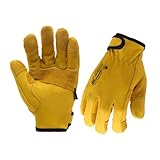
8. Schwer Pro Max A9 Leather – Full-Grain Cowhide for Reusable Heavy Work
Schwer Pro Max ANSI A9 Cut Resistant Leather Work Gloves, PM3401, XL
Full-grain cowhide outer
Ansi A9 cut liner inside
Reinforced palm and fingertips
Velcro cuff
Pros
- Full-grain cowhide outer shrugs off abrasion
- A9 cut-resistant liner beneath the leather
- Reinforced palm and fingertips at the wear points
- Breathable leather avoids the trapped sweat of a coated knit
- Velcro cuff adjusts over a jacket sleeve
Cons
- Only the liner is cut-rated rather than the leather
- Runs small so size up
- Hand wash and leather conditioning only
This is the one leather glove in the roundup, and it earns its place because it protects differently from all eleven knit options. A 100 percent full-grain cowhide shell sits over an ANSI A9 cut-resistant liner, so abrasion resistance and cut resistance come from two different layers doing two different jobs.
Full-grain leather is the top layer of the hide, which is why it darkens and softens with use instead of flaking the way corrected-grain leather does. In a shop that keeps gloves for months, that difference is the whole argument.
Read the Liner, Not the Leather
The A9 rating belongs to the inner liner, not the cowhide. That distinction is stated plainly in the specifications and it is the single most misunderstood thing about leather cut-resistant gloves, so take it seriously: if the liner is exposed or torn, the glove has lost its cut protection even though the palm still looks brand new.
Reinforced leather palm and fingertips handle the part of the hand that actually meets rough metal, and the wedge-shaped thumb with seams placed away from the palm reduces the blistering you normally get at the base of the thumb after a week of gripping a pipe wrench.
Why Leather Beats a Coated Knit for Reuse
A coated knit protects you with fiber that abrades away. Cowhide protects you with a surface that can be wiped, re-conditioned, and worn for years. For someone who moves structural steel or does demolition, a leather shell simply survives more cycles than any nitrile palm.
Leather also breathes better than a coated knit, which matters on a long shift. The catch is that oil and grease soak into the hide rather than sitting on top, and a leather palm that has absorbed oil becomes a liability on a smooth part.
Care and Sizing Notes
Care is hand wash with mild soap and warm water, air dry, and condition periodically. Do not put cowhide in a dryer and do not soak it in solvent to clean oil, because the finish goes hard and cracks.
Fit sentiment runs loose and reviewers recommend sizing up, and it is a heavyweight glove that will feel warm in summer. For outdoor and cold work this is an advantage rather than a drawback.
9. COOLJOB A9 Gloves – High Cut Rating at a Light Weight
COOLJOB A9 Cut Resistant Safety Work Gloves with Grip, Touchscreen Nitrile Coated Heavy-duty for Glass Metal Sheet Handling, Blue Medium, 1 Pair
ANSI A9 at 6000 grams
HPPE and metal yarn
Microfoam nitrile palm
Reinforced thumb crotch
Pros
- A9 rating in a lightweight wearable knit
- Microfoam nitrile palm grips oily steel
- Lightweight enough for all-day wear
- Reinforced thumb crotch at the key wear point
Cons
- Metal fiber fragments can shed from the knit
- Grip coating wears faster than rivals
- No puncture protection against splinters
Not everyone wants the highest rating. For a lot of metal tasks, a glove that is rated A5 but stays lightweight all day protects you better in practice than an A9 glove that gets pulled off halfway through the afternoon because it is too much.
This is an A9 rated glove built on HPPE with metal yarn and a microfoam nitrile palm, and the appeal is that you get the top of the cut scale without the weight of a heavy leather over-glove. Reviewers rate it as a good balance of protection and comfort for light to medium duty work.
Why the Metal Yarn Matters and What It Costs
Metal yarn is what carries a knit glove into the A8 and A9 range, and it is also the component people notice first. Reviewers of this model report metal fragments shedding from the knit, which matters in a machining environment where swarf and loose fiber are both a hazard and a nuisance.
If you are grinding or plasma cutting, that shedding is a reason to look at a leather shell or an impact-rated glove instead.
Microfoam Nitrile for Oily Steel
The microfoam nitrile palm is a good choice for handling engine parts, castings, and any metal carrying a film of oil. Foam nitrile holds grip without the aggressive grit of a sandy coating, so you keep more tactile feedback while still stopping the slip.
The grip coating is reported to wear faster than the heavier competitors, and there is no puncture protection, so a sharp burr that pierces rather than slices will find skin. Sizing is also inconsistent across the unisex run.
When to Choose This Over the Lighter A5 Options
Choose it when the edge risk is genuine and unpredictable, such as a salvage yard, a demolition clean-out, or a bin of cut-off drops with unknown history. The A5 gloves in this roundup handle the same work when the metal is clean and you control the edges.
Multiple color and pack options are listed, which makes it easier to color-code a crew by task.
10. toolant ComfyCut A6 – Impact-Rated A6 Protection with Tungsten Yarn
toolant ComfyCut A6 Cut Resistant Work Gloves, ANSI & EN388 Industrial Protection with Comfort, Fiberglass-Free, Touchscreen, Flexible Grip for Metal Fabrication, Manufacturing, Construction, X-Large
ANSI A6 and EN 388
Impact Level 4 rating
18-gauge MetalQ with tungsten
Fiberglass-free knit
Pros
- A6 cut rating paired with Impact Level 4
- Tungsten-reinforced 18-gauge yarn
- Fiberglass-free and allergy friendly
- Sandy nitrile holds wet dry or oily parts
- Color-coded cuffs make sizing obvious
Cons
- Palm-side cut protection only
- Runs small so size up
- Warm over a full shift
This is the middle rung of the toolant range, and it is the only glove here combining an A6 cut rating with an ANSI impact Level 4 rating. That pairing is unusual, and it matches a specific job profile: sheet metal stamping and fabrication where you are handling parts and also knocking them out of a fixture.
The yarn is an 18-gauge MetalQ blend reinforced with tungsten wire, which is denser than the steel or metal wire used in cheaper high-end gloves and holds a cut level without adding bulk.
Where a Six Rating Earns Its Keep
A6 sits between the A5 workhorses and the A9 extremes, and for a fabricator stamping parts or handling half-formed sheet it is the sweet spot. You get genuine cut margin over an A5 without paying the weight of a heavily reinforced metal-wire yarn.
Pair that rating with ANSI impact Level 4 and you have a glove suited to a job where the metal is both sharp and moving, such as a press or a powered brake. Add a reinforced palm for prying and the coverage story holds together for most fabrication work.
Tungsten Wire for a Higher Cut Level at Low Gauge
Gauge is the quick way to read a knit glove’s thickness, and 18-gauge is thin. Thin plus a high cut level sounds contradictory until you account for the tungsten reinforcement, which is denser and finer than the metal wire used in most A9 gloves at the same thickness.
Fiberglass-free construction means no itching fibers against the skin, and reviewers who reacted to other gloves report that as the reason this one stayed on. Full touchscreen compatibility across the hand is useful for reading a work instruction mid-job.
Sandy Nitrile and Color-Coded Cuffs
The sandy nitrile coating gives reliable grip across wet, dry, and oily conditions, and the color-coded cuffs are a genuinely useful detail when you are kitting gloves for a shop. A supervisor can hand out the right size without a fitting session, and the packs scale to a dozen or three dozen for a full crew.
The limitation that matters most here is that cut protection is on the palm side, leaving the back of the hand exposed. It also runs small, so size up, and reviewers note it gets warm over extended wear.
11. MAGID D-ROC A5 – Abrasion Level 6 and Coreless DX+ Yarn
MAGID D-ROC ANSI A5 DX+ Technology VersaTek Grip Work Gloves, 1 Pair, Size 10/XL, DXPG53
ANSI A5 cut rating
Abrasion level 6
VersaTek adaptive palm
Coreless DX+ liner
Pros
- Abrasion level 6 resists scuff and drag
- Coreless DX+ liner with no fiberglass fibers
- VersaTek grip holds wet dry or oily
- Reinforced thumb saddle
- Lightweight and cool to the touch
Cons
- Not waterproof
- Touchscreen reliability varies
- Sold as a single pair
Most cut-resistant gloves are rated for cutting and quietly ignore abrasion, which is the failure mode when a glove drags across a rough steel plate or gets caught on a bracket. The MAGID D-ROC carries an abrasion level 6, the top of that scale, alongside the A5 cut rating.
The other headline is the coreless DX+ technology. No fiberglass and no steel fibers means no itching, and users who abandoned cut gloves because of irritation describe this as the pair that stayed on the hand through a full shift.
VersaTek Grip Adapts to Wet, Dry, and Oily
The VersaTek palm coating is built to amplify grip as conditions change, which is the situation in a mechanic bay or a fabrication shop where your hands move from a clean stainless bracket to a cast housing with oil on it. Reviewers consistently rate the grip as the standout feature.
The glove is also about thirty percent lighter than a traditional HPPE of the same rating, and the material feels cool on contact, which reduces the sweaty-hand problem that drives people to strip their gloves off.
Reinforced Thumb Saddle and Wear Points
The reinforced thumb saddle is where a glove dies first, because that is the pivot point for every grip, twist, and pry. Doubling the material there extends the life of a glove that would otherwise crack across the thumb web after a few weeks.
Machine washable, touchscreen compatible for basic functions, and a stretch fit in size 10. The honest limits: it is not waterproof, touchscreen reliability varies, and it is a single pair rather than a multipack.
Where Abrasion Level 6 Actually Matters
Think about the motion rather than the object. Sliding a cut plate across a bench, dragging a bracket along a bench hook, or pulling a piece out of a rack all load the back of the hand and the palm sideways against an abrasive surface.
That is where a level 6 abrasion rating earns its place, and why this glove is a sensible pick for assembly and material handling as much as for cut protection.
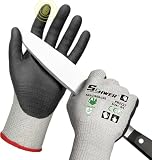
12. Schwer ProGuard A7 – Balanced A7 Protection for HVAC and Automotive Work
Schwer ProGuard A7 Cut Resistant Work Gloves for High Risk Work, PR3727, L
ANSI A7 cut rating
13-gauge knit
Micro-foam nitrile palm
Reinforced thumb crotch
Pros
- A7 cut rating in a light breathable knit
- Micro-foam nitrile grip on wet or oily metal
- Moisture-wicking design for long shifts
- PFAS-free materials
- Machine washable
Cons
- Wrist elastic curls after repeated washes
- Warm during extended wear
- Sizing runs slightly snug
A7 sits just below the ceiling of the cut scale, and this glove is the one I would hand a service technician who does both HVAC and automotive work. The stated applications include metal fabrication, HVAC repairs, automotive assembly lines, glass handling, and precision tasks, which is a fair description of what it actually does well.
It is a 13-gauge knit with a micro-foam nitrile palm, so the balance between protection and feel is closer to the A5 options than to the heavier A9 pairs.
A7 Without the Bulk of an A9 Glove
There is a real difference in feel between A7 and A9 gloves, and it comes down to the fiber content. The A9 designs in this roundup carry more metal wire, which adds both protection and stiffness. If your edges are sharp but predictable, A7 delivers most of the protection with a glove you can pick up a fastener with.
The moisture-wicking design is aimed squarely at technicians who wear gloves for a full shift, and the PFAS-free materials are a reasonable choice for shops moving toward lower-chemistry sourcing.
Machine Washable, With One Weak Spot
Machine washable at a maximum of 160 degrees Fahrenheit with a short tumble dry is the correct care routine for a micro-foam palm, and it keeps the grip texture from flattening across a season of use.
The consistent complaint is the wrist elastic, which users report curling inward after repeated washes. A curling elastic does not reduce cut protection, but it traps sweat and it is the first thing to fail. Sizing also runs slightly snug, so consider sizing up for extended wear.
How to Choose Work Gloves for Handling Metal: Cut Level, Grip, and Cuff
Start With the Metal, Not the Glove
Every rating decision follows from what you are actually moving. Clean rolled sheet and finished stamped parts are forgiving, because the edge is uniform and usually deburred. Plate steel with a torch-cut edge, rebar with lifting lugs, and salvage from a demolition site are not forgiving at all.
Then add the second variable: is the metal hot? The moment you are carrying something that came out of a plasma table, a cut-off saw, or a forge, the decision stops being about cut resistance and becomes about contact heat. No cut-rated knit glove in this roundup is heat-rated, and treating an A9 knit as a welding glove is how people get burned.
ANSI/ISEA 105 and EN 388 in Plain English
ANSI and ISEA 105 is the US cut scale, and it runs A1 through A9 by the weight a circular blade applies before cutting through the glove. A4 is three thousand grams, which is the level most safety guidance names as the general threshold for working with metal. A5 is roughly four thousand grams, A7 is higher still, and A9 is six thousand grams.
EN 388 is the European system and works differently. It reports abrasion, tear, cut, and puncture as separate numbers, and a glove certified EN 388 4544 has the highest rating in each of those four categories. EN 388 cut levels run A through E, and the letter mapping is not a straight conversion from the ANSI scale, so treat a cross-standard comparison as approximate rather than exact.
For a home shop or a small fabrication business, the practical rule is simpler than the standards. A4 for clean sheet and ductwork. A5 for plate and general shop handling. A7 and above for rebar, drop-offs, and salvage where the edge history is unknown.
Cut Resistance Is Not Puncture Resistance: The Splinter Problem
This is the hazard that safety leaflets and competitor guides both gloss over. A cut rating tells you how a blade traveling across the glove behaves. It says nothing about a sharp spike traveling into the glove, and a short piece of sheet metal burr, a broken burr from a drilled hole, or a sliver of cast iron is a puncture event, not a cut event.
The failure is usually a small, deep wound in the fingertip or the web between thumb and finger that bleeds a lot and gets ignored for two days. Nobody on any forum thread can recall a satisfying answer, and the honest one is that no glove on the market stops every metal splinter. What you can do is use a glove with a leather or reinforced palm rather than a thin knit palm, keep the cut-resistant liner intact, and train people not to grab burrs by hand when a glove and a file are right there.
Coatings: Micro-Foam Nitrile, Smooth Nitrile, PU, PVC Dots, Sandy Rubber
Micro-foam nitrile is the most common coating on the gloves in this roundup and the best all-round choice for oily metal. The foam structure wicks oil and moisture away from the contact patch, and it leaves enough tactile feel to pick up a small part.
Smooth nitrile is cheaper and wetter feeling, sandy rubber grips hardest on oily surfaces but reduces fingertip sensitivity, polyurethane is the thinnest coating and prioritizes feel over grip, and PVC dots are the traditional choice that works well and then wears flat. For metal, the ranking is generally micro-foam for assembly and fine work, sandy for heavy oily handling, and PU when you need to feel the edge of a part more than you need to hold it.
Leather Versus Knit: Cowhide, Goatskin, Pigskin, Aramid, HPPE
Full-grain cowhide is the toughest common glove leather and takes abrasion better than any knit, at the cost of heat and weight. Goatskin is thinner and softer and gives up some abrasion resistance for feel. Pigskin is the one tradespeople describe most often as tough, though it is more sensitive to oil than cowhide.
Aramid and HPPE are the knit families. Aramid handles heat and sharp edges well but runs warm. HPPE is lighter, cooler, and now carries most of the cut-resistant market, often blended with glass fiber, spandex, nylon, or newer fibers like tungsten and proprietary yarns.
The practical difference in metal work: leather for dragging, carrying, welding, and anything that lasts; knit for turning fasteners, assembly, sheet handling, and any job where you need to feel what you are holding.
Cuff Style and the Layering Habit Fabricators Use
Cuff choice is the part most buyers skip and most shop injuries reward. A knit wrist stops sweat. An elastic wrist adds a little. A gauntlet or safety cuff covers the forearm, which is what you want for grinding sparks, plasma spatter, and dragging sheet metal.
On forums, the most-repeated practice from working tradespeople is layering: a nitrile-coated cloth glove as the base for grip and oil, with a leather TIG or fabricator glove pulled over the top for welding and grinding. It is a real shop habit, not a hack, because the outer glove takes the heat and sparks while the inner one keeps the oil off your skin. It only works if the base glove is thin enough to fit under the outer one.
Gauge, Fit, and Measuring Your Hand
Knit gloves are rated in gauge, and the number runs opposite to intuition: 13-gauge is chunkier, 18-gauge is thinner and more dexterous. Anything at 18 gauge is assembly territory. Anything at 13 gauge is a general work glove that still cuts well.
For size, measure the width of your palm across the knuckles and compare it to the manufacturer’s chart, and measure your hand at the end of the day when it is larger. A glove that is snug at the start of a shift is tight by the afternoon, and tightness concentrates pressure on exactly the fingertips that a cut would take first. If you are between sizes, our glove fit guide for small hands walks through the measuring step in more detail.
Replacement Rhythm and Total Cost of Ownership
A coated knit glove has a predictable failure curve. The palm coating goes shiny, then slick, then holes. That is the point of replacement, and it arrives long before the fibers fade. Replacing on grip rather than on appearance is the single cheapest safety habit in this article.
Buying three cheap pairs and rotating them beats buying one and machine-washing it hard, because heat and detergent destroy a nitrile coating faster than wear does. Leather gloves invert that logic entirely: they survive far longer and need conditioning rather than replacement, which is why the cowhide pair here is the right call for a shop that keeps gloves for a year.
Which Glove for Which Metal: A Task-Based Guide
Sheet Metal, Flashing, and Stamped Parts
Clean sheet metal is the easiest metal job, and the only real hazard is a burr or a freshly cut edge. A thin A4 knit with a micro-foam palm is the most comfortable way to handle it, because you still need to feel the seam you are feeling up. Toolant ComfyCut A4 and the WORK FORMULA pair fit this work. Move up to an A5 if your sheet comes off a sheared edge that has not been deburred.
Plate, Structural Steel, Rebar, and Rough Bar
Rough material rewards both cut level and reinforcement. The DEX FIT Level 5 and the Radians RWG603 handle plate steel well, the Radians adding waterproofing and EN 388 certification for outdoor work. For rebar and load paths, the Schwer ProGuard A9 gives the highest cut rating in a light knit, and the Schwer Pro Max leather pair wins if you are moving the same sections repeatedly.
Oily Engine and Powertrain Parts
Oil is a grip problem before it is a cut problem, and a failed grip causes the crush injury that follows a dropped sump. Micro-foam and sandy nitrile palms both handle oil; the MAGID D-ROC with VersaTek is the pick when you want the best grip with no itching fibers, and the toolant ComfyCut A4 is the right choice when you also need fingertip feel for connectors and fasteners.
Hot, Freshly Cut Metal and Welding Support Hands
For the support hand on a welding or plasma operation, cut-rated knit gloves are the wrong tool. A TIG or fabricator leather glove with a gauntlet cuff is the correct answer, and a safety-rated leather sleeve covers the arm. If you cannot fit a second glove over your work glove, the work glove is too thick. The liner gauge matters here more than the cut level.
Scrap, Salvage, and Demolition
Salvage means unknown edge geometry, which is the one case where the top of the cut scale is justified. The Schwer ProGuard A9 and the COOLJOB A9 both serve, and the Ironclad Command Impact 360 earns its place because the TPR overlays take the knuckle impacts that come with prying material out of a pile. A full-grain leather outer is worth adding when the material includes sheet metal that will be dragged rather than lifted.
Glove Care, Lifespan, and When to Replace Your Gloves
Coated knits: machine wash in warm water, air dry or tumble dry low, and never dry them on a radiator or in direct sun. Heat is what kills a nitrile coating. The DEX FIT, toolant, Ironclad, MAGID, and Radians pairs all have specific care instructions, and the Radians glove in particular is hand wash only.
Leather gloves: hand wash with mild soap and warm water, air dry away from heat, and condition periodically with a leather conditioner. Never use solvent to strip oil out of cowhide, because the finish goes stiff and cracks within a few shifts. Never put leather in a washing machine.
The sign to replace a coated knit is a palm that has gone shiny and slippery, a coating separating at the cuff, or any hole in the cut-resistant layer. The sign to replace a leather glove is a worn-through palm, a split seam at the thumb, or an exposed cut-resistant liner, which means the leather has gone but the safety layer beneath it has worn through too.
Store them away from direct heat and out of sunlight, and do not compress knit gloves in a tool bag, because a crease that goes through the coating is a crease that traps grit against your palm.
Frequently Asked Questions
What type of gloves are best for working with metal?
Cut-resistant gloves rated ANSI A4 or higher with a coated or leather palm are the best general choice for metal work. A4 suits clean sheet metal and stamped parts, A5 handles plate steel, and A7 or above covers rebar and unknown salvage. Add a micro-foam or sandy nitrile palm for oily parts, a reinforced thumb for prying, and a gauntlet cuff if you will be near grinding sparks. None of these protect against heat, so add a welding-rated leather glove for hot metal.
What are the best gloves for handling sheet metal?
Thin A4 or A5 knit gloves with a micro-foam nitrile palm are the best gloves for handling sheet metal. Thinness matters because you still need to feel a seam, a burr, and a fastener while fitting the panel. The DEX FIT Level 5 and toolant ComfyCut A4 are both strong picks, and both are machine washable so the coating keeps its grip. Step up to an A5 or above if the edges are torch-cut or not deburred.
What gloves should be worn when working with sharp edges?
Wear gloves rated ANSI A4 or higher, and higher for rough or rusty edges, with a leather or reinforced palm rather than a thin knit palm. Cut ratings measure a blade sliding across the glove, so choose a glove that also resists abrasion and impact where you will be prying material. Keep the cut-resistant liner intact, replace gloves the moment the coating wears through, and treat any splinter wound on the hand as a reason to see someone.
Are welding gloves the same as heat resistant gloves?
They are not the same, and the difference matters. Heat-resistant gloves are rated for a maximum contact temperature for handling hot or glowing material. Welding gloves are built for welding specifically, with heavier insulation, a gauntlet cuff, and stitch thread that resists sparks and spatter. A heat-resistant glove with no gauntlet cuff can be entirely appropriate for picking up a cut-off piece, while a welding glove may be too bulky for precision handling.
Do cut-resistant gloves protect against metal splinters?
Not reliably. A cut rating measures a blade traveling across the surface, not a sharp fragment driving into the glove, so a splinter or burr can still penetrate a high-rated knit. Reduce the risk by choosing a glove with a leather or reinforced palm, keeping the cut-resistant liner intact, and never grabbing a burr by hand. If you work around swarf or broken burrs regularly, impact-rated gloves with knuckle protection are the better option.
How do I choose the right size of cut-resistant glove?
Measure the width of your palm across the knuckles and compare it with the manufacturer size chart, then measure again at the end of a day because hands swell. If you are between sizes, size up: a glove that is snug at the start of a shift is tight by the afternoon, and pressure concentrates on the fingertips a cut would take first. Knit gloves also differ in gauge, where 13-gauge is chunkier and 18-gauge is thinner and more dexterous.
The Best Work Gloves for Handling Metal in 2026
There is no single best glove for handling metal, because metal arrives in forms that punish different parts of the hand. The way through is to name the hazard first and let the rating follow.
If you move clean sheet metal, duct, and finished stamped parts, take a thin A4 or A5 knit with a micro-foam palm and pick the toolant ComfyCut A4 or the DEX FIT Level 5. If you handle plate, rebar, and salvage with edges you cannot predict, take the highest rating you can wear all day, which is the Schwer ProGuard A9, and add the Ironclad Command Impact 360 when prying and knocking parts loose is part of the job. If your metal is oily and your hands are in a mechanic bay, the MAGID D-ROC or the Ironclad pair keep the part in your hand. If you need one glove that survives being dragged across rough steel for a year, the Schwer Pro Max cowhide pair is the only leather option here and it earns its place.
If the metal is hot, stop reading the cut rating and pick up a welding-rated leather glove with a gauntlet cuff, layered over a thin nitrile base glove if you need the grip. None of the twelve gloves here will keep you safe from a freshly cut plate, and pretending otherwise is the most expensive mistake in this guide.
Whichever one you choose, buy the size up, buy two so you can rotate while one washes, and replace the pair the moment the palm stops gripping rather than when it looks tired. That habit is worth more than any label on the tag.
Leave a Reply