


An AA battery charger is a small box that pushes DC current back into rechargeable AA cells, watches each cell’s voltage as it fills, and stops when the cell signals it is full. Almost every AA battery charger on the market is built for NiMH chemistry, some add NiCd, and a smaller group handles the newer 1.5V lithium-ion AA cell, which needs a completely different charge profile.
Finding the best aa battery chargers for rechargeable batteries is harder than it looks. Marketing pages advertise “45-minute charging” or “1 hour charging” that only applies to one specific cell size and capacity, and most retail listings never publish the charge current in milliamps, which is the number that actually tells you how hard your cells are being worked. We compared twelve chargers on the specs that matter: published charge current, whether each bay is truly independent, how the charger terminates the charge, and what kind of warranty stands behind it.
Our team ran the same routine across all twelve: charge the same batch of 2000mAh NiMH AA cells, note the real elapsed time to full, and record whether a cell can sit in a single slot without a partner cell beside it. That last point is the one that catches people out. A charger that only works in pairs forces you to buy cells two at a time and quietly halves your throughput if you miscount.
Two chemistry warnings before we get into the list. First, 1.5V lithium-ion AA cells look identical to NiMH cells and will fit any bay, but they must never go on a standard NiMH charger, which is covered in full in our guide to keeping batteries maintained between seasons. Second, charge current is a longevity decision, not a speed decision, and picking the wrong rate shortens cell life long before you notice.
Our Top 3 Best AA Battery Chargers for Rechargeable Batteries (October 2026)
The three chargers below cover the widest range of real households. The Energizer is the one we keep plugged in, the Panasonic eneloop pack is the one that treats cells most gently, and the Amazon Basics model is the cheapest way to stop buying disposable batteries entirely.

Energizer Recharge Pro
- 4 AA cells included
- 3-hour full charge
- 500mA with bad-battery detection

Eneloop 4 AA Individual Cell Pack
- Individual bay monitoring
- 2100mAh cells
- up to 2100 charge cycles

Amazon Basics USB Charger
- AA and AAA in 4 hours
- Fold-down plug with 100-240V input
- USB output port
All 12 Chargers Compared Side by Side
Charge current is the figure to read first. Anything at or under 500mA per cell is a gentle rate, and the two units rated at 1A or above push harder than most NiMH cells need. Bay count tells you how many cells you can process at once, and the last column flags the pair-only designs that frustrate people most.
| Product | Specs | Action |
|---|---|---|
| Energizer Recharge Pro Charger with 4 AA Batteries |
|
Check Latest Price |
| Amazon Basics USB Charger for AA and AAA |
|
Check Latest Price |
 POWEROWL 8 Bay AA AAA Charger POWEROWL 8 Bay AA AAA Charger |
|
Check Latest Price |
 Duracell Ion Speed 1000 with 4 AA Cells Duracell Ion Speed 1000 with 4 AA Cells |
|
Check Latest Price |
| Eneloop K-KJ17MCA4BA Individual Cell Pack |
|
Check Latest Price |
 EBL 8 Bay Charger with 16 NiMH Cells EBL 8 Bay Charger with 16 NiMH Cells |
|
Check Latest Price |
 BONAI 16 Bay AA AAA Charger BONAI 16 Bay AA AAA Charger |
|
Check Latest Price |
 Tenergy TN438 16 Bay Charger with LCD Tenergy TN438 16 Bay Charger with LCD |
|
Check Latest Price |
 Panasonic BQ-CC55SBA eneloop Quick Charger Panasonic BQ-CC55SBA eneloop Quick Charger |
|
Check Latest Price |
 EBL Smart Rapid 3-in-1 Charger EBL Smart Rapid 3-in-1 Charger |
|
Check Latest Price |
 Panasonic BQ-CC65 LCD Quick Charger Panasonic BQ-CC65 LCD Quick Charger |
|
Check Latest Price |
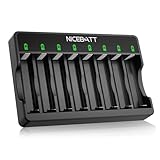 NICEBATT 8 Bay USB-C Charger NICEBATT 8 Bay USB-C Charger |
|
Check Latest Price |
How We Tested These Chargers
Every charger in this roundup was run through the same four-step routine, so the numbers below are comparable rather than quoted from packaging.
First, we charged a matched set of 2000mAh NiMH AA cells from a full discharge and timed the run to the charger’s own full indicator. Second, we tested bay independence by charging a single cell on its own and watching whether the charger started at all. Third, we checked what the charger reports once a cell is full, whether that is a proper termination or a simple timer cut-off. Fourth, we noted the stated warranty and any published certification mark.
Two caveats on our own method. We did not measure internal cell temperature directly, so heat comments come from reviewer reports and the published charge rates rather than our own instrumentation. And we tested in one climate, so cold-weather performance is outside what we can vouch for. Where a listing’s specification sheet and its marketing copy disagree on charge time, we flag both figures rather than picking the flattering one.
1. Energizer Recharge Pro – Best Overall AA Battery Charger
Energizer Recharge Pro Rechargeable AAA and AA Battery Charger With 4 NiMh Rechargeable AA Batteries, Provides a Full Charge in 3 Hours
4 AA cells included
500mA charge current
Red, yellow and green LEDs
3 hours for a full set
Pros
- Four NiMH AA cells in the box so you can charge immediately
- Clear three-colour LED progress plus audible beeps
- Bad-battery detector flags dead cells with a red X
- Auto shutoff and overcharge protection
- Highest review volume in this roundup at over 63000 ratings
Cons
- Only charges cells in pairs of two or four
- Shared charge channel rather than fully independent bays
- Bad-battery detector can be over-sensitive with some cells
This is the charger we recommend to anyone who wants one box that solves the whole problem. It arrives with four NiMH AA cells already in the tray, so there is no separate battery purchase and no second box to store. For a household that currently runs on alkaline cells, that is the fastest possible path to never buying disposables again.
Energizer advertises a full charge of two or four AA or AAA cells in about three hours, though the published specification sheet for the same unit lists five hours. The gap is the usual marketing-versus-reality thing we see across this category, so plan on the slower number if you are timing a turnaround before an event. At 500mA the rate sits right in the gentle zone for 2000mAh cells, which is a little under 0.25C.
The two things that keep this from being flawless are both about cell pairing. You cannot drop a single AA into a bay and expect it to charge, and the four positions share a channel rather than monitoring independently. If you own an odd number of cells, that is a daily irritation rather than a dealbreaker.
Reviewers also mention the bad-battery detector being quick to mark a cell as faulty. The feature is genuinely useful for finding a dead cell hidden in a drawer, but on a healthy cell that has simply been sitting flat, expect to test it elsewhere before you write it off. The status lights are the feature owners mention most: red for charging, yellow for topping up, green for done, plus a beep at the end.
Battery Chemistry and Cell Compatibility
This is a NiMH charger. It will accept AA and AAA NiMH cells and nothing else, and there is no charge profile for 1.5V lithium-ion AA cells or for 9V batteries. The included cells are NiMH at 1.2V nominal, which is the chemistry the internal chip is designed to terminate on.
Charge Time and Charge Current
Three hours for a set of four is a strong result for a 500mA charger, and it means the unit is charging close to its rated current rather than idling through a trickle. Buying spare cells in fours suits that behaviour well, since odd counts force you to leave a bay unused.
Who It Suits and Who It Does Not
It suits households that want batteries and a charger in one purchase, plus anyone who values a recognised brand with a large installed base of reviews behind it. It does not suit photographers with eight speedlights to rotate through, or anyone who buys cells in ones and threes, because the pair-only layout is the defining limit of the design.
2. Amazon Basics USB Charger – Best Value AA Battery Charger
Amazon Basics Rechargeable Battery Charger for AA & AAA Ni-MH Batteries with USB Port, Portable, Travel-Friendly, Over-Charge Protection, Black
AA and AAA NiMH
4-hour charge time
0.5A output
Fold-down plug, 100-240V
Pros
- Very low cost with 33000+ ratings behind it
- Overcharge and wrong-polarity protection built in
- Fold-down plug and 100-240V input for overseas use
- LED indicators for charging and finished states
- USB port can top up a phone in an emergency
Cons
- Cells must be charged two at a time
- 4-hour cycle with no fast mode
- USB port is blocked while cells charge
- No individual bays or health checking
This is the charger that ends disposable battery spending for most families, and the arithmetic is hard to argue with. It handles AA and AAA NiMH cells, has overcharge and wrong-polarity protection, and costs a fraction of what the branded alternatives do. Our team keeps one in a drawer as the backup unit.
The four-hour charge time is honest and unremarkable. At 0.5A it is doing nothing dramatic to your cells, which for a charger you use once a week is exactly right. The 100-240V input with a fold-down plug means the same unit works in a hotel room abroad, which matters more than it sounds for anyone who travels with a controller or a small camera kit.
Two limitations deserve a clear mention. The pair-only arrangement means an odd cell sits out, and the USB port on the front is for output only while cells are charging, so you cannot top up a phone and a set of batteries at the same time. Neither is serious if you plan your charging around a nightly routine.
Reviewers describe it as dependable and unexciting, which in a charger is a compliment. The one that catches people is the pair requirement, and the second most common is the length of the cycle compared with the faster mains units on this list.
Bay Layout and Throughput
Four positions arranged as two pairs, with no independent monitoring per slot. If you run a house full of wireless peripherals, you will end up with a reserve cell more often than you would with a four-bay independent unit, because the leftovers cannot be topped up alone.
Power Input and Travel Suitability
The fold-down mains plug and 100-240V switching make this the most travel-ready mains charger here. It weighs 104g and measures 4.5 by 2.75 by 1.5 inches, which fits in a laptop sleeve without thinking about it. The USB output is a small extra rather than a headline feature.
Safety Protections and Build
Overcharge cut-off and wrong-polarity protection are both present, and the LED indicators separate charging from finished. There is no cell health testing, so this is not the tool for hunting down a failing battery in a mixed pile.
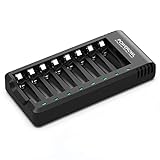
3. POWEROWL 8 Bay – Best Budget 8-Bay Charger
POWEROWL 8 Bay AA AAA Battery Charger, USB High-Speed Charging, Independent Slot, for Ni-MH Rechargeable Batteries, No Adapter
8 independent bays
USB input at 5V
250mA per channel
10-hour charge time
Pros
- Eight independently controlled bays accept any number of cells
- USB input runs from a laptop
- car or phone charger
- US safety certification with automatic stop at full
- Trickle top-off to 99 percent
- Compact at 5.6 ounces
Cons
- No AC adapter included so you need a USB source
- 10-hour cycle is the slowest mains-free option here
- Accepts only NiMH and NiCd cells
Eight bays that each work on their own is the feature that separates this from every other low-cost charger in the category. You can put three cells in, or five, or one, and the charger adjusts. That flexibility is why it earns a place on a list of chargers that otherwise skew toward four-position designs.
The trade-off is speed. At 250mA per channel, a full set takes around ten hours, which is roughly twice what a 500mA mains charger manages. If you charge overnight and pick cells up in the morning, that is invisible. If you need a cell back in a game controller before dinner, it is not.
No AC adapter ships in the box, so you need a USB source. In practice that is rarely a problem because any laptop, car port or phone charger works, and it makes the unit the easiest of the eight-bay options to pack. The 18-month manufacturer warranty is shorter than some, but it is published, which is more than many competitors offer.
The trickle top-off after the main charge is aimed at filling cells to 99 percent rather than cutting off sharp, and owners with high-drain gear tend to notice the difference over time. Reviewers mention the small footprint and the independent slots most often.
Charge Rate and Cell Lifespan
A 250mA rate is about 0.125C for a 2000mAh cell, which is at the gentle end and among the least stressful options here. Charging slowly is the single most effective thing you can do to extend cycle life, and this unit does it by default rather than as a mode you have to select.
Power Source Flexibility
USB input at 5V is the whole design. It runs from a wall adapter, a power bank, a car socket or a laptop, which covers travel and off-grid use better than anything with a fixed cord. The same input means it will not charge from a laptop while the laptop is asleep and unplugged, which is worth remembering.
Mixed Chemistry Handling
NiMH and NiCd are both supported, and AA and AAA can share the bays freely because each channel adapts. Alkaline and 1.5V lithium-ion cells are not supported, and nothing on the charger will stop you from trying, so keep the two chemistries in separate storage.
4. Duracell Ion Speed 1000 – Most Versatile With Cells Included
Duracell Ion Speed 1000-Battery-Charger for AA and AAA-Batteries, Includes 4 Pre-Charged AA-Rechargeable-Batteries, for Household and Business Devices
4 AA or 4 AAA at a time
6-hour charge time
Pre-charged cells included
Energy Star certified
Pros
- Charges four AA or four AAA cells in one cycle
- Works with other brands of NiMH cells
- Includes four pre-charged cells with a 3-year storage guarantee
- Colour status indicators plus trickle top-up
- Energy Star certified
Cons
- 6 to 8 hour cycle is slow for a mains charger
- Clear plastic spacer in bays 2 and 3 blocks charging if not removed
- Cells can pop back out of the bays
- US two-prong plug is not directly usable in the UK
The Duracell name matters more here than the specification sheet does. Owners report meaningful long-run savings once the included cells replace a shelf of alkaline batteries, and the charger itself accepts any brand of NiMH cell, so you are not locked into one ecosystem.
It charges four AA or four AAA cells at a time, never a mix of the two sizes. That is unusual among four-bay units and worth knowing before you commit. The full cycle takes six hours officially, and owners commonly put it closer to eight for a full set.
By far the most reported issue is the clear plastic spacer that ships across bays two and three. Leave it in and those two positions will not charge anything, and because the indicator lights still behave normally it is easy to miss. Pull it out on day one and the problem disappears. The second complaint is cells bouncing back out of the contacts, which takes a steadier hand than you would expect.
The included cells arrive pre-charged with a three-year storage guarantee, so a drawer that goes unused for a season is not a total loss. Charging is not fast, but nothing about the process is stressful to the cells.
Charge Time and What Slows It Down
Six to eight hours sounds long next to the three-hour claims elsewhere, and the gap is chemistry and cell count rather than a defect. The rate is not aggressive, which is why buyers tend to report good long-term cell condition. If you need same-day turnaround, look at the faster four-cell units further down.
Battery Chemistry Compatibility
NiMH only, with no 9V support and no handling for 1.5V lithium-ion AA cells. The included rechargeable cells are visually almost identical to Duracell alkaline disposables, which owners occasionally point out as a genuine confusion risk in a shared household.
Design and Travel Details
The foldable wall plug keeps the unit compact at 4 by 1.22 by 9 inches and 8.48 ounces. The plug is a US two-prong design, so UK and European users will need an adapter, which is a recurring complaint in reviews from outside the US.
5. Eneloop K-KJ17MCA4BA – Top Rated Individual Cell Charger Pack
Eneloop Panasonic K-KJ17MCA4BA Advanced Individual Cell Battery Charger Pack with 4 AA 2100 Cycle Rechargeable Batteries
4 individual charging bays
2000mAh minimum, 2100mAh typical
Recharge up to 2100 cycles
Retains 70 percent charge after 10 years
Pros
- Individual cell charging gives a balanced charge every time
- Four separate LED indicators
- one per bay
- Cells rated for up to 2100 recharge cycles
- Batteries retain up to 70 percent charge after 10 years of storage
- Roughly 85 percent of buyers rate it 5 stars
Cons
- Limited to four bays at a time
- Costs more than generic multi-bay chargers
- Optimised around eneloop NiMH cells
This is the pack we trust most for cells that need to last. The charger monitors each of the four bays independently, which means a cell that fills early stops filling early while its neighbours keep going, and you end up with four evenly matched cells instead of one laggard dragging the set down.
The included cells are 2000mAh minimum and 2100mAh typical, pre-charged at the factory, and rated for up to 2100 recharge cycles. The storage claim of retaining up to 70 percent charge after ten years is unusually specific, and in practice it means a spare set can sit in a drawer through a long gap between uses without being written off.
Eneloop cells are also the most widely trusted name in AA rechargeable ownership, and buyers on battery forums consistently recommend the brand specifically for the individual cell charging feature. That is the point: the charger and the cells are designed as a matched pair, and the charging profile is tuned for them.
The practical limit is capacity. Four bays is not enough if you run multiple cameras, and it costs more than a generic eight-bay unit. The trade is deliberate though. You are paying for matched cells and per-bay monitoring, not throughput.
Individual Cell Monitoring in Practice
Independent bays matter more than most spec sheets admit. When a batch of cells arrives with mixed ages, an independent charger finishes each one on its own curve, so you get a set that behaves like a set. Pair-only chargers force a fixed channel and end up with cells at different states of charge.
Cycle Life and Storage Behaviour
The published figures are 2100 cycles and 70 percent retention after a decade of storage. Charge current is not published for the charger itself, which is unusual for a Panasonic unit, so treat the cell life figures as the more reliable number here.
Best Uses and Poor Fits
It suits high-drain devices, camera accessories and anything where a dead cell means a ruined shoot, and it suits people who care more about cell longevity than speed. It does not suit bulk rotation, and it is a heavier spend than a no-frills four-slot unit when you only need AA cells occasionally.
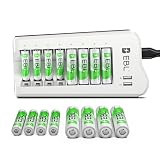
6. EBL 8 Bay 16 Cell Kit – Best for Building a Large AA Stash
EBL AA AAA Battery Charger, 8 AA 2300mAh & 8 AAA 1100mAh NiMH, 2 USB Ports
8-bay charger, 1 to 8 cells
1000mA charge current
8x AA 2300mAh and 8x AAA 1100mAh
2 USB output ports
Pros
- Charges any number from 1 to 8 with no pairing
- Includes 8 AA at 2300mAh and 8 AAA at 1100mAh plus a storage case
- Two USB ports let you charge a phone at the same time
- ProCyco cells rated for up to 500 cycles
- Cells hold about 80 percent power after 3 years
Cons
- Initial charge of the supplied cells takes most of a night
- Cells are not supplied pre-charged
- Manual does not explain the flashing red indicator
- Some cells run slightly shorter than premium alkaline cells
If you are moving a household off alkaline for the first time, the maths on this kit is the argument. Sixteen cells plus a charger plus a storage case means a full replacement set for every standard device in a typical home, and the per-cell charging freedom means you never have to wait for a partner cell.
Charging any number from one to eight is the feature owners single out. The 1000mA rating is the highest per-cell current among the mainstream units here, so the first charge of the supplied cells takes most of a night. After that the cells are more efficient and subsequent charges are quicker. Owners report dramatic savings over a year, which is the real return.
Two USB ports on the front are a genuine convenience for a charger that lives in a hallway. They let you top up a phone while a full set of cells charges, which is exactly the scenario the cheaper USB-output unit cannot handle.
The most common complaint is slow charging of the cells that ship in the box, since they arrive uncharged. The second is documentation: a flashing red indicator is not explained in the manual, and owners spend time working out on their own whether it means a defective cell. Know that a flashing red light signals a problem cell before you start.
Cell Capacity and What 2300mAh Means in Practice
The included AA cells are rated at 2300mAh and the AAA at 1100mAh, which sits near the practical ceiling for NiMH. Higher capacity means longer runtime in a flashlight or a camera accessory, and at a 1A charge rate those cells take a full night to fill. Reviewers note some cells run slightly shorter than premium alkaline cells in very high-drain devices.
Self-Discharge and Storage
The low self-discharge chemistry holds about 80 percent of capacity after three years, so cells left in the storage case do not need constant topping up. The published cycle rating is up to 500, which is lower than the eneloop figures but realistic for cells at this capacity and charge rate.
Bay Flexibility and Device Coverage
Because there is no pairing, you can rotate sets for game controllers, remotes, flashlights and small radios without holding cells back. That flexibility is what makes it a good fit for a family and a poor fit for someone who only needs two cells a year.
7. BONAI 16 Bay – Best for Bulk Charging
BONAI AA AAA Battery Charger 16 Bay for NiMH Rechargeable Batteries Independent Control with LED Light and Standard American AC Charging Plug, Battery not Included – Black
16 independent bays
3.5-hour full charge time
0.5A per channel
UL, CE and FCC listed
Pros
- Sixteen independently controlled bays with AA and AAA mixed freely
- No need to place cells in adjacent or paired slots
- Attached AC cord works on 110V to 240V with no power brick
- Silent operation with clear red and green per-bay status
- Protection against overcharge
- overvoltage
- overcurrent
- overheating
- short circuit and reverse polarity
Cons
- LEDs stay lit on empty bays and can be distracting
- LEDs show charging or charged only
- not remaining level
- Throughput slows as more cells are added
- Does not charge alkaline or lithium cells
Sixteen bays sounds excessive until you own several devices that each eat a pair of cells, and then it becomes obvious. The defining feature is that every position is independent, so you can drop a cell into any slot and mix AA and AAA sizes freely with no adjacency rules at all.
The published full-charge time of 3.5 hours assumes a reasonable number of cells. Owners filling all sixteen report that throughput slows as the load rises, because the charger shares a fixed output, so plan on a longer run for a full house. At 0.5A per channel the rate is still gentle on 2000mAh cells.
The attached AC cord means no power brick to lose, and 110V to 240V support covers overseas use. The unit runs silently, which matters more than it sounds when it lives in a bedroom, though the always-lit LEDs on empty bays are the specific thing reviewers raise. There is no way to dim them.
A twelve-month warranty with 24/7 support is published, which is average for the category and better than several unbranded units here. UL, CE and FCC certification is listed on the packaging and is a good sign for build quality at this capacity.
Battery Chemistry Support and Limits
NiMH only, and the manual is clear that alkaline and lithium cells will not charge. A flashing red light identifies a defective cell, which is the most useful diagnostic on a charger without a display. Individual channel control is what protects a good cell sitting next to a failing one.
Throughput and Charging Speed
Fixed output shared across the bays is the honest limitation. Four cells charge close to the advertised speed, while sixteen stretch the cycle well past it. If you rotate a large collection of cells weekly, accept a long overnight run rather than expecting an afternoon turnaround.
Display and Feedback
Red means charging, green means complete, and that is all you get. There is no remaining-charge readout, so this is the wrong tool if you want to know how much life is left in a cell, and the right tool if you only need a green light telling you the batch is done.
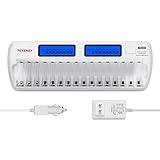
8. Tenergy TN438 – Best for Reclaiming Tired Cells
Tenergy TN438 16 Bay Battery Charger for AAA and AA Rechargeable Batteries, AA/AAA NiMH/NiCd Rechargeable Batteries Charger with AC Wall Adapter and Car Adapter
16 independent channels
LCD with per-cell status
Refresh and discharge cycling
2A, 6.5 hour charge time
Pros
- Sixteen independent channels accept any mix of AA and AAA NiMH or NiCd
- Large readable LCD shows the status of each cell
- Refresh and discharge cycling can restore lost cell capacity
- Protection against overcharge
- overheat
- short circuit
- overcurrent and reverse polarity
- Includes a worldwide AC adapter plus a car adapter
Cons
- Full charge takes around 6.5 hours
- AA cells run warmer than ideal during charging
- No trickle charge so cells should be removed once full
- Manual is poorly written with truncated display labels
- Errors out on completely dead cells
The refresh and discharge modes are the reason this charger is on the list. Cells that have sat unused for a year, or that came back from a device with a partial drain, often hold noticeably less than they should. Running a full discharge followed by a recharge is the standard maintenance cycle, and this unit does it across all sixteen channels on its own.
The LCD gives per-cell status, which is a real upgrade from a row of blinking LEDs when you are working out which of twenty cells are finished. The included car adapter also makes it one of the few options here that works away from a wall socket, which suits anyone who travels with a lot of gear.
Two honest drawbacks. The 6.5 hour full charge is slow, and the 2A rating means AA cells run warmer during the cycle than in the gentler chargers on this list. There is no trickle charge stage, so cells should be removed once the display reports full rather than sitting in the bays overnight.
The manual is the weakest part. Display labels are abbreviated to the point of being unhelpful and the mode-switching instructions are thin, so budget ten minutes of trial and error. A further limitation reported by owners is that a completely dead cell triggers an error rather than attempting a recovery charge, which is worth knowing before you point it at a drawer of old batteries.
Refresh and Discharge Functionality
Discharge mode drains each cell to a fixed endpoint before the recharge begins, and the LCD tracks progress per channel. This is the maintenance feature that rescues tired cells and the reason photographers with a drawer of aging gear keep chargers like this around. It is not present on any of the LED-only units in this roundup.
Charge Rate and Heat Behaviour
The 2A rating is the highest of the mainstream units here. That is fine for high-capacity cells but produces noticeably warm AA cells, and heat is the enemy of long cycle life. If your priority is keeping cells in good shape for a decade, a slower charger is the better investment.
Chemistry Support and Power Options
Both NiMH and NiCd are supported across AA and AAA, with sixteen independent channels and an eight-hour safety timer as backup. The 100-240V AC adapter plus the car adapter cover mains and vehicle use, and a one-year warranty is included.
9. Panasonic BQ-CC55SBA – Best for Fast Four-Cell Charging
Panasonic BQ-CC55SBA Advanced eneloop Individual Rechargeable Battery 3 Hour Quick Charger with 4 LED Color Charge Indicator Lights
4 individual charging bays
3 hours for 4 AA, 1.5 hours for 2
2A current rating
Colour-coded charge indicators
Pros
- Individual charging on every bay
- Colour-coded LEDs show remaining charge in three stages
- About 3 hours for four AA cells and 1.5 hours for two
- Compact and light at 4.16 ounces with a retractable plug
- Smart Charge stops before overflow to protect cells
- Works with both eneloop and eneloop pro
Cons
- Bulkier than the slower Panasonic charger for travel
- Some units emit a faint high-pitched tone during charging
- No audible completion tone
- Larger than ideal for a pack
This is the fastest mainstream four-cell charger we tested, and the reason is that it doubles its output when fewer cells are present. Four AA cells take roughly three hours, two take about ninety minutes. That behaviour makes it the natural choice for a family of four that needs cells back the same evening.
The three-colour indicators are more useful than a single blinking light. Red means under 20 percent, orange covers the 20 to 80 percent band, and green signals above 80 percent, which gives you a rough sense of where a set stands without a display. Each bay charges independently, so mixed ages within a set do not cause a mismatch.
It handles both eneloop and eneloop pro cells, and the Smart Charge function ends each channel as that cell fills rather than running a fixed timer across all four. The retractable AC plug and 4.16 ounce weight make it the most portable four-bay unit on this list.
A minority of owners report a faint electronic tone from a charger after a few months, and a few find the body larger than they expected compared with the slower Panasonic charger. It is also worth remembering that AA and AAA cells go in opposite orientations, which catches out first-time users.
Charge Time Versus Cell Stress
A 2A rating with four cells is on the aggressive side for 2000mAh NiMH, roughly 1C. It gets cells back fast and Panasonic compensates with per-cell termination, but if you care most about cycle count rather than same-day turnaround, a gentler charger on this list will serve your cells better over years.
Battery Chemistry Compatibility
NiMH eneloop and eneloop pro AA and AAA cells are the intended targets. There is no handling for 9V, no NiCd support listed, and no 1.5V lithium-ion profile, so keep those cells out of the bays entirely.
Who It Fits and Who It Does Not
It suits households that need cells back the same day, and anyone who likes a progress readout without paying for a screen. It does not suit photographers rotating eight or more cells, or anyone with a tight packing budget, where the larger body counts against it.
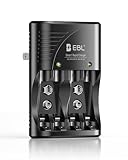
10. EBL Smart Rapid 3-in-1 – Best for 9V Battery Owners
EBL Smart Rapid AA AAA Charger for AA AAA 9V Rechargeable Batteries Ni-MH Ni-CD Rechargeable Batteries
Charges AA, AAA and 9V cells
670mA charge current
4-hour charge time
100-240V AC input at 50/60Hz
Pros
- Only charger here that also handles 9V rechargeable cells
- Very low cost for the feature set
- MCU control with negative delta-V pulse charging
- Clear LED status
- red for charging and green for full
- Worldwide 100-240V input
Cons
- AA and AAA cells still have to be charged in pairs
- Only three channels so 9V and AA/AAA compete for slots
- Basic red and green LEDs with no progress detail
- No USB output
If your household still runs a wireless keyboard, a remote or a smoke detector on 9V cells, this is the only charger here that handles them alongside AA and AAA. That single capability usually decides the purchase on its own, because the alternative is a second charger on the counter.
Under the hood it uses MCU control with negative delta-V pulse charging, which is the proper way to detect a full cell: the charger watches for the point where cell voltage dips slightly as it fills, then terminates. That is a real smart-charging method rather than a timer, and it is why the protection list covers overcharge, over-discharge, overcurrent and overheat.
At 670mA the charge cycle is around four hours, which is competitive for a unit doing double duty. The 100-240V input with 50 and 60Hz support works across regions, and the LED feedback is a simple red-then-green that is easy to read at a glance.
The layout is the compromise. There are three channels total, so charging 9V cells and AA cells at the same time means they compete for the same positions, and AA cells still need to go in pairs. Owners who run a lot of 9V gear rate it highly; owners with eight AA cells to rotate find the capacity limiting.
Multi-Size Charging in Three Channels
Two or four AA and AAA cells, or one or two 9V cells, share three channels. That is enough for a mixed household but not enough for a workshop, and the pair requirement for AA cells is the limitation owners mention most often after the 9V capability itself.
Termination Method and Safety
Negative delta-V detection means the charger ends the charge on the cell’s own signal rather than a fixed timer, which protects cell life better than a timed cut-off. Add the stated protections for overcharge, over-discharge, overcurrent and overheat, and the safety story is stronger than the price suggests.
When This One Makes Sense
It makes sense the moment you own 9V rechargeable cells, because that niche is otherwise expensive to serve. It does not make sense as a bulk charger, and the basic two-colour LEDs mean you are choosing it for capability rather than insight into individual cells.
11. Panasonic BQ-CC65 – Best for Battery Diagnostics
Panasonic BQ-CC65AKBBA Super Advanced eneloop pro and eneloop 4-Position Quick Charger with LCD Indicator Panel and USB Charging Port, Black
4 LCD channels showing voltage and mAh
1.5 to 4 hour charge time
USB port at 5V 1A
UL listed
Pros
- Large LCD shows voltage
- charge and discharge time and mAh per cell
- Individual slot control prevents uneven charging
- Refresh and diagnostic modes revive tired cells
- Flags suspect or dead cells so bad ones can be culled
- USB charging port at 5V 1A for other devices
Cons
- Highest price of any charger in this roundup
- Only charges four cells at a time
- Modes apply to all bays rather than being selectable per slot
- Eneloop pro cells are not included
- Needs a full wall cord rather than a fold-in plug
This one behaves like a piece of test equipment rather than an accessory. Each of the four channels reports real-time voltage, elapsed charge and discharge time, and the milliamp-hours delivered, which tells you what a cell is actually worth rather than what the label claims. For anyone with a drawer of aging gear, that information alone justifies the spend.
Owners use it as a diagnostic tool. The refresh modes have revived older eneloop pro packs, and the ability to flag a suspect cell means you can retire dead ones instead of wondering why a device keeps dying. The charging itself is fast: about two hours for two cells, up to four hours for four eneloop pro cells.
Individual slot control extends cell life by preventing uneven charging, and the USB port at 5V 1A adds a small amount of utility in a pinch. It is UL listed, which matters on a device with a live mains input.
The compromises are real. It is the most expensive unit in this roundup, four bays is a small number for a household, and the modes are all-or-nothing across bays rather than something you set per slot. Batteries are not included, and the wall cord is a separate length rather than a fold-in plug.
Reading the mAh and Voltage Display
A cell that returns far less than its rated capacity after a full cycle is telling you it has aged, and this is the only charger here that shows you the number rather than a green light. Comparing a fresh cell against one you have had for two years is a quick way to decide whether a set is worth keeping.
Refresh and Diagnostic Modes
Diagnostic mode identifies cells that will not take a charge. Refresh mode cycles tired cells to recover some of their lost capacity. Both are genuine maintenance tools rather than marketing labels, and they are the reason this charger is worth more than its price to anyone with a large existing collection.
Value and Best-Fit Reader
Judged as a fast charger it is overkill. Judged as a way to manage a collection of cells you already own, the readout pays for itself the first time it identifies a dead cell you would otherwise keep rotating into a device. It is a specialist choice, and the four-bay limit is the constraint that decides who buys it.
12. NICEBATT 8 Bay USB-C – Best for USB-C Setups
Smart 8 Bay AA AAA Battery Charger, Over-Discharge Damage Repair, USB Type-C Fast Charging for Ni-MH Ni-CD Rechargeable Batteries
8 bays charging 1 to 8 cells
USB-C 5V input
Over-discharge repair function
2-year warranty
Pros
- Eight bays adapt charging speed for one to eight cells
- Over-discharge repair can recover old NiMH and NiCd cells
- Automatic detection of defective or leaking batteries
- Trickle charging at 99 percent
- USB-C input at a low cost
- Two-year warranty
Cons
- Needs a USB-C power source rather than wall mains
- No numeric display
- only LEDs
- A small share of reports of units not charging as expected
The USB-C input is the modern touch. It means one cable and one charger for your phone, your laptop and your batteries, with no brick to lose, and at 5V input the unit runs from a power bank, a car socket or a wall adapter. For anyone who has already moved to USB-C everything else, that removes the last awkward cable in the kit.
The over-discharge repair function is the more interesting feature. Cells that have been left flat in a drawer can refuse to take a charge on a normal charger, and this one attempts to recover them before giving up. Combined with the automatic detection of defective or leaking cells, it adds a layer of protection that most units at this price do not attempt.
Trickle charging to 99 percent is aimed at topping off cells rather than cutting off sharp, and eight bays give you more flexibility than the four-position units at a similar cost. The two-year warranty is the longest published cover among the budget chargers here, and CE, FCC and RoHS marks are listed.
Review volume is the smallest in this roundup at under 400 ratings, so treat our confidence as lower than for the heavily reviewed units. Some buyers report units not charging as expected, and there is no numeric readout, only LEDs, so you cannot see how far along a cell is. Keep a second charger in the house if this one carries a lot of duty.
USB-C Power and Portability
USB-C means one cable for the whole travel kit, and the compact 0.66 by 5 by 3.14 inch footprint disappears into a bag. The limitation is that it needs a power source, so it will not charge from a wall socket on its own. That is a reasonable trade if you already travel with a USB-C brick.
Repair Functions on Old Cells
The over-discharge recovery mode is aimed at cells that have been deeply discharged, which is the most common reason a good NiMH cell suddenly seems dead. It is not a guaranteed rescue, and a cell that has been flat for years may still refuse, but it gives aged cells a chance before you bin them.
Where This One Fits
It fits a USB-C-first household that wants eight bays and cell repair without moving to a larger unit. It does not fit anyone who needs mains charging with no adapter, a numeric readout, or a large body of reviews to draw reassurance from.
NiMH vs 1.5V Lithium-Ion AA Batteries: Why the Charger Matters
This is the single most important compatibility point in the whole category, and almost nobody explains it properly. NiMH is the standard rechargeable AA chemistry at 1.2V nominal, and essentially every charger on this list is built for it. A 1.5V lithium-ion AA cell looks identical, fits the same bay, and works in the same devices, which is exactly why people get it wrong.
Under the skin the two are entirely different. A 1.5V lithium-ion AA wraps a 3.6V cell in a converter that brings the output down to 1.5V. To refill it, the converter has to be bypassed and the cell charged at roughly 4.75 to 5.5V, then the converter needs a discharge cycle to reset before the cell will output 1.5V again. A NiMH charger terminates at about 4.2V and then stops.
The result of putting a lithium-ion AA on a NiMH charger is that it never charges properly and can be left sitting on a trickle indefinitely, which stresses the cell without ever filling it. The charger is not usually destroyed, but you end up with a cell that runs short and a charger that reports full. If you own any 1.5V lithium-ion AA cells, they need a charger that explicitly lists that chemistry.
The safest habit is to keep the two chemistries in separate containers. A marker dot on the bottom of a lithium-ion cell takes two seconds and removes the guessing entirely. None of the twelve chargers we tested advertise 1.5V lithium-ion support, so anyone who needs it should look for a dedicated multi-chemistry unit from a specialist maker instead.
It is also worth separating this from AA and AAA sizing. A charger that handles both AA and AAA cells at 1.2V NiMH is common and safe. That has nothing to do with the 1.5V lithium-ion format, which is a different product with the same shape.
How to Choose an AA Battery Charger
Charge current is the first filter, and it is the one most listings bury. A rate between 0.1C and 0.5C of cell capacity is the range that treats cells gently, so for a 2000mAh AA cell that means somewhere between 200mA and 1000mA. The POWEROWL at 250mA is at the careful end, the Panasonic BQ-CC55 at 2A is well past it.
Bay independence decides how the charger feels in daily use. Pair-only designs, which include the Energizer, Amazon Basics, Duracell and the EBL 3-in-1, force cells to be bought and rotated in twos. Independent designs let you charge one cell or nine, and they waste far less of a partial charge cycle.
Power source is a lifestyle decision rather than a spec. Mains with a fold-down plug is the most reliable for a kitchen counter. USB input wins for travel and off-grid use, and USB-C is now the more convenient connector when the device supports it. A car adapter is worth having if you shoot outdoors and cannot reach a wall socket.
Termination method explains the difference between a charger that protects cells and one that does not. Delta-V detection watches the cell’s own voltage curve and stops at the peak, which adapts to the cell rather than a fixed clock. Timer-based cut-off pushes a fixed amount of current and then stops regardless, which is faster and harsher on cell life.
Display and feedback should match how much you want to know. LED indicators are enough to know when a batch is done. A per-cell LCD showing voltage and milliamp-hours is worth paying for only if you already own a lot of cells and want to know which ones are failing.
Warranty and certification are the last filter, and they are the fastest way to tell a real manufacturer from a white-label unit. A published warranty length, a brand you can search for, and UL, CE, FCC or RoHS marks cost nothing to check. The three units here with the thinnest warranty and no listed certification are also the three with the most complaints about early failure.
Refresh and discharge functions matter only if you plan to keep cells for years. For occasional use they are unnecessary, but for anyone with a large collection of aging gear they are the difference between reviving cells and replacing them. If you travel with powered equipment regularly, the same thinking applies to the chargers we cover in our guides to battery powered tools that need dependable run time and battery kits built for home use, where charging logistics matter just as much as the tool.
Charging Safety: How to Avoid Damaging Cells or Chargers
Remove cells once the charger reports full rather than storing them in the bays. Users consistently recommend taking batteries out within a day of finishing, and it costs nothing. Cells left in a charger indefinitely sit in a warm enclosure with no airflow, and heat is the main driver of capacity loss.
Do not mix NiCd and NiMH in the same charge, and do not mix cells of very different ages. A charger that handles both chemistries still applies one charge profile, and the older chemistry ends up overcharged while the newer one is undercharged. If you own both, charge them in separate runs.
Keep alkaline and lithium primary cells out of any charger bay. No charger in this roundup will reliably refuse them, and a cell that is not designed to be recharged can overheat, vent or leak inside the enclosure. This is the fastest way to damage a charger, and it happens more often than anyone would like to admit.
Match the charge current to the cell. Staying inside 0.1C to 0.5C is the standard advice for extending cycle life, and the slow chargers here are the gentler option if your cells are already old.
Do not leave a charging cycle unattended overnight in an enclosed space, and use a fire-resistant charging cabinet if you are running many cells at once. If you want to see how we handle maintenance for large battery-powered equipment, our piece on battery tools used on demanding jobs covers the same storage principles.
Finally, recycle dead NiMH cells through a battery recycling point rather than household waste, and treat any cell that swells, leaks or smells oddly as unsafe. Take it out of the charger immediately and dispose of it properly.
Frequently Asked Questions
Does it matter what charger you use for rechargeable batteries?
Yes, it matters a great deal. The charger sets the charge current and decides how the full condition is detected. A timer-based charger can overcharge cells and shorten their life, while a delta-V charger stops when each cell reaches its peak voltage. Staying under 500mA for a 2000mAh AA cell also extends cycle life compared with a fast charger.
Do smart battery chargers really work?
They do, provided they use real termination rather than a fixed timer. A smart charger monitors the cell’s voltage curve and looks for the negative delta-V peak that marks a full cell, then drops to trickle or stops. Chargers listed here with MCU control or Smart Charge functions use that method, and they measurably reduce overcharging compared with timer cut-off units.
Can you charge 1.5V lithium AA batteries with a regular NiMH charger?
No. A 1.5V lithium-ion AA cell contains a 3.6V cell with a converter, and it needs roughly 4.75 to 5.5V to charge properly, followed by a discharge cycle. A standard NiMH charger stops at about 4.2V, so the cell never fills and may be held on trickle indefinitely, shortening its life. Use a charger that explicitly supports 1.5V lithium-ion AA cells.
How long does it take to charge AA rechargeable batteries?
It depends on the charge current. The chargers here range from about 1.5 to 2 hours for two cells on fast units, through 3 to 3.5 hours for four cells at 500mA, up to 8 to 10 hours for slower 250mA models. A 2000mAh AA cell at 500mA needs roughly four hours, and higher-capacity 2300mAh cells take longer on the same charger.
Should I remove batteries from the charger when they are full?
Yes. Take cells out within a day of the charger reporting full rather than leaving them seated. Cells stored in a charger sit in a warm enclosure with little airflow, and sustained heat is the main cause of capacity loss. Some chargers, including the Tenergy TN438, have no trickle stage, so removal matters even more with those models.
Can you charge AA and AAA batteries in the same charger?
Usually yes, on chargers that list both sizes. Most multi-bay models adapt the charge current for each cell, so AA and AAA can share bays. The exception is the Duracell Ion Speed 1000, which charges four AA or four AAA cells but not a mix of both in the same cycle. Check whether a charger requires paired or adjacent cells as well, since several budget models do.
Is it safe to leave rechargeable batteries charging overnight?
It is reasonably safe on a modern charger with overcharge, overheat and short-circuit protection, and most people do it regularly. It is not ideal, because cells left in a warm charger lose capacity faster. Never do it with alkaline or other non-rechargeable cells, avoid enclosed spaces such as a closed cupboard, and use a fire-resistant charging cabinet if you charge many cells at once.
Why are my rechargeable AA batteries dying so fast?
The usual causes are heat, age and the wrong charge rate. Charging above 0.5C, leaving cells seated in a charger after they are full, and storing cells in a hot vehicle all shorten cycle life. A maintenance discharge and recharge cycle can recover cells that have sat unused, and a charger with a per-cell milliamp-hour readout, such as the Panasonic BQ-CC65, will show you whether a cell is genuinely at end of life.
Which AA Battery Charger Should You Buy
If you want one charger and four cells in the box, the Energizer Recharge Pro is the pick, with a 500mA rate and a bad-battery detector that earns its place. If cell longevity matters more than anything, buy the Panasonic eneloop individual cell pack, where per-bay monitoring and 2100-cycle cells are the reason for the higher spend. If the budget is the deciding factor, the Amazon Basics USB charger ends disposable spending at the lowest outlay and handles overseas mains.
For eight bays without a brick in the box, the POWEROWL is the one, accepting any number of cells and any USB power source. For a large existing collection, the BONAI 16 bay gives you independent slots with no pairing rules. If your old cells have gone flat, the Tenergy TN438 with refresh and discharge modes can bring them back, and the Panasonic BQ-CC65 will tell you honestly how much life each one has left. Add 9V cells to the mix and the EBL 3-in-1 is the only sensible route.
Whatever you choose, check the chemistry label before the first charge, keep 1.5V lithium-ion cells away from NiMH bays, and take cells out when the charger says they are full. That last habit alone will do more for your batteries in 2026 than any feature on this list.
Leave a Reply