


Spraying paint puts two completely different things into the air at once: a fine mist of liquid overspray, and solvent vapour that you can often smell before you see anything. Searching for the best respirators for spray painting usually means sorting out which of those two hazards the filter on the mask actually handles, because most of the confusion in this category comes from people expecting one filter to do both jobs. I have sprayed enough paint in a garage to know that the filter rating matters less than whether the facepiece seals to your face on the first try.
Our team compared eight reusable and half-face respirators built for painting, sanding and chemical work, checking the published filtration ratings, the facepiece construction, the strap and lens systems, and what owners report after real projects. Everything below names the certification class and the particulate rating plainly, so you can match the mask to the paint chemistry rather than to the packaging. Updated for 2026.
One thing to say up front, because no product list changes it: a respirator is a fallback for air you could not otherwise clean. If you can build a spray booth or open the garage door and pull air out with a fan, that control beats any filter on this list. A mask earns its place in a basement, a closed room in winter, and any job where the ventilation is not doing its job. Forum users across Paint Talk, Garage Journal and the painting subreddits all land on the same order of priority, and the search results for this topic are dominated by people asking each other the same question, which is how we knew where to dig.
Our Top 3 Tested Respirators for Spray Painting
We narrowed the field of eight to three that cover the most common situations: an all-round half-mask, a full-face unit for eye protection, and the value pick. Each one carries a filtration rating that names what it removes, which is the difference between a mask that works and a mask that merely feels official.

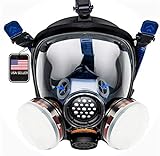
Parcil Full Face
- Organic vapor and particulate
- ANSI Z87.1 dome lens
- 200 degree view
- Anti-fog design
All 8 Respirators for Spray Painting Compared in 2026
Every respirator below is reusable and every one uses replaceable filters or cartridges, so the table compares what actually matters when you are holding a spray gun: what the filter media is rated for, whether your eyes are covered, and which job the facepiece suits best. Certification marks are listed as the manufacturer states them, since that is what determines whether the rating can be trusted at all.
| Product | Specs | Action |
|---|---|---|
| AirGearPro G-500 |
|
Check Latest Price |
| Parcil Distribution Full Face |
|
Check Latest Price |
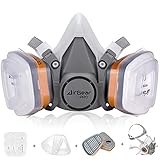 AirGearPro M-500 AirGearPro M-500 |
|
Check Latest Price |
 3M P95/OV Paint Project 3M P95/OV Paint Project |
|
Check Latest Price |
 3M 65021 Multi-Purpose 3M 65021 Multi-Purpose |
|
Check Latest Price |
 3M 6297P1-C-M P100 3M 6297P1-C-M P100 |
|
Check Latest Price |
 Tesoro Moda M401 Tesoro Moda M401 |
|
Check Latest Price |
 Draeger X-plore 3500 Draeger X-plore 3500 |
|
Check Latest Price |
1. AirGearPro G-500 – Best All-Round Half-Mask for Spray Painting
AirGearPro G-500 Reusable Respirator Mask with A1P2 Vapor & Dust Filters
A1P2 dual filtration
P2 dust layer at 98%
92 g with goggles and ear plugs
2 year warranty
Pros
- CE certified mask and goggles in one kit
- Dual A1P2 filtration for vapours and particles
- P2 dust layer rated at 98%
- Soft silicone seal for long sessions
- Storage bag included
Cons
- Goggles can fog with prescription lenses
- Runs warm during extended wear
- First assembly takes a little practice
The G-500 is the one I reach for when a project moves between water-based enamel, solvent-based paint and sanding dust without pausing to rethink protection. It is a half-mask with a soft silicone face seal, an A1P2 combination cartridge and a separate P2 dust layer rated by the manufacturer at 98% particle filtration. Owners running painting, renovation and demolition work consistently describe the seal as the standout feature rather than the filter.
What makes it the most complete kit on the list is what arrives in the box: the mask, gas filters, dust filters, safety goggles, ear plugs, a storage bag and a manual. Seven pieces, and the goggles are sized to sit with the mask rather than fight it. For a first spray-painting respirator, that removes the two most common early exits, which are dropping the goggles because they clash with the mask and losing the ear plugs in the first week.
A1P2 Means Gas and Particle Protection in One Cartridge
A1P2 is a European filter class, and it describes two layers working together. The A1 rating covers organic vapours with boiling points above 65 degrees Celsius, which covers the solvent families most common in household and shop spray paint. The P2 rating covers airborne particles, and this cartridge is stated at a minimum of 98% filtration against those aerosols. Masked overspray from an HVLP gun is a particle problem, and the solvent coming off the can is a vapour problem, and this cartridge answers both in the same housing.
The certification is CE rather than NIOSH, which matters if you are painting under an occupational program in the United States, where a respirator has to carry a NIOSH approval number to count toward compliance. For a weekend cabinet repaint or a garage floor, the A1P2 rating is a meaningful and clearly stated performance claim. If you are being paid to spray, move down the list to the NIOSH-approved 3M options.
Weight, Fit and Long Session Comfort
At 92 grams the facepiece is light enough that you stop noticing it, which is the real test of comfort on a six-hour spraying day. The soft silicone seal and adjustable elastic straps distribute tension rather than digging in at the temples. The weak point is heat: owners report the mask running warm during extended wear, which matters if your spray booth is already warm and you are generating heat with a compressor nearby.
Sizing is listed as one size with a regular fit type, and there is no small option in this listing. If you have a narrow face, the strap tightening takes care of most of it, but the seal check described later in this guide is the real test rather than the size on the box.
Who It Suits and Who It Does Not
This is the respirator for a hobbyist or tradesperson who sprays regularly across different materials and wants eye protection in the same purchase. It also serves well as a secondary mask for dusting and chemical handling jobs around the shop.
It is the wrong choice if you wear prescription glasses, because the bundled goggles fog and there is no way to fit glasses under the mask and the goggles together. It is also the wrong pick for anyone who needs a NIOSH approval number for workplace compliance.
2. Parcil Distribution Full Face Respirator – Best for Eye Protection
Parcil Distribution Industrial Air Purifying Respirator Mask, Survival, and Chemical PT-100 Full Face Respirator – Activated Carbon Organic Vapor Particulate Respirator Mask with Filters – CE Tested
Organic vapor and particulate
ANSI Z87.1 impact lens
200 degree field of view
Five point strap and voice amplifier
Pros
- Full face coverage for eyes and lungs
- Wide 200 degree field of view
- Anti-fog cooling design holds clarity
- Five point strap suits multiple faces
- Built-in voice amplifier
Cons
- Cannot be worn with eyeglasses
- Bulkier and heavier than a half-mask for long wear
Half masks protect the airway and leave your eyes to goggles. Full-face units put a lens between the overspray and your eyes, and for a person spraying furniture, cabinets or coatings at close range that difference is immediate rather than theoretical. This Parcil unit is the full-face option in the lineup, rated for organic vapor and particulate filtration with an ANSI Z87.1 impact-resistant dome lens and a stated 200 degree field of view.
Two details set it apart from a generic full-face. The lens is described as anti-fogging with a cooling design, which addresses the fogging complaint that shows up in almost every forum thread about full-face respirators. And there is a built-in voice amplifier, which sounds like a gimmick until you are trying to talk to someone on the other side of a running exhaust fan.
Lens Clarity and Field of View During a Spray Cycle
A 200 degree field of view means you can look down at a workpiece and check coverage without tipping your head into overspray, and the impact rating matters more than it sounds when a piece of furniture is flaking and a stray droplet is travelling toward you. The anti-fog treatment is the feature owners mention most, because a lens that clouds after ten minutes forces you to stop and clear it with a glove, which is exactly when you do not want a gloved hand near your facepiece seal.
The trade-off is that you give up the option of wearing ordinary eyeglasses. Owners consistently report that as the main limitation, and it is worth checking before you buy. If you wear glasses full time, plan on contacts for spraying days or choose a half-mask with separate goggles instead.
The Five Point Harness and Day-Long Comfort
The five-point adjustable head strap is what keeps the seal consistent across a long session, and it spreads load across the top and back of the head rather than relying on two side straps. That matters more than it sounds, because a two-strap half mask migrates downward as you move and the leak opens at the chin.
Full-face units are bulkier and heavier than half masks, and buyers note that as a genuine drawback for extended wear. Fogging is largely handled, but heat around the cheeks builds faster than it does on a half mask. If your sessions are short and concentrated, that is a fair trade for full eye coverage. If you are spraying for four hours straight, weigh it against a half mask and goggles.
Who It Suits and Who It Does Not
This suits anyone spraying coatings, sealants, epoxy or paint where overspray reaches the eyes, and it holds up well in industrial and coating work where a standard half mask leaves you wiping your eyes every few minutes. It is a solid upgrade for anyone moving from a dust mask to real respiratory protection.
Skip it if you wear eyeglasses, if heat in a warm garage bothers you, or if your work is short enough that swapping between a half mask and goggles is simpler. It is also not a substitute for a supplied-air system in confined spaces.
3. AirGearPro M-500 – Best Value Reusable Half-Mask
AirGearPro M-500 Reusable Respirator Mask with Filters | Ideal for Painting, Woodworking, Construction, Sanding, Spraying
A1P2 organic vapour and P2 dust
95%+ particle filtration
92 g adjustable straps
4 piece kit
Pros
- Low breathing resistance for long jobs
- Handles fine sanding dust and fumes
- Simple snap-together filter assembly
- Works with eyeglasses
- Replaceable low-cost filters
Cons
- Cheek seal is not airtight for everyone
- Slight odour pass-through on heavy fumes
- Rubber smell needs airing out first
The M-500 is the cheaper half of the AirGearPro pair on this list, and it is the one to buy if you want a reusable mask with no goggles in the way. It shares the same 92 gram weight, the same soft adjustable strap system and the same A1P2 dual filtration concept, with the P2 dust layer stated here at 95% or better particle filtration. The kit is four pieces: mask, gas filters, dust filters and a manual.
The single biggest practical advantage over the G-500 is that it works with eyeglasses. If you already own a pair of clear safety glasses, they fit under the straps and the facepiece, and you get eye protection without the fogging conflict that comes with bundled goggles.
Breathing Resistance Through a Full Day
Owners frequently single out low airflow restriction as the reason they kept this mask, and it is the detail that decides whether you finish a project in the mask or push it up onto your forehead. Particle filters are the main source of resistance, and a lighter dust layer breathes more freely than a P100 layer. That is the trade this mask makes, and for sanding dust and typical household spray work it is the right side of the trade.
The negative side of low resistance is that some users report a slight odour pass-through under heavy paint fume loads, plus a face seal that is not perfectly airtight around the cheeks. If you are spraying a solvent-heavy coating for hours, treat this mask as a dust and light-fume respirator and step up to a NIOSH OV/P95 or OV/P100 pairing.
The Rubber Odour Break-In and Filter Changes
New masks arrive with a faint rubber or elastomer smell, and owners recommend airing the facepiece out before a first use rather than spraying with it straight from the packaging. It fades quickly once the mask has been worn or left open.
Filter assembly is a snap-together design and the replacement filters are inexpensive, which is the core of the value argument. You change two small filter elements instead of discarding an entire mask, and the filters are listed in both Abek1 P2 and A1P2 variants, so the same facepiece can be set up for gas and vapour work or for dust alone.
Who It Suits and Who It Does Not
Best for the sprayer who wears glasses, works across dust and paint in a home shop, and wants a mask that survives a year of projects without being replaced. It also handles the sanding and demolition side of a furniture build very well.
It is not the right mask for automotive clear coat work or for heavy solvent exposure where odour breakthrough is unacceptable, and the CE marking means it does not satisfy NIOSH-based workplace requirements. For paid work with paint fumes, look at the NIOSH-approved options instead.
4. 3M P95/OV Paint Project Reusable – Best NIOSH OV/P95 Pairing
3M OV/P95 Paint Project Respirator 6211, Reusable Respirator, Medium, 1-Kit
NIOSH approved OV cartridge with P95
Oil-proof P-series filter
Soft thermoplastic faceseal
Occupational use only
Pros
- Niosh approved organic vapor with P95
- Soft faceseal stays comfortable for hours
- Medium size fits a wide range of faces
- Works with eyeglasses and safety glasses
- Quiet operation and low breathing resistance
Cons
- Straps are hard to adjust once worn
- Nose bridge soreness after long sessions
- Instructions do not explain the pre-filter setup
This is the respirator to shortlist if you paint under a program that requires a NIOSH approval, or if you simply want a filter whose performance claim comes from a US certification body rather than a European mark. It pairs a NIOSH-approved organic vapor cartridge with a P95 particulate filter, stated to remove at least 95% of solids and liquid aerosols along with certain organic vapours.
The oil-proof P-series filter matters more than the number suggests. N-class filters are not designed for oil aerosols, R filters tolerate up to one shift of oil exposure, and P filters are oil-proof within the manufacturer’s time-use limits. Paint mist is an oil or solvent aerosol, so a P-rated layer is the correct side of that split.
What the NIOSH Approval Actually Covers
The approval means the cartridge configuration was tested as a system for a stated concentration limit, and that is the difference between a rated respirator and a mask with a carbon insert. It is labelled for workplace and occupational use only, and in a commercial setting it has to sit inside a written respiratory protection program that includes fit testing, which is the part most home users skip and the part that decides whether protection is real.
For household use the same rating still works in your favour, because you know the filtration figure is third-party tested rather than a marketing line. The stated coverage is certain organic vapours, which is a phrase worth taking seriously: organic vapour cartridges are rated by boiling point against a reference substance, so a cartridge can be a poor match for a high-boiling solvent or an acetone blend even though the label says organic vapor.
Faceseal Comfort Over Hours of Wear
The soft thermoplastic faceseal is the part owners praise most, along with the fact that the medium size fits a wide range of face shapes and works with eyeglasses and safety glasses. Long-term users report a secure seal and effective blocking of spray paint and pesticide vapours, which is the outcome that matters.
Two comfort complaints recur: the straps are difficult to loosen once tightened while worn, so you adjust them before you put the mask on rather than after, and the nose bridge can become sore after extended sessions. There is also a faint whistle from the exhale valve at rest, which is harmless and does not affect the seal.
Who It Suits and Who It Does Not
This suits the painter who needs a documented approval for their work, and anyone spraying oil-based enamel, alkyd, heavier solvent coatings or pesticide products. It is a strong all-rounder for a shop that alternates between paint and sanding.
It is not the choice if you need the highest particulate performance, since a P95 layer filters less than a P100 layer, and the cartridge has a finite service life that is hard for a hobbyist to judge from smell alone. Plan on a calendar replacement schedule rather than waiting for a breakthrough odour.
5. 3M 65021 Multi-Purpose P100/OV – Best for Stains, Varnishes and Coatings
3M OV/P100 Odor/Particulate Multipurpose Respirator 65021, Medium
P100 particulate plus OV cartridge
Medium reusable facepiece
Bayonet connection
Stated for occupational and DIY
Pros
- Highest average rating in the lineup
- P100 particulate with organic vapor cartridge
- Bayonet system accepts 3M filters
- Quiet and comfortable for long sessions
Cons
- Organic vapor section is rated for nuisance-level odour reduction
- Medium size only in this listing
The 65021 is the highest-rated product we included, sitting at 4.7 stars, and it is a different tool from the entry-level masks. It combines P100 particulate filtration with a NIOSH-approved organic vapor cartridge in a reusable medium facepiece, and it uses the 3M bayonet connection so the same facepiece accepts a wide range of 3M cartridges and filters as your work changes.
Buyers single out odour control across stains, varnishes, coatings and sealants as the reason it performs well, with the P100 particulate layer handling the overspray side of the job. That combination is what you want for a furniture refinisher or a cabinet painter rather than someone rolling latex on a wall.
Why P100 Changes the Breathing Calculation
A P100 filter is rated at 99.97% filtration against particles, which is a real step up from the 95% and 98% layers on the two AirGearPro masks. The cost is airflow. Owners and reviewers both note that denser particulate media is harder to breathe through, and that difference becomes obvious in the fourth hour of a spraying day rather than the first.
The practical advice is to use the highest rated filter the job actually requires. If you are spraying a coating in a ventilated area, a P95 layer gives you nearly all the particle protection you need at a fraction of the breathing effort. If you are doing lead paint, mould remediation, or spraying a coating that produces heavy mist, the P100 layer is the right trade and you plan your breaks around it.
The Bayonet System and Long-Term Filter Strategy
The bayonet connection is a mounting standard rather than a brand lock, and once you own the facepiece you can move between organic vapor, acid gas and particulate filters without buying a new mask. That is the argument for reusable respirators in general: the facepiece outlives the filter, and the filter choice follows the material.
Be precise about what the cartridge does. The organic vapor section is described by the manufacturer as odour reduction for certain non-harmful sprays and vapours, which is a lower bar than a full vapor protection claim. It is a well-regarded respirator for the coating and finish work it is built for, but you should not treat it as authorised protection against a solvent you have not identified.
Who It Suits and Who It Does Not
This is the pick for a serious furniture and cabinet refinisher, a trim and detail sprayer using an HVLP gun, and anyone who wants one facepiece that accepts multiple cartridge types over the life of the mask.
It is not ideal for a small face, since this listing is medium only, and the higher filtration rating means more breathing resistance if your session is long. If you are spraying rather than finishing, and fume control matters more than particle control, the OV/P95 pairing is the more comfortable answer.
6. 3M 6297P1-C-M P100 – Best for Lead Paint and Mold Removal
3M P100 Performance Mold & Lead Paint Removal Respirator, Medium
2097 P100 at 99.97%
Carbon layer for nuisance odours
Two spare filters included
8.8 oz facepiece
Pros
- P100 rated at least 99.97% filtration
- Includes a spare pair of 2097 P100 filters
- Lightweight 8.8 ounce facepiece
- Bayonet connection takes a wide range of 3M cartridges
- Adjustable multi-point fit seals well
Cons
- Carbon layer does not block all paint fumes
- Not suitable for acetone vapour
- Goggles are not included
This one belongs on the list for a specific job: stripping lead-based paint and dealing with mould in an older home, plus the heavy dust work that goes with it. It uses the 3M 2097 P100 filter, rated by the manufacturer at a minimum of 99.97% filtration efficiency against solids, liquid aerosols and oil-based particulates, on an 8.8 ounce half facepiece with adjustable straps.
The kit includes one facepiece and two pairs of replaceable P100 filters, which is more useful than it sounds. The first pair goes on the respirator and the second becomes your first replacement, so you are not searching for a filter mid-project with dust still in the air.
Lead Paint Is a Particulate Problem First
Lead paint stripping produces a fine lead dust that stays airborne long after the scraping stops, and the failure mode is inhaling it repeatedly over days rather than getting one big exposure. A P100 particulate layer rated at 99.97% is the correct tool for that, and users working on mould, lead paint and fiberglass cite the filtration figure as the reason for their purchase.
The limits are equally important. The carbon layer in the 2097 filter reduces nuisance organic vapours such as certain solvents, degreasers and resins, and it is not suitable for acetone vapour. If you are spraying rather than stripping, the vapour side of the hazard needs a genuine organic vapor cartridge, not a carbon layer inside a particulate filter.
Fitting, Filter Swaps and the Bayonet Advantage
Adjustable multi-point straps create a consistent seal across the face, and the 8.8 ounce weight keeps the mask from dragging as the job goes on. The bayonet connection means this facepiece accepts the wider range of 3M cartridges and filters, so you can upgrade to an OV cartridge later without replacing the mask.
Goggles are not included, so budget for a separate pair of chemical-rated splash goggles for the stripping work. Nothing in the box protects your eyes, and mould and lead work is exactly the job where your eyes and skin need covering as much as your airway.
Who It Suits and Who It Does Not
This suits a homeowner dealing with paint in a pre-1978 house, a mould remediation contractor, and anyone doing heavy sanding, grinding or demolition where the dust load is the primary hazard. It is also a good general-purpose shop mask for woodwork.
It is the wrong choice for spray painting with solvent-heavy coatings, since the carbon layer is an odour reducer rather than a full organic vapor protection rating. The facepiece is also listed as medium only.
7. Tesoro Moda M401 – Best Bundled Starter Kit
Tesoro Moda Respirator Mask for Spray Painting, Woodworking, Welding, Dust, and General Safety with Clear Eye Goggles, 10 Replacement Filters, Half Face Cover with Safety Glasses
Reusable silicone half mask
Ten replacement filters included
Clear safety goggles
One size fits most adults
Pros
- Comfortable seal that does not dig in
- Bundled goggles sit well with the mask
- Ten replacement filters cover months of work
- Covers spray paint dust and yard chemicals
- Simple reusable design
Cons
- Hard to wear over prescription glasses
- Positioned mainly for general dust and particles
The M401 is the odd one out in this lineup because it is not sold with a gas cartridge. It is a reusable half mask with a soft silicone face piece, a box of ten replacement filters, and a pair of reusable clear safety goggles, and the manufacturer positions it across painting, woodworking, welding prep, resin and epoxy work, and strong-smelling cleaners.
That positioning tells you where it sits. It is a particle respirator for spray mist and dust rather than a solvent-vapour respirator, and the honest way to read it is as a general shop mask with a generous filter supply. If your work is dust, sawdust, drywall, insulation and concrete grinding with some spray overspray, it does all of that well.
Filter Supply Is the Real Feature Here
Ten replacement filters is the headline. Owners mention that the supply covers months of projects, and because the facepiece is rinsed and reused you are replacing a small element rather than a whole mask each time. For someone who sprays occasionally and then does a lot of sanding, having filters already in a drawer removes the most common reason people push through without protection.
The silicone construction is the other reason owners keep coming back. It is described as not digging in or restricting breathing, and the face piece is simple to clean and reassemble with a fresh filter.
Goggle Fit and the Prescription Eyeglasses Problem
The bundled clear goggles are sized to sit with the mask, and buyers report that they do not fog easily, which is a genuine improvement over forcing goggles under a half-mask strap. The catch is the same one that appears across this category: it is hard to wear over prescription glasses.
If you do not wear glasses, this pairing is close to ideal for a home shop. If you do, plan on contacts for spraying days, or choose a half mask that leaves the strap path clear and buy goggles separately.
Who It Suits and Who It Does Not
This is a strong first respirator for a hobbyist who sprays occasionally, sands and grinds regularly, and wants goggles and spare filters in the same purchase. It also works well for yard chemical spraying and epoxy or resin work.
It is not the respirator for solvent-heavy spray finishing, because it is built around particle filtration rather than an organic vapour cartridge. For oil-based paint and lacquer work, use one of the OV-rated masks on this list instead.
8. Draeger X-plore 3500 Multi-Gas/P100 – Best Multi-Gas Coverage
Dräger X-plore 3500 Respirator Mask Multi-Gas/P100 Combination Cartridge (OV/AG/HF/FM/CD/AM/MA/HS/P100) NIOSH-certified Half-Mask for Painting, Chemicals, Construction
Multi-Gas plus P100 filters
Side-positioned cartridges
Flexible head harness with neck clips
Medium size
Pros
- Seal covers more skin area to cut leaks
- Does not fog eyeglasses or safety goggles
- Broad multi-gas coverage with P100
- Lightweight and breathable for hours
- Built to outlast cheaper masks
Cons
- Replacement cartridges are expensive
- Instructions are cryptic and the neck strap is hidden
- Can get uncomfortable over very long durations
The X-plore 3500 is the least-reviewed product here and the most technically capable, and those two facts belong in the same sentence so you can weigh them. It ships as a Dräger X-plore 3500 half mask in size medium with two sealed Multi-Gas plus P100 filters, and the multi-gas media covers organic vapours plus chlorine, hydrogen chloride, sulfur dioxide, chlorine dioxide, hydrogen fluoride, formaldehyde, ammonia, methylamine and hydrogen sulfide alongside particulates.
That gas list is why it earns a place. Paint spraying is one application among many, including chemical handling, acids, insecticides, lab work, sanding and grinding. If your shop involves more than one kind of chemical, a single multi-gas cartridge avoids keeping a shelf of different cartridges for each material.
Side-Mounted Filters and the Seal Advantage
Positioning the filters on the sides rather than the cheeks keeps your field of view open, which helps when you are aligning a spray pattern or reading a work surface. Owners upgrading from other masks call the seal the real improvement: the facepiece contacts a larger area of skin, which is what removes nostril leaks, the most common complaint on cheaper half masks.
It also does not fog eyeglasses or safety glasses during long wear, which is a consistent theme in reviews of this mask. Lightweight and breathable construction keeps it workable for multi-hour sessions.
Cartridge Cost and the Instructions Problem
The recurring drawback is price. Multi-gas P100 cartridges are not inexpensive, and users report that as the main cost of ownership over time. On a hobby project schedule that adds up faster than a pair of A1P2 filters does.
Instructions are also described as cryptic, with the neck strap retracted and hard to locate on first assembly, and some users find the mask uncomfortable over very long durations. Allow time to set the harness properly before a job rather than in the middle of it.
Who It Suits and Who It Does Not
This suits a serious hobbyist or contractor working across several chemical hazards in the same shop, and anyone who has been frustrated by nostril leaks on a cheaper mask. It is a genuine step up in sealing surface area.
It is not the best value for spraying paint alone, where a simpler OV and particulate cartridge does the same job for less, and the medium size is a limitation for small faces. If cartridge cost over a year matters more than coverage breadth, choose the A1P2 or OV/P95 options instead.
How to Choose a Respirator for the Paint You Are Spraying
Choosing a respirator for spray painting comes down to three questions in order: what chemical is in the can, what is the airflow in the room, and will this facepiece seal on your face. Answer them in that order and the product choice nearly picks itself. Skip the first question and you end up with a mask that filters mist beautifully and lets solvent vapour straight through.
Match the Cartridge to the Chemistry, Not to the Can Label
Water-based latex and acrylic emulsions produce very little solvent vapour, and their hazard is overspray droplets. A particulate filter of P95 or better handles that adequately, and a dust mask is not far off for low-mist roller and brush work. Oil-based alkyd and enamel, lacquer, and most aerosol coatings are different: these release organic vapours that only an organic vapor cartridge is rated to remove, and no particulate rating on the box changes that.
Stains, varnishes and clear poly are an intermediate case that the 65021 is built for, combining P100 particulate filtration with an organic vapor cartridge across coating and finish materials. The one category that sits outside what any air-purifying respirator on this list should be used for is 2K automotive urethane clear, which contains isocyanates. Those products belong in a spray booth with supplied-air respiratory protection, handled by a shop set up for that work, not by a hobbyist with a cartridge respirator in a closed garage.
What N, R and P Actually Mean
The letter tells you about oil resistance and the number tells you about filtration efficiency. N filters are not designed to be used with oil aerosols, R filters tolerate oil exposure for a limited shift, and P filters are oil-proof within the manufacturer’s time-use limits. Paint mist is an oil or solvent aerosol, so for spraying you want a P-rated filter, which is why an R95 is a poor fit for this job and an N95 is worse.
This is also where most online advice goes wrong. N95, P95 and P100 are particulate ratings and say nothing about vapour. Asked directly whether a P100 protects against paint fumes, the answer is no: it removes droplets, not solvent molecules. What you need is a combination cartridge, labelled organic vapor plus P95 or plus P100. Asked whether an N95 is good enough for spray paint, the answer is only for water-based coatings in a well-ventilated space, and never for oil-based, lacquer or enamel.
Half-Mask or Full-Face: The Eye Question
A half mask seals over the nose and mouth and relies on separate goggles for eye protection. A full face adds a lens, which removes one piece of equipment and one source of seal problems, at the cost of more bulk, more heat and, in most cases, an incompatibility with prescription glasses.
For a sprayer, the deciding factor is how much overspray reaches your eyes at working distance. Furniture and cabinet refinishing at close range with an HVLP gun will put droplets on your face within a few minutes, which makes the full-face unit worth the trade. Trim and detail work in a ventilated area is comfortable with a half mask and goggles.
The Four-Step User Seal Check
A rated filter on a leaking facepiece protects very little, and fit is the number one theme across every forum thread about this topic. The test takes under a minute and the phrase used in serious threads is simple: the best respirator is the one that fits properly.
Start by covering the cartridge inlets with your hands, or the filter covers if you have them, and breathe in gently. A good facepiece pulls inward against your face with no leakage around the edges, which feels like gentle suction. Next, hold your breath for about ten seconds and watch for any sagging that would let air in around the seal.
Then do the positive check: exhale hard into the mask with the inlets uncovered. Nothing should leak around the facepiece, though a small amount at the exhale valve is normal. Finally, repeat the inhalation check with the headbands adjusted. If either check fails, reseat the mask from the nose outward and retighten the lower strap first, since the lower strap is what holds the chin seal. If it still fails, the facepiece size or shape is wrong for you, and no filter rating compensates for that.
Ventilation Beats Filtration Whenever You Can Build It
Most spraying advice online treats the respirator as the control, and it is the wrong order. A respirator works by filtering the air you are about to breathe, which means the contaminant has already been released into the room and is settling onto your surfaces. Ventilation removes it before it gets there.
For a garage, a box fan in a window pulling air out, and a second fan or a loose door feeding fresh air in, changes the job more than any filter choice. For a fixed workspace, a spray booth with a filtered exhaust is the difference between a respirator as a backup and a respirator as your main control. Masks exist for the situations you cannot engineer around: a cold basement, a windy day, a room you can only close up, and the cleanup work after the spraying stops.
Cartridge Life, Storage and Total Cost
Replace organic vapor cartridges on a schedule, not on smell. A cartridge can be well past useful life before you notice anything, and some organic vapor media give very little odour warning as they load up, which is the failure mode people get wrong. Use a calendar, a filter change schedule, or the manufacturer guidance printed on the cartridge, and write the date on the cartridge with a marker when you install it.
Particulate pre-filters clog faster than vapour cartridges exhaust, so check the dust layer on your spray jobs. Store cartridges sealed in their packaging in a cool, dry place, since a hot garage degrades activated carbon and a freezing shed damages seals and makes media brittle. Over a year of regular work, the cartridge cost is what determines whether a reusable mask is cheaper than buying disposables, and for someone spraying only a few times a year the disposable route can still win on both cost and hassle.
Frequently Asked Questions
Is an N95 good enough for spray paint?
For water-based latex and acrylic coatings in a well-ventilated space, an N95 handles overspray droplets adequately. For oil-based paint, alkyd enamel, lacquer and aerosol coatings, it is not enough. Those release organic vapours, and N95 is a particulate rating only. You need a combination cartridge labelled organic vapor plus P95 or P100 for solvent-based spray paint.
Does a P100 protect against paint fumes?
No. A P100 rating is a particulate filter rating and covers mist, dust and droplets at 99.97% efficiency. Solvent vapours are molecules rather than particles, so they pass straight through a particulate-only filter. For spray paint you need a combination cartridge combining an organic vapor section with a P95 or P100 particulate layer, or you will still smell the paint through the mask.
Is P100 or N95 better for painting?
P100 filters more particles, at 99.97% against 95%, and it is oil-proof, which matters because paint mist is an oil or solvent aerosol. N filters are not designed for oil aerosols at all, and R filters tolerate oil only for a limited shift. P100 also resists clogging in a heavy-mist environment, though it is harder to breathe through over a long session.
What kind of respirator should I use for spray painting?
Use a reusable half mask or full facepiece fitted with a combination organic vapor and particulate cartridge, rated P95 or better. Add a full face or separate chemical goggles for eye protection from overspray. Ventilate the room first, and treat the respirator as backup protection. 2K urethane isocyanate clear coats require a supplied-air system in a proper booth, not a cartridge respirator.
How long are spray paint fumes harmful, and how long do cartridges last?
Fumes are most intense during and just after spraying, and the risk comes from repeated exposure over days rather than one session. Open the space and ventilate for several hours after you stop. Organic vapor cartridges have a finite service life that a smell test will not reliably reveal, so replace them on a calendar or the manufacturer schedule rather than waiting for odour breakthrough.
The Verdict: Which Respirator Should You Buy
If you want one respirator that handles paint, dust and shop chemicals with goggles and spares in the box, the AirGearPro G-500 is the pick, and it is our choice for the best respirators for spray painting in 2026. If you spray at close range and overspray reaches your eyes, take the Parcil full face and accept the eyeglass trade-off.
If you wear glasses or want the lowest ongoing cost, the AirGearPro M-500 does the same job without the goggles. If you need a documented approval, go with the 3M P95/OV for solvent paint, the 65021 for stains and coatings, and the 6297 for lead paint and mould. For broad chemical coverage, the Draeger X-plore 3500 is the most capable, and the Tesoro M401 is the easiest place to start.
Whichever you choose, run the seal check before you pull the trigger on the gun, set a cartridge replacement date the day you install it, and get the air moving in the room first. That last step costs nothing and does more for you than any filter on this list.
Leave a Reply