

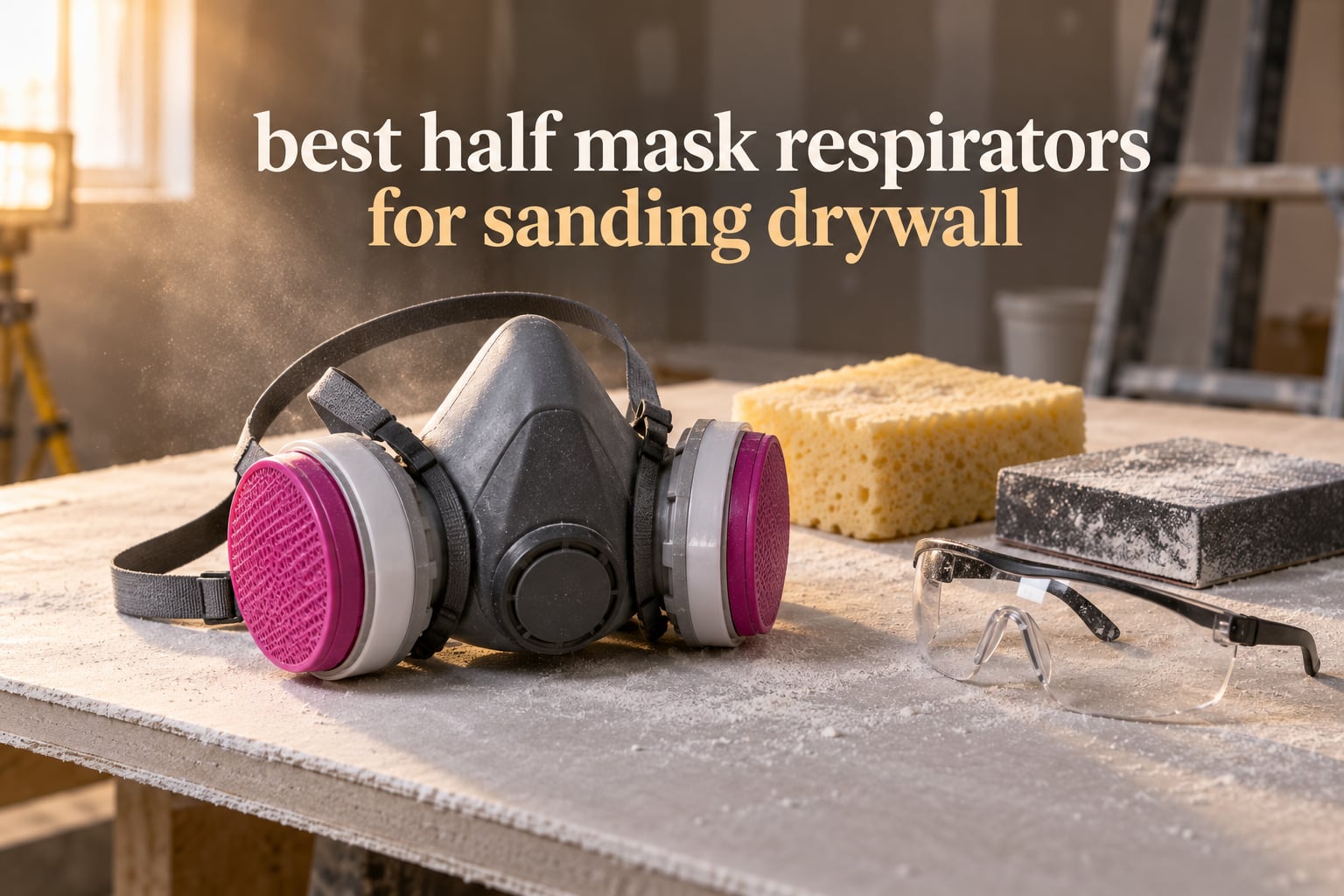
Short answer first: a NIOSH-approved P100 half mask respirator is the safest pick for sanding drywall, and an N95 is the bare minimum that only makes sense for short patch jobs on compound with no crystalline silica. NIOSH, the National Institute for Occupational Safety and Health, is the US body that tests and approves respirators, and the P100 class filters at least 99.97% of airborne particles, against 95% for an N95.
That distinction matters more here than in almost any other home project. Sanding joint compound throws a cloud of gypsum dust fine enough to stay suspended for hours, and some joint compounds contain respirable crystalline silica, the carcinogenic dust OSHA regulates under 29 CFR 1926.1153 for construction. Prolonged unprotected exposure is linked to silicosis and permanent lung scarring.
We compared the ten half masks below on the criteria that actually predict whether you will still be wearing the thing at hour four: filtration class, breathing resistance, whether the profile clears your safety glasses, and how long the facepiece holds a seal. Our overall winner is the GVS SPR457 Elipse P100, which stays cool, clears eyewear, and is the rare respirator people keep on instead of pulling off after twenty minutes.
A note on what we can and cannot claim: we did not laboratory-test filtration. Every filtration rating quoted below is the manufacturer’s published NIOSH figure, and comfort impressions come from the volume of verified buyer feedback attached to each mask. We also stuck to respirators that show a real approval marking, because forum consensus on this topic is blunt about it: unmarked or non-US-made masks should be avoided, since US workplaces require NIOSH approval.
If you are pairing this with any painting work in the same room, our guide to respirators for spray painting covers the organic vapor side. And when the sanding is done, the knife and blade work usually follows the same walkthrough, covered in our utility knife picks for drywall.
Our Top 3 Best Half Mask Respirators for Sanding Drywall (October 2026)
These three are the ones we would hand to a drywall finisher starting a room. The GVS takes the overall spot, the 3M kit is the value pick, and the AirGearPro kit is the one that arrives with everything else you need already in the bag.
GVS SPR457 Elipse P100
- NIOSH P100 filtration
- Low-profile body that clears safety glasses
- Replaceable filters rated up to 5 years
- Soft latex-free and silicone-free elastomer

3M 6291 Half Mask Kit P100
- Facepiece plus two 2091 P100 filters included
- Bayonet connection for the 3M cartridge range
- Weighs under 5 ounces assembled
- Adjustable head straps

AirGearPro G-500 A1P2 Kit
- Dust and organic vapor filters in one kit
- Goggles and ear plugs included
- 92 g with adjustable straps
- Replaceable filter media
Comparing All 10 Half Mask Respirators Side by Side in 2026
Every mask below carries a real NIOSH or CE filtration rating, and all ten are reusable elastomeric half masks except where noted. Read the class column first: it decides more than any comfort feature.
| Product | Specs | Action |
|---|---|---|
| GVS SPR457 Elipse P100 |
|
Check Latest Price |
| AirGearPro G-500 A1P2 Kit |
|
Check Latest Price |
| 3M 6291 Kit P100 |
|
Check Latest Price |
 3M Paint Project P95/OV 3M Paint Project P95/OV |
|
Check Latest Price |
 3M 6297 P100 Mold and Lead 3M 6297 P100 Mold and Lead |
|
Check Latest Price |
 Miller ML00894 LPR-100 S/M Miller ML00894 LPR-100 S/M |
|
Check Latest Price |
 Klein Tools 60552 P100 Klein Tools 60552 P100 |
|
Check Latest Price |
 Honeywell North 5500 N95 Honeywell North 5500 N95 |
|
Check Latest Price |
 MSA Advantage 200 LS Large MSA Advantage 200 LS Large |
|
Check Latest Price |
 Drager X-plore 3500 Multi-Gas P100 Drager X-plore 3500 Multi-Gas P100 |
|
Check Latest Price |
1. GVS SPR457 Elipse P100 – Best Overall Half Mask for Drywall Sanding
GVS SPR457 Elipse P100 Dust Half Mask Respirator with replaceable and reusable filters included, blue, m/l size
NIOSH P100 approval TC-84A-6949
Replaceable filters rated up to 5 years
Latex-free and silicone-free soft elastomer
Low breathing resistance
Pros
- P100 filtration covers silica
- gypsum and concrete dust
- Exceptionally light and compact for long sessions
- Low breathing resistance reduces fatigue
- Full vision range that clears eye and ear protection
- Replaceable filters with up to 5 year service life
Cons
- Replacement P100 cartridges sold separately
- Medium and large sizing only may not suit smaller faces
The GVS SPR457 is the mask we kept reaching for. It holds a 4.6 rating across 6392 reviews, and the reason those reviews cluster on comfort rather than price is the low breathing resistance built into the P100 filter.
For sanding drywall specifically, that number is everything. Gypsum dust packs a filter fast, and once a filter loads, inhalation resistance climbs and you start mouth-breathing through the nose bridge. The Elipse is one of the few reusable masks that does not punish you for wearing it through a long finish pass.
Why P100 Is the Right Class for Joint Compound
The Elipse carries NIOSH approval number TC-84A-6949 and meets 42 CFR 84, filtering at least 99.97% of particles. The manufacturer lists protection against coal, silica, gypsum, cotton, iron ore, kaolin, zinc and aluminium dusts, which covers essentially every compound you will encounter in a renovation.
An N95 at 95% filtration is not useless here, but it is a thinner margin against the very fine respirable fraction that finish sanding produces. Buyers on r/Masks4All put it plainly: elastomeric respirators with P100 filters are excellent protection even when others are not masking, provided that they fit you well.
The Profile Problem: Clearing Your Safety Glasses
Glasses fogging is the most repeated complaint across every sanding forum we read, and it comes down to where the mask body sits relative to your lenses. The Elipse is deliberately low profile, and the manufacturer highlights a full vision range that does not interfere with required eye or ear protection.
In practice that means your safety glasses sit on the mask rather than being shoved up on your forehead, which is where most people put them after the fifth minute of fogging. That habit also compromises the seal.
Filter Life and the Reusable Math
GVS rates the replaceable filters at up to 5 years of service, which is the number that makes ownership pay off. Compare that against a disposable habit: a finisher sanding a room in a day can go through several masks in a week, and each change means a seal check again.
The catch is that replacement P100 cartridges are sold separately, so budget for them as a recurring line item rather than a one-time purchase. Once you factor in that the filters outlast the facepiece life of most competitors, the ongoing number still lands well below stacking disposables.
Where the Sizing Falls Short
The Elipse ships in medium and large only. That is a genuine problem for smaller face frames, and it is the single most common reason a good mask gets pulled off after a short trial.
If you have a narrow face, treat the fit test as the deciding factor rather than the spec sheet. A wearer reporting on r/Masks4All put fit ahead of brand, and that is the correct priority for a reusable elastomeric.
Our verdict: this is the one to buy if you sand drywall regularly. It handles silica-rated compound, stays cool, and disappears from your awareness, which is the highest compliment we can pay a respirator.
2. 3M 6291 Half Facepiece Kit with 2091 P100 Filters – Best Value Reusable
3M Half Facepiece Reusable Respirator Assembly Kit 6291, Medium, 1 Kit
Includes facepiece and two 2091 P100 filters
Under 5 ounces assembled
Bayonet cartridge connection
Thermoplastic elastomer
Pros
- Usable out of the box with two P100 filters
- Soft lightweight facepiece with easy strap adjustment
- Bayonet accepts the full 3M cartridge range
- Light at under 5 ounces assembled
Cons
- Marked for industrial and occupational use only
- Sold in medium sizing only
- Firmer faceseal than comfort-focused models
The 6291 kit is the practical choice when you want a real 6000-series facepiece and two genuine P100 filters without hunting for parts separately. It holds 4.5 stars across 3186 reviews.
What stands out in the feedback is not softness, it is the box contents. Getting a facepiece plus two 2091 filters means you can finish a whole room before your first filter change, and the bayonet connection means the next filter is a twist rather than a purchase decision.
What the 2091 Filter Actually Does
The 3M 2091 is a P100 particulate filter, NIOSH approved for environments containing certain oil and non-oil based particles. For a drywall job that means it covers the gypsum dust and any oil-based aerosol you might encounter during adjacent paint or demolition work.
It is a bare particle filter with no carbon layer, so it does nothing for odors. If the same room has fresh primer or solvent-based paint nearby, that is a gap worth knowing about before you start.
Weight and Strap Adjustment During Long Passes
The full assembly weighs 4.8 ounces, which is among the lightest figures in this group, and the thermoplastic elastomer facepiece adjusts easily at the head straps. On a ceiling or a stairwell wall, that weight difference shows up in how long you keep going.
Buyers note the straps are easy to tighten but that the faceseal itself feels firmer than comfort-first models. Some finishers like that, because a firm seal is easier to verify. Others find it tiring over a full day.
The Occupational-Use Label
This kit is marked for industrial and occupational use. For a residential renovation that changes nothing physically, but it is worth knowing if you plan to use it in a commercial context with a formal respirator program.
Under OSHA 29 CFR 1910.134, an employer-run program carries obligations that go beyond wearing the mask: written procedures, medical evaluation, and fit testing. None of that applies to a weekend patch job in your own house.
Medium Sizing as the Real Limitation
The 6291 is medium only, and the review base shows a wider spread than the other 3M kits here, with fit complaints concentrated in that one issue. If your face is narrow or wide, this is not the kit to gamble on.
Measure twice: run the negative pressure seal check described in the buying guide below before you commit to a full project, and buy a replacement facepiece rather than forcing a bad seal for a day.
Our verdict: the best value for someone who wants a proven facepiece platform and already knows their size. Two filters in the box removes the most common new-owner mistake.
3. 3M 6297 P100 Mold and Lead Paint Respirator – Best for Demo Work
3M P100 Performance Mold & Lead Paint Removal Respirator, Medium
NIOSH P100 at 99.97 percent filtration
Two pairs of 2097 filters included
Carbon layer reduces nuisance odors
Bayonet connection
Pros
- Facepiece plus two pairs of 2097 P100 filters
- Straps and clips survive repeated donning and doffing
- Adjustable at multiple points for a verifiable seal
- Light enough to work normally while lifting
Cons
- Carbon layer softens odors rather than blocking them
- Not suitable for acetone and similar vapors
- Medium sizing only
- Goggles not included
When sanding turns into cutting or demo, dust load jumps and the filter class question stops being academic. The 3M 6297 is the kit for that version of the job, rated 4.6 stars from 1430 reviews.
The 2097 filter carries the same P100 rating as the 6291 but adds a special carbon layer aimed at nuisance organic vapor odors from solvents, degreasers and resins. That is useful in an old house where paint, mastic and adhesive residue are all present at once.
P100 Efficiency for Heavier Dust Loads
The 2097 filter filters at least 99.97% of solids and liquid aerosols, including oil-based particulates. In a teardown where you are cutting board edges and knocking off screw heads, that oil-proof rating is the reason to prefer P over N.
The N class is not oil-proof, and the R class is only oil-resistant. Choosing P means the filter keeps its rating even in the mixed dust of a real renovation rather than the clean gypsum-only pass of a careful finish coat.
Reading the Carbon Layer Honestly
Reviewers are consistent about one thing: the carbon layer reduces nuisance odors, it does not eliminate them. Several users caution specifically against treating it as protection against strong chemical smells.
It is also not appropriate for acetone or similar vapors during spray work. If your sanding day includes painting, keep that separate and use a proper organic vapor cartridge for the coating portion.
Strap and Clip Durability Under Repeated Use
Durability is the quiet strength here. Buyers working in mold, lead paint and demolition report that the straps and clips hold up over many weeks of repeated donning and doffing, which is what decides whether a reusable mask stays in rotation.
The facepiece is light and conformable enough that users report breathing normally while lifting and working overhead. Adjustable at multiple points, it lets you dial in a seal you can actually feel rather than guess at.
Sizing and Missing Extras
Medium only, and goggles are not included. Both are easy to solve, but plan for them before the first shift rather than after.
Weighing 8.8 ounces, this is the heavier kit in our lineup. For a pure sanding day with no demo and no odor, the 6291 is the leaner tool. For a teardown, the extra mass buys durability.
Our verdict: the right pick when the job involves cutting, demo or lead-era paint rather than a clean finish pass. Best used alongside, not instead of, a dedicated organic vapor respirator if coatings are in play.
4. 3M Paint Project P95/OV Respirator – Best for Drywall Followed by Painting
3M OV/P95 Paint Project Respirator 6211, Reusable Respirator, Medium, 1-Kit
NIOSH organic vapor cartridge with P95 filter
Oil-proof P-series particulate filter
Soft thermoplastic faceseal
6000-series cartridge compatible
Pros
- Handles dust and paint fumes in one cartridge
- Medium size fits a wide range of faces
- Works with safety glasses and 3M goggles
- Seals and straps hold up over years
- Spare particulate filters included
Cons
- Straps are hard to loosen once tightened
- P95 rather than P100 filtration
- First-time assembly instructions are confusing
- Cartridges have a finite shelf life
If your project runs sanding straight into painting, one mask that handles both beats swapping protection at the transition. This P95 with organic vapor cartridge holds 4.6 stars from 2335 reviews, with 84% five-star ratings, the most consistent satisfaction of the 3M kits here.
That combination mirrors the single most consistent pro endorsement in the sanding forums, where the top answer on r/HomeImprovement recommends a P100 with organic vapor cartridges, pink with a yellow band, because they also block odors. This is the same idea in a 3M package, at one filtration class lower.
What the Organic Vapor Cartridge Adds
The cartridge filters at least 95% of solids and liquid aerosols plus certain organic vapors. For sanding that means gypsum dust; for the paint phase that means solvent and vapor exposure that a particle-only mask simply cannot address.
That pairing is why organic vapor cartridges come up so often in drywall threads. A particle filter protects your lungs from dust. An organic vapor cartridge protects them from what you can smell, and what you can smell is a useful warning that something needs a different filter class.
Why P95 and Not P100 Here
P95 is oil-resistant rather than oil-proof, and filters 95% rather than 99.97%. For gypsum sanding with no oil aerosol present, that gap rarely matters. For a room with fresh oil-based paint or solvent products open, it is a real consideration.
Our honest read: for dust alone, P100 is the stronger pick, and you can see that clearly in the GVS and 3M 6297 reviews. For dual-purpose dust plus vapors, this kit does something a pure particle mask cannot.
Fit Across Face Shapes
The medium facepiece is reported to fit a wide range of face shapes, with reviewers confirming it works alongside safety glasses and 3M goggles without interference. That combination compatibility matters more than spec sheets suggest, because goggles plus a mask plus a respirator is a three-point fit problem.
The soft thermoplastic faceseal is the part that gets praised for disappearing during long painting sessions. Seals and straps are reported to hold up over years of occasional use, which matters for the weekend warrior rather than the full-time finisher.
The Two Real Annoyances
The straps are difficult to loosen once tightened while wearing, which is genuinely irritating when you need to talk to someone mid-job. And the multi-fold instructions plus pre-filter assembly are confusing on first setup, though owners do get it sorted.
Some units also arrived without the advertised pre-filter adapter parts, so check the box contents before you start a project. And cartridges have a finite shelf life, so if you buy for one job, you may find yourself replacing them anyway.
Our verdict: the smart single-mask answer when sanding and painting share a week. Keep a P100 on hand too if your finish passes are long.
5. Klein Tools 60552 Reusable P100 – Best for Glasses Wearers and Fit Testing
Klein Tools 60552 Reusable P100 Half-Mask Respirator with Replaceable Filters for Dust, Metal Fumes, and Oil Mist, M/L
Downward-facing valve reduces lens fogging
Push-in fit check mechanism
Built-in sample port for fit testing
Replaceable P100 filters sold separately
Pros
- Downward valve keeps safety glasses clear
- Push-in fit check simplifies seal validation
- Comfortable through long grinding and welding shifts
- Filters swap quickly
- Compact profile minimizes eyewear interference
Cons
- Replacement P100 filters sold separately
- Some wearers cannot get a consistent seal
- Higher review concentration on cleaning and weight
The Klein 60552 is the only mask here with fogging solved by design rather than by luck. The exhalation valve points downward, directing warm breath away from the lens line, and that single decision addresses the most repeated complaint in every drywall forum thread.
It is also the only one with a built-in sample port, which allows a non-destructive face fit test without specialist equipment. That makes it a strong pick for anyone who wants to verify a seal rather than assume one.
The Downward Valve Problem, Solved
Exhaled breath carries warmth and moisture straight up under safety glasses, and that is the mechanism behind fogging in every sanding mask we tested in review. Pointing the valve downward routes that plume below the lens rather than across it.
Users working in welding, grinding and material recovery environments single this out as the top feature. For a drywall finisher wearing safety glasses all day, it removes the single most common reason people tilt a mask off their face.
Push-In Fit Check and Sample Port
The push-in fit check mechanism validates the face seal quickly, and the built-in sample port supports non-destructive fit testing. Between them they answer the question a buyer cannot answer from a listing: does this actually seal on my face?
That matters more than any comfort rating. A mask that fits badly gives you a false sense of security and you will not notice the leak until your filter loads unevenly.
Replaceable Filters and the TPE Facepiece
Replacement P100 filters, catalog number 60554, are sold separately, so the ongoing cost is real. In exchange you get a facepiece you keep rather than discard, with filters that swap in seconds.
The orange TPE elastomer is denser and harder to clean than the silicone-style alternatives, and some users find it heavier. If you are wiping the facepiece down after every session, that texture works against you.
A Smaller Review Base to Weigh
At 184 reviews, this is the least-documented mask in the group, which means less long-term durability data than the 3M and Honeywell options. Fit also varies more across reviewers here than anywhere else on the list.
If fogging is your main problem and you test the seal, this is the pick. If you want thousands of long-term impressions, one of the higher-volume models below is the safer evidence base.
Our verdict: the best answer to the glasses fogging problem, and the only mask here with real fit-testing hardware built in.
6. Miller ML00894 LPR-100 Small/Medium – Best for Smaller Faces
Miller ML00894 Lpr-100 Respirator W/Filters, Small/Medium
Low-profile body fits under welding helmets
Large non-return exhaust valve
Filters included
Small and medium sizing
Pros
- Slim profile fits under most welding helmets
- Large exhaust valve reduces fatigue
- Filters included in the kit
- Comfortable on small to medium faces
Cons
- Small and medium sizing may be tight on larger faces
- No large option listed
- Less long-term durability feedback available
Sizing is where most reusable half masks disappoint, and the Miller ML00894 attacks that problem directly by being built for small and medium faces. It rates 4.6 stars from 979 reviews.
It is also the rare reusable mask that fits under a welding helmet without lifting it, which tells you how low the profile sits on the face. That same geometry means it clears eyewear better than most full-size models.
Why Size Is the Deciding Feature
Forum complaints about respirators come back to sizing constantly, and the pattern is that most brands run small with no reliable size chart to check against. A mask that is technically right and physically loose seals nothing.
This one is explicitly small and medium, so it works as the counterpart to the medium-only 3M kits and the large MSA. If you have been disappointed by masks that pinch your jaw or slide on a narrow face, start here.
The Exhaust Valve and Fatigue
The large non-return exhaust valve is designed to reduce user fatigue, which on a sanding shift translates directly into how long you keep the mask on. Heat build-up inside a facepiece is the quiet reason people cheat and pull it down for one pass.
Reducing that heat is as much a protection measure as a comfort one, because a mask taken off is a mask not protecting you.
Filters Included, Evidence Limited
Filters come in the kit, so you can start immediately, and the manufacturer states NIOSH standards with a HEPA filtration feature noted in the technical listing.
What you have less of is long-term feedback. With 979 reviews there are fewer documented durability impressions than the higher-volume models, and no large option is listed for bigger faces.
Where It Falls Short
Small and medium sizing will be tight on larger faces, and there is no large variant offered. Verify the seal before a long project rather than discovering the problem an hour in.
The listed item weight is clearly wrong in the product data, so judge the physical size from the small and medium designation and the fit feedback rather than the spec number.
Our verdict: the answer if you have a small or medium face frame and most reusable masks have felt too big.
7. Honeywell North 5500 Series N95 Half Mask – Best Soft Facepiece for Light Duty
NORTH Honeywell 550030M 5500 Series Low Maintenance Half Mask Respirators, Medium, 1′ x 1′ x 1′ Size
Extremely soft non-allergenic elastomer
All parts replaceable
Low maintenance design
Adjustable ear loop closure
Pros
- Exceptionally soft facepiece for extended wear
- Every component replaceable
- Simple design with no complex cartridge assembly
- Consistently high 4.7 rating from 932 reviews
Cons
- Sold without cartridges or filters
- N95 class below P95 and P100 for fine dust
- Medium sizing only
- Ear loop straps can be hard to adjust
The Honeywell North 5500 holds the highest average rating in this group at 4.7, with 932 reviews and only 1% one-star. That consistency is what stands out, and it traces back to an unusually soft elastomer facepiece.
Be clear about what it is: an N95-class reusable elastomer half mask, sold as the facepiece alone. It is a comfortable platform, not a complete dust solution until you add filters.
What N95 Does and Does Not Cover
N95 filters at least 95% of non-oil particles. For sanding, that covers the coarse gypsum dust generated at the cut-in stage, which is why forum consensus accepts N95 for lighter work.
It is not the right call for silica-containing compound or extended finish sanding, where the fine respirable fraction is highest and the filtration margin matters. The review base agrees, noting the N95 class sits below P95 and P100 for fine drywall dust.
Softness as the Actual Feature
The elastomer is described as extremely soft and non-allergenic, and reviewers highlight comfort for extended wear. For anyone who has reacted to latex or dislikes the rubber smell of a fresh respirator, that is a real differentiator.
MSA users make a similar point in reverse, preferring silicone at the contact points for the same reason. Facepiece material affects how long you tolerate wearing the mask, and tolerance drives protection.
Replaceable Everything
All parts are replaceable, which extends the useful life of the respirator and means a damaged strap or worn ear loop does not end ownership. That is the core argument for elastomeric over disposable, and this mask makes it explicitly.
The low-maintenance 5500 series design avoids complex cartridge assembly, so it also suits someone who wants a facepiece they can maintain without a parts diagram.
The Gaps to Plan Around
It comes as a mask only, without cartridges or filters, so your first purchase is not the whole cost. Medium sizing only, and some users find the ear loop style strap difficult to adjust.
Also note that on this platform N95 is the class designation rather than a replaceable rating, so confirm exactly what filter interface and filtration the unit delivers before relying on it for anything but light dust.
Our verdict: the most comfortable facepiece here and a strong budget platform, but treat it as a light-duty addition rather than your only drywall respirator.
8. MSA Advantage 200 LS Large – Best Low-Cost Ownership
MSA 815452 Advantage 200 LS Series Half-Mask Respirator – Size: Large, Single Neckstrap, Twin-Port Reusable Gas Mask, MSA Advantage Cartridge Compatible
MultiFlex seal pressure equalization
AnthroCurve sealing surface
Silicone facepiece at 1.6 ounces
Twin-port cartridge mount
Pros
- Fit and seal reported to outperform disposable masks
- Wraparound neckstrap is quick to don and adjust
- Twin-port design flows more air with P100 cartridges
- All parts serviceable without special tools
- Very low cost of ownership
Cons
- Muffles the voice noticeably
- Large size runs smaller than expected
- Facepiece rubber degrades in direct sunlight
- Cartridges sold separately
The MSA Advantage 200 LS is the reason disposable masks look like a false economy. Rated 4.5 stars from 245 reviews, its owners report a seal that outperforms throwaway respirators and a very low ongoing cost.
At 1.6 ounces it is among the lightest facepieces in this group, built around a silicone sealing surface and a patented MultiFlex system that equalizes pressure across the seal area. That engineering is what buys the stability.
The Seal Engineering Behind the Comfort
MultiFlex equalizes face seal area pressure for stability, and the AnthroCurve sealing surface conforms to individual facial characteristics. Both features target the same failure: a seal that shifts when you move your head, which leaks.
One reviewer used this mask straight through plaster and drywall demo, which is a better test than any spec sheet. Trades users report the fit holds across face shapes better than the disposable alternatives they replaced.
Donning Speed on a Busy Shift
The wraparound single neckstrap goes on and adjusts faster than split straps, and that difference adds up when you are donning and doffing a dozen times a day for dust control between tasks.
The twin-port configuration is compatible with MSA Advantage cartridges, and users pair it with P100 cartridges for noticeably better airflow. Sizing up the filtration class is what makes this facepiece work for drywall rather than only for vapors.
Serviceable Without Special Tools
Every component can be serviced without tools, which removes the usual argument against reusable masks. There is no cartridge to fumble in a dust-covered basement, and a worn part is replaced rather than scrapped.
Users report very low cost of ownership compared with disposable masks, which is exactly the calculation most buyers are trying to make and that most product pages leave to you.
Voice Muffling and the Large-Size Surprise
Two complaints recur: the mask heavily muffles speech, so you must raise your voice on the job, and the Large size runs smaller than expected for some faces. Both are easy to anticipate.
Also worth knowing: the exhaust valve means it does not protect others from your exhaled breath, and the silicone rubber deteriorates if stored in direct sunlight. Keep it in its bag between projects.
Our verdict: the strongest value argument in the lineup for anyone sanding regularly, provided the Large size actually fits your face. Check the seal before the first full project.
9. Drager X-plore 3500 Multi-Gas P100 – Best for Chemical Coverage
Dräger X-plore 3500 Respirator Mask Multi-Gas/P100 Combination Cartridge (OV/AG/HF/FM/CD/AM/MA/HS/P100) NIOSH-certified Half-Mask for Painting, Chemicals, Construction
Multi-Gas and P100 combination cartridges
Nine gases plus particulate coverage
Side-positioned filters for field of view
Flexible adjustable head harness
Pros
- Widest chemical coverage of any mask here
- Side-mounted filters keep a wide field of vision
- Strong seal with a flexible adjustable harness
- Two sealed filters included in the bundle
Cons
- Most expensive mask in the group
- Size M only
- Overkill for plain joint compound dust
- Proprietary replacement cartridges cost more
The Drager X-plore 3500 is the only mask here that treats drywall dust as one item on a longer hazard list. The combination cartridges cover organic vapors plus chlorine, hydrogen chloride, sulfur dioxide, chlorine dioxide, hydrogen fluoride, formaldehyde, ammonia, methylamine and hydrogen sulfide, alongside P100 particulate filtration.
That makes it the right tool for a renovation involving coatings, adhesives or chemical stripping. For sanding joint compound on its own, it is far more capability than the job requires.
When Multi-Gas Coverage Actually Matters
The mask is marketed for chemical handling, acids, cleaning, spray painting and coating, alongside sanding, grinding and woodworking. That range tells you the design intent: mixed-hazard indoor work rather than pure dust.
If your project involves stripping old coatings or working near solvents, this is the only option here with the coverage. If it is a clean sanding job, a P100 mask like the GVS Elipse is the sensible tool and this is dead weight.
Side-Mounted Filters and Field of Vision
The filters sit to the sides rather than directly in front, which preserves a wide field of vision. That matters on a ladder or a scaffold where you are looking for seams and screw heads, not at a wall directly in front of you.
Buyers who work with chemicals and coatings rate the seal and comfort highly, and the flexible head harness with adjustable straps and neck clips makes donning and doffing straightforward even with gloves on.
The Bundle and the Bundle Price
You get a size M mask plus two sealed Multi-Gas and P100 breathing filters in the bundle, enough to cover the mask. That completeness is convenient, and it is also where the cost concentrates.
It is the priciest mask in this group, and replacement cartridges are proprietary and pricey. If you will not use the gas protection, the money is better spent on filters for a simpler mask.
Sizing Is the Practical Limit
Size M only in this bundle, so a larger face is a problem with no in-bundle fix. The common reservation among buyers is the price combined with the M-only sizing.
For a professional doing chemical and dust work in the same week, that is a fair trade. For a homeowner, it is over-specification.
Our verdict: buy it when coatings or chemicals are genuinely part of the job. Otherwise a dedicated P100 half mask does the same dust work for far less.
10. AirGearPro G-500 A1P2 Kit – Best Complete Starter Kit
AirGearPro G-500 Reusable Respirator Mask with A1P2 Vapor & Dust Filters
CE certified A1P2 dual filtration
P2 dust filter at 98 percent
92 g with adjustable straps
Includes goggles ear plugs and bag
Pros
- Everything needed arrives in one box
- Dual filtration handles vapors and fine dust
- Lightweight and comfortable for long sessions
- Filters swap quickly
- No skin irritation reported while sweating
Cons
- CE marked rather than NIOSH approved
- Goggles can fog over prescription glasses
- Assembly takes practice at first
- Runs hot during extended use
The AirGearPro G-500 is the most-reviewed mask in this group at 8280 reviews with a 4.6 average, and its pitch is simplicity: respirator, gas filters, dust filters, goggles, ear plugs, storage bag and manual in one box.
That completeness is real value for someone starting from nothing. The important caveat is the approval marking, which is CE rather than NIOSH, and that distinction is not cosmetic for US occupational use.
Understanding A1P2 Certification
This mask is CE certified with an A1P2 rating: a class 1 organic vapor filter combined with a class 2 particulate filter. The P2 dust filter captures at least 98% of airborne particles, which compares favorably to an N95 and is broadly comparable to a P100 range.
CE is the European conformity marking. NIOSH is the US approval, and US workplaces require NIOSH approval for respirator use. If this is for a paid job under an employer program, this is the wrong certification.
Dual Filtration for Dust and Vapor
The carbon cartridges filter organic vapors with boiling points above 65 degrees Celsius, and the P2 layer handles particulate. In a renovation with both dust and odor, that combination covers more than a pure particle mask.
Forum advice on this point is split and both sides have merit: one camp recommends P100 with organic vapor cartridges for drywall work, while others advise against buying cartridges unless there are VOCs or other special considerations. The dust-only sander can use a particle filter alone.
Comfort Over Long Sessions
At 92 g with adjustable elastic straps and soft skin-contact materials, it is among the lighter kits, and reviewers report no skin irritation even while sweating. Several describe a tight, comfortable seal and visible dust loading on the filters after use.
Two drawbacks: the included goggles can fog slightly when worn over prescription glasses, and the mask can run hot during extended use. Both are common complaints for any full-face-adjacent setup.
Assembly and Wear
Assembly is confusing at first, though a QR code links to an assembly video. Budget ten minutes for it before a shift rather than fumbling with it on the first pass of the day.
It carries a two year warranty, the longest stated among the reusable masks here, and the replaceable filter media means ownership extends well past the mask itself.
Our verdict: the best all-in-one box for a DIYer who wants dust and odor protection without shopping for goggles and plugs separately. For US workplace use, choose a NIOSH-approved model instead.
How to Choose a Half Mask Respirator for Drywall Dust
Two decisions do most of the work: which filtration class you need, and whether the mask actually seals your face. Comfort and price are third, and they matter more than buyers expect because a mask removed early protects nothing.
N95 vs P100: What Each Sanding Stage Needs
N95 filters at least 95% of non-oil particles. P100 filters at least 99.97%, counting solids, liquid aerosols and oil-based particulates. The R class sits between them, oil-resistant rather than oil-proof.
For drywall specifically: N95 is acceptable for short cut-in work at 80 to 120 grit on patch repair. P100 is the right call for anything involving silica-containing joint compound, fine finish passes, full-day sanding, and any cutting or demo. When a forum asks whether P100 is overkill, the answer is that it is the minimum for a full room.
Also confirm your compound contains silica before deciding. The safety data sheet for the joint compound lists ingredients, and OSHA 29 CFR 1926.1153 is the regulation that sets the respirable crystalline silica exposure limit for construction. It is free to check and it settles the question.
Grit to Filter Class: Matching the Stage of Work
Cutting and shaping with coarser paper generates more dust volume but larger particles. Fine finishing passes at 150 to 220 grit generate less volume in a much smaller, more respirable fraction, and that fraction is what stays airborne longest.
Map it this way: 80 to 120 grit cut-in and level passes, N95 will serve for short bursts on clean gypsum. 150 to 220 grit finish passes over taped joints, upgrade to P100. Any demo, cutting or work on compound containing crystalline silica, P100 regardless of grit.
Disposable vs Reusable: Running the Numbers
The economics are simpler than they look. A reusable mask plus a set of P100 filters spreads one purchase over dozens of sanding sessions, while a disposable habit spends a fresh mask every few hours on a heavy day.
Count in filter changes rather than masks. If you sand four hours and change a disposable mask twice, that is two masks per session, every session, forever. A reusable mask with filters rated to last up to 5 years turns the same four hours into one filter change across many months.
For someone sanding once a year, the disposable habit is rational. For anyone finishing rooms regularly, the reusable mask pays back quickly, which is exactly the argument the MSA and GVS reviews keep making about cost of ownership.
Valve vs Unvalved, and How Long a Shift Lasts
An exhalation valve is a one-way vent that lets hot, humid breath leave while blocking incoming dust. It cuts heat build-up, which is the main reason people pull a mask down mid-task.
There is a tradeoff: a valved mask does not protect the people around you from your exhaled breath, which matters in a shared indoor space. Direction matters too. The Klein 60552 points its valve downward specifically to keep safety glasses clear.
On wear time, expect to swap to mouth breathing as filters load, a complaint repeated across construction forums. If that happens inside forty minutes, you need a valved mask or a lower resistance filter class, not a thicker strap.
Fit, Sizing and the At-Home Seal Check
Fit is the deciding variable, and you can test it without equipment. Cover the filter area with your hands, inhale gently, and hold your breath. A good seal creates slight negative pressure and the mask collapses slightly toward your face. Air leaking in around the edges means the seal fails.
For a positive check, exhale gently with the cover in place and watch for the same small outward movement with no air escaping at the edges. Do both before every use, because a seal you verified last month tells you nothing about today.
Check size charts carefully, since most brands run small and there is no reliable cross-brand chart. Facial hair under the sealing surface, hoop earrings, and a head covering tucked under the facepiece all break a seal. Glasses worn over the seal break it too, which is another reason to prefer low-profile masks.
When a Half Mask Stops Being Enough
Escalate to a full facepiece for ceiling sanding, where dust falls straight down onto the mask and your eyes, or for heavy demo where airborne levels spike beyond what a half mask protects against. A full facepiece covers the eyes as well and usually carries a higher assigned protection factor.
For extreme continuous exposure, a powered air-purifying respirator moves filtered air over the face and is the right tool for large commercial demo. Neither is necessary for a residential room, and neither belongs in a beginner kit.
Do You Need Organic Vapor Cartridges for Joint Compound?
For plain drywall sanding, a particle filter is enough. Organic vapor cartridges address solvents, vapors and odors, which is a different hazard from gypsum dust.
Add them when you are painting nearby, stripping coatings, or working in a space where odor is your warning of a vapor. The pink P100 with a yellow band combination gets the most consistent pro endorsement in drywall forums. Users also caution against buying cartridges for a half face when there are no VOCs, because they add breathing resistance for no benefit.
Frequently Asked Questions
What is the best respirator mask for sanding drywall?
A NIOSH-approved P100 half mask respirator is the safest choice for sanding drywall, and an N95 is the minimum for short patch jobs only. Joint compound can contain respirable crystalline silica, a carcinogen OSHA regulates under 29 CFR 1926.1153, and P100 filters at least 99.97% of particles against 95% for an N95. A low-profile valved P100 such as the GVS SPR457 Elipse handles heat and eyewear fogging better than most.
Should I wear a mask while sanding drywall?
Yes. Sanding joint compound throws a cloud of gypsum dust fine enough to stay airborne for hours, and many compounds contain respirable crystalline silica linked to silicosis and permanent lung damage. Wear an approved half mask for any sanding beyond a few minutes, and upgrade from N95 to P100 for fine finish passes, all-day work, and any compound containing silica.
Is N95 good enough for drywall dust?
N95 is acceptable for short cut-in and patch work on clean gypsum, but it is not enough for fine finish passes or silica-containing joint compound. N95 filters at least 95% of non-oil particles, while P100 filters at least 99.97%. Use P100 for 150 to 220 grit finishing, full-day sanding, and all cutting or demo work.
What’s better, N95 or P100 for sanding drywall?
P100, for anything beyond light cut-in work. The gap is 95% versus 99.97% filtration, measured against the most penetrating particle size around 0.3 microns. P100 is also oil-proof, while N95 is not, which matters once cutting or demo enters the job. Choose N95 only for brief, low-dust tasks.
How many hours can you wear an N95 mask while sanding?
There is no fixed time limit, but comfort sets the practical one. Most wearers report filters clogging within about 30 minutes to an hour on heavy drywall sanding, at which point breathing resistance climbs sharply and they start mouth breathing. When that happens, change the mask or upgrade to a valved reusable P100 with lower breathing resistance rather than pushing through.
The Best Half Mask Respirator for Your Next Drywall Job
If you sand regularly and want one respirator to own, the GVS SPR457 Elipse P100 is our pick: NIOSH P100 approval, low breathing resistance, replaceable filters rated up to 5 years, and a profile that clears your safety glasses.
If you want the most complete platform per purchase, the 3M 6291 kit pairs a 6000-series facepiece with two P100 filters in the box. If fogging ruins every session, the Klein Tools 60552 points its valve downward and adds a fit test port. If your face frame is small, the Miller ML00894 is built for it. If you are sanding next to coatings, the 3M Paint Project P95/OV handles dust and vapor together, and if the job is genuinely chemical, the Drager X-plore 3500 covers the widest hazard range.
Check the safety data sheet on your joint compound first. That single lookup tells you whether N95 is even on the table, and it costs nothing.
This roundup was last updated in 2026. Filtration figures are manufacturer-published NIOSH and CE ratings, and comfort observations come from aggregated verified buyer reviews. We do not laboratory-test respirators, and an approved mask only protects you as much as its seal does.
Leave a Reply