A turntable only plays correctly through a receiver’s dedicated PHONO input, because that input carries the RIAA equalisation circuit and roughly 40 dB of gain. Everything else on the back panel is line level and will leave your records quiet, thin and bassless. That single detail decides most of what follows in our roundup of the best stereo receivers for vinyl setups in 2026.
I have spent the last few months swapping turntables between budget two-channel units and network receivers with far more expensive phono stages, mostly on bookshelves rather than in a treated room. The recurring surprise was how little the receiver mattered to the sound and how much the input and grounding details mattered to whether records played at all. Six models survived the cut, and every one of them has a real PHONO input with its own ground post.
This is a records-first list. Every pick below was measured against the same questions: does the phono stage stay quiet, does it support the cartridge type you actually own, can you drive your speakers without straining, and can you still do the useful things like switch two speaker pairs or stream from a NAS. I also weighed what buyers on r/turntables and r/BudgetAudiophile actually argue about, since most of those threads are about hum, grounding and upgrade order rather than sound quality.
One note before the picks: if your collection is growing faster than your equipment budget, a plan for storing records properly matters as much as the receiver does. We covered climate-safe storage in our vinyl storage guide, and it is worth sorting out before you move on.
Our Top 3 Best Stereo Receivers for Vinyl Setups (October 2026)
These are the three that came closest to a one-box answer for a turntable. The Sony leads on phono-stage quality relative to what you spend, the Yamaha R-S202 is the simplest warm-sounding option, and the Onkyo is the only pick here with a switchable moving-coil stage.

Sony STR-DH190
- Dedicated PHONO input
- 100 watts x 2 into 8 ohms
- A/B switching for two speaker pairs
- Bluetooth and FM tuner
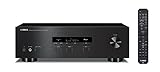
Yamaha R-S202
- 85 watts per channel
- Built-in phono input
- Speaker selector for two systems
- AM/FM tuner with 40 presets

Onkyo TX-8470
- Isolated MM/MC phono board
- Discrete op-amp phono circuitry
- Wi-Fi and Roon Ready streaming
- 110 watts per channel
Comparing the Best Stereo Receivers for Vinyl Setups in 2026
All six units below have a dedicated phono input. What separates them is gain, cartridge support, power and how much they can do beyond vinyl. The Onkyo is the only model in the group with a switchable MM/MC phono board, and the R-N600A is the only one rated highest by owners while staying firmly in the stereo-only camp.
| Product | Specs | Action |
|---|---|---|
| Sony STR-DH190 |
|
Check Latest Price |
| Yamaha R-S202 |
|
Check Latest Price |
| Onkyo TX-8470 |
|
Check Latest Price |
 Yamaha R-N600A Yamaha R-N600A |
|
Check Latest Price |
 Yamaha R-N800A Yamaha R-N800A |
|
Check Latest Price |
 Yamaha R-N1000A Yamaha R-N1000A |
|
Check Latest Price |
1. Sony STR-DH190 – Best phono stage per dollar for a first vinyl setup
Sony STRDH190 2-ch Home Stereo Receiver with Phono Inputs & Bluetooth Black
100 watts x 2 into 8 ohms
6-16 ohm speaker range
Dedicated phono input
Bluetooth and FM tuner
Pros
- Phono stage praised as better than costlier outboard preamps
- Plenty of clean power for two speaker pairs
- Reliable Bluetooth and a capable FM tuner
- Four analog line inputs plus a 3.5 mm jack
- Clear manual and a full remote
Cons
- Spring-clamp speaker terminals barely accept bare wire
- Most functions are only reachable from the remote
- No subwoofer pre-out
- FM presets can be reordered but not deleted
The STR-DH190 is the unit I kept coming back to because the phono stage is far better than it has any right to be at this level. Owners report a clean, loud vinyl input with no distortion, and several compare it unfavourably to much more expensive integrated amplifiers. For a first turntable setup, that comparison is the whole argument.
It is also the only pick here with A/B speaker switching that handles up to four speakers rather than two. That matters if you want to compare a pair of bookshelves against a pair of larger standmounters without rewiring anything.
Power and speaker matching
Rated at 100 watts x 2 into 8 ohms with a stated speaker impedance range of 6 to 16 ohms, this is a genuinely usable amount of power for bookshelf speakers in a normal apartment or listening room. Owners drive two pairs of speakers to high volume without the amp running out of headroom.
The catch is physical. The spring-clamp binding posts have very small openings that barely accept real speaker wire, and some buyers resort to banana plugs or cutting their own connectors. Budget five minutes and a pair of plugs before you start.
Phono stage and cartridge support
There is one phono input with its own ground terminal, and it is tuned for moving-magnet cartridges, which is what almost every entry turntable ships with. Vinyl owners consistently confirm the stage is quiet and loud enough that no external preamp is needed for MM.
If you plan to run a moving-coil cartridge later, this is not the box. The signal sits too low and there is no gain switch to bring it up to a usable level.
Inputs, Bluetooth and the missing sub-out
You get four stereo RCA line inputs, a 3.5 mm input for a phone or laptop, a stereo RCA output, an FM tuner with 30 presets and Bluetooth. The tuner accepts an external antenna, which is unusual in this class and genuinely useful if your signal is marginal.
Two omissions stand out. There is no subwoofer pre-out, so adding a sub means going through the speaker terminals rather than a line-level connection. And almost all critical functions live only on the remote, with very few front-panel controls to fall back on.
Who it suits and who it does not
Buy this if you are starting out with a moving-magnet turntable, want two speaker pairs, and would rather not buy a separate phono box. The phono stage quality per dollar here is the reason this is our first pick.
Pass if you need moving-coil support, a subwoofer output, or control from the front panel. If your speakers dip below 6 ohms, check their manual first, because the stated range starts there.
2. Yamaha R-S202 – Warm entry-level sound with a real phono input
YAMAHA R-S202BL Stereo Receiver
85 watts per channel
Two-speaker selector
Bluetooth 4.1 + EDR
AM/FM tuner with 40 presets
Pros
- Warm balanced tone with strong bass
- Clean output at high listening levels
- Tuner sensitivity often beats costlier units
- Speaker selector for two speaker sets
- Simple uncluttered layout
Cons
- Treble control tops out around 3 kHz
- No HDMI or optical input for TV audio
- No subwoofer pre-out
- Flimsy plastic spring speaker terminals
The R-S202 is the one people describe as a no-fuss receiver, and that is accurate. It produces a warm, musical tone with firm bass that some listeners prefer to more analytical alternatives, and it stays clean and distortion-free at high volume. On records it sounds unhurried rather than clinical.
It regularly turns up as a second-zone, patio or bedroom unit rather than a main system, which tells you how robust it is. Buyers frame it as a solid first receiver where the budget stops the conversation, and that is exactly the role we think it plays.
Power and connectivity
Output power is 85 watts per channel, which is ample for bookshelf speakers and small rooms rather than large floorspeakers in open-plan spaces. The speaker selector handles two separate speaker systems, so an A/B setup is possible.
Connectivity is where it narrows down quickly. Bluetooth 4.1 with EDR covers phone streaming and pairs smoothly, and there is a 40-preset AM/FM tuner with genuinely good sensitivity for the money. There is no HDMI and no optical input, so getting sound from a television means adding an external converter.
Tone controls and the soft top end
The single most repeated complaint is that the treble control tops out around 3 kHz, which leaves cymbals and high-frequency detail permanently soft no matter how you set it. If you like sparkle, this is not the receiver for you and no amount of adjustment will fix it.
One owner also reported a spring speaker terminal breaking during installation, and the volume control has a noticeable dead zone at the low end before sound becomes audible. Neither is fatal, but both are worth knowing about before you plug in.
What turntable it suits
The built-in phono input handles moving-magnet cartridges, which covers the majority of turntables at this budget. It is a simple moving-magnet stage with no cartridge selector, so a moving-coil cartridge will play too quietly to be usable.
Choose it for a small or medium room, warm tonal preferences, and a tuner you will actually use. Skip it if your records need sparkle, your TV needs HDMI, or you plan to add a subwoofer through a proper pre-out.
3. Onkyo TX-8470 – The switchable MM/MC phono board for moving-coil owners
Onkyo TX-8470 2 Channel Stereo Receiver with Wi-Fi, Bluetooth, Phono, Hi-Res Audio and Roon Ready
110 watts per channel
Isolated MM/MC phono board
Discrete op-amp circuitry
Dirac Full Band correction
Pros
- Isolated MM/MC phono board with discrete op-amps
- Wide deep soundstage with strong microdetail
- Enough power for floorstanding speakers
- Roon Tidal and Deezer streaming built in
- Four HDMI ports with ARC
Cons
- Onkyo control app and Wi-Fi setup are unreliable
- No bass management for subwoofer integration
- USB playback stops at the end of a folder tree
- Large remote with small buttons
This is the most interesting box in the group for records, and it is not the most popular one. The phono board is isolated from the main circuitry and built around discrete op-amps, with a switch to select between moving-magnet and moving-coil. In A/B comparisons against separates at several times the cost, owners describe the soundstage as wide and deep with strong microdetail.
It is also built as a two-channel network receiver optimised for music rather than home theatre, which is exactly the brief. Four HDMI ports, Roon, Tidal and Deezer, Dirac Full Band correction and 110 watts per channel sit behind a phono stage that is the point of the machine.
The MM/MC switch is the reason to buy it
A moving-coil cartridge outputs a fraction of the voltage of a moving-magnet, so a receiver with only an MM stage leaves records barely audible. Most owners in this situation add a step-up transformer, which costs money and adds another box to the chain.
The TX-8470 removes that problem with a front-panel switch. If you own an MC cartridge now or will eventually, this is the only receiver here that handles it natively.
Power, HDMI and room correction
At 110 watts per channel there is enough output for floorstanding speakers at low distortion, and the chassis uses gold-plated terminals and audio-grade capacitors. Four HDMI ports with ARC mean it can also carry TV audio, which makes it a reasonable hybrid for a mixed room.
Dirac Full Band room correction is included with a microphone, which is rare on a two-channel unit. Just note there is no bass management, so subwoofer integration has to be dialled in manually rather than handled by a crossover menu.
The software is the weak point
Almost every negative review is about software rather than sound. The Onkyo control app is described as unreliable, frequently losing Wi-Fi and dropping its connection to the receiver, and network setup is fiddly because the password has to be typed with the remote. Some owners report needing a soft reboot to restore the connection.
There is also a specific USB regression: playback stops at the end of a folder tree instead of continuing through the drive, which will matter if you were planning local hi-res playback as a primary source. Check the remote and menu depth are acceptable to you before buying, because a large remote with tiny buttons and a complex menu tree is a daily irritation.
Who should buy it
Pick this if you run a moving-coil cartridge, want a network streaming platform alongside vinyl, and are willing to fight the app once during setup. The phono board and the measured power make it the strongest musical performer here for those two use cases.
Pass if you want simple plug-and-play networking or plan to control everything from a phone every day. The sound and gain are worth the setup effort; the software is not for everyone.
4. Yamaha R-N600A – The quietest vinyl floor with a built-in DAC and streaming
R-N600A Network Receiver with Streaming, Phono and Built-in DAC, Black
175 watts output
ESS SABRE ES9010K2M DAC
Pure Direct and MusicCast
Two speaker sets plus sub out
Pros
- Tank build with a thick brushed metal front panel
- Transparent DAC handles CD through 24/192 and DSD
- Owners report an unusually quiet record floor
- Pure Direct bypasses network and tone controls
- Two speaker pairs plus subwoofer output
Cons
- Phono stage is MM only with modest gain
- No room correction of any kind
- No HDMI ports
- MusicCast app has no desktop version
The R-N600A carries the highest owner rating in this group, and vinyl listeners give a specific reason: the record floor is nearly silent. Several owners say they hear far less surface hiss than they expected, and that the phono stage tracks the RIAA curve closely. For a system that spends its life spinning records, that is the detail that matters.
Around it sits an unusually complete hub. An ESS SABRE ES9010K2M Ultra DAC, MusicCast with Spotify, Tidal and Qobuz, front-panel USB with DSD 11.2 MHz native and 384 kHz playback, optical and coax digital inputs, and two sets of speaker terminals plus a subwoofer output.
Pure Direct and what it actually does
Pure Direct is the mode vinyl owners should be using. It bypasses the network circuitry, Bluetooth and the tone controls, so the analogue path stays as short as possible. It is the digital equivalent of not touching anything on a mixing desk.
Buyers who raise Pure Direct as a buying criterion are usually coming from network receivers where streaming and digital sections leak noise into analogue playback. On this model the mode exists and works, which is more than some competitors offer.
Power and speaker flexibility
Output is listed at 175 watts, and there are two sets of speaker terminals plus a subwoofer output with crossover control. That means you can run your main pair, a second pair for comparison, and a subwoofer without a separate amplifier or splitter.
Build quality is described as phenomenal, with a thick brushed metal front and heavy internals. The rear terminals feel sturdy, which is worth noting given how many competing units in this article have spring clips.
The phono stage limits
Here is the catch. The phono input handles moving-magnet cartridges only, with modest gain, and several owners add a separate phono preamp to get more headroom or a wider cartridge match. If you already run a moving-coil cartridge, this box is not for you despite the excellent silence.
There is also no HDMI and no room correction at all. Owners point out that the front-panel knobs are plastic on an otherwise metal chassis, and some listeners report a grainy midrange with thin highs as volume rises. The MusicCast app is mobile-only, with no Mac or PC version.
Who it suits
This is the pick for someone who wants one box to handle records, streaming and a subwoofer, and who values a quiet phono stage and a clean analogue path above all. The ESS DAC and front USB also make it a sensible centre for a hi-res library.
Pass if you need moving-coil gain, television audio over HDMI, or automatic room correction. Those gaps are real and no amount of software patches them.
5. Yamaha R-N800A – Premium network power with 2.1-channel TV support
Yamaha R-N800A Network Receiver with Phono and Built-in DAC, Silver
240 watts output
ESS SABRE ES9080Q DAC
YPAO-R.S.C. room correction
2.1-channel TV audio with HDMI
Pros
- Wide soundstage with precise instrument separation
- Real power for demanding bookshelf and tower speakers
- Consistent quality across analog and network sources
- YPAO-R.S.C. measures distances accurately
- Five-year manufacturer warranty
Cons
- Built-in phono stage is considered the weak link
- Volume levels differ sharply between turntable and CD
- Some owners prefer YPAO switched off
- Calibration microphone fails on some units
The R-N800A is the most powerful output figure in the group at 240 watts, and it backs that up with the widest feature set: a 2.1-channel network receiver with MusicCast, an ESS SABRE ES9080Q Ultra DAC, USB playback to DSD 11.2 MHz native and 384 kHz, three HDMI ports, and YPAO-R.S.C. calibration with an included microphone.
Sound quality is the reason most owners keep it. Reviewers describe an exceptionally clean, wide soundstage with precise instrument separation when paired with revealing speakers, and roughly 100 watts per channel of real power that drives demanding bookshelf and tower speakers without strain.
The phono stage is the weak link
Owners are split, and the split is worth reading before you buy for records. Several consider the built-in phono stage sub-par, and at least one added an external Cambridge Audio preamp. If records are your primary source, treat the phono section as the compromise in this machine rather than the reason to choose it.
A second recurring complaint is volume level mismatch. Owners report levels differing sharply between turntable and CD sources, requiring a readjustment every time you switch. That is an annoyance you will feel daily in a mixed-source system.
YPAO-R.S.C. and the debate around it
Room correction is the other flashpoint. Some owners say it measures speaker distances accurately and tightens the room up nicely. Others say the correction muddies the sound and simply switch it off entirely, and a few report the calibration microphone returning an error message.
Our advice: run it, listen, and compare. If you play records in Pure Direct or bypass the correction, the argument becomes irrelevant on your chosen source.
Connectivity and reliability
Sound quality stays consistent across optical, coaxial, AirPlay, Bluetooth and streaming sources, which is unusual for a receiver at this level. The ESS SABRE ES9080Q DAC resolves fine detail with low noise.
Reliability complaints cluster around software rather than hardware. The Amazon Music app can freeze and require a reset, while Tidal and Qobuz are reported as reliable. The rear speaker binding posts use thin sheet metal that feels insubstantial, and the remote and front knobs have a cheap plastic feel.
Who it suits
Buy this if your room is large, your speakers are demanding, and you want vinyl alongside television audio and hi-res streaming in a single chassis with a five-year warranty. The power and the DAC are genuinely class-leading.
Pass if vinyl is your only source and you want the best possible phono stage. Adding an external preamp to reach that point costs money and defeats part of the purpose of buying one box.
6. Yamaha R-N1000A – High power for demanding 4-ohm speakers
R-N1000A Network Receiver with Phono, HDMI and Built-in DAC, Black
140 watts output
ESS SABRE ES9080Q DAC
HDMI input for 2.1 TV audio
Pre-out for an external power amp
Pros
- MM phono stage described as top notch
- Drives demanding 4 ohm speakers such as KEF Meta R3s
- Build quality and weight above the competition
- Pre-outs for an external power amplifier
- Runs cool after hours of use
Cons
- MusicCast app and network setup are widely criticised
- Manual network settings do not persist
- Some units arrive with poor packaging
- Retro styling less refined than rivals
The R-N1000A exists for the case where your speakers are the constraint. Owners report it driving demanding 4-ohm loads such as KEF Meta R3s and JBL L100s, with output power listed at 140 watts. Build quality and weight are described as well above the competition, and it runs cool even after hours of use.
It is also the only pick here with a pre-out for a separate power amplifier, which makes it a useful centre for a system you plan to grow. An HDMI input lets it work as a two-channel home theatre amplifier rather than a music-only box.
The phono stage is better than expected here
Interestingly, this is the Yamaha network receiver where owners are most positive about the built-in MM phono stage, describing it as top notch and pairing it enthusiastically with a turntable. Several report a large jump in clarity, detail and soundstage over the mainstream AV receivers they replaced.
Support is moving-magnet only, and the specification lists an MM phono input with no MC switching. Plan on a step-up transformer if a moving-coil cartridge is in your future.
The software divide
This model draws the harshest software criticism in the entire group. MusicCast networking and the setup app are widely described as clunky and unreliable, with the device dropping off the network and manual network configuration that does not persist after a disconnect. A few owners returned units over this despite enjoying the sound.
There is also a supply-chain note worth mentioning: some receivers arrive with poor or missing foam packaging and turn up dented. Check the box on delivery. The retro 1980s styling is less refined than competing models from Carver, NAD and Adcom, which matters only if the receiver sits in a visible position.
Pre-outs, Pure Direct and five-year cover
Pure Direct, loudness compensation and pre-outs for an external power amp are all present, and the warranty runs five years. YPAO-R.S.C. calibration is included with a microphone, though some owners consider it unnecessary and simply disable it.
Because of the low owner volume on this model, treat the software complaints as a pattern to check rather than a certainty. If your listening is mostly vinyl and local files with the occasional stream, the network features matter less.
Who it suits
Buy this if your speakers are low-impedance or demanding and you want one chassis that can also drive a second power amplifier later. The phono stage, power and build quality make it a strong foundation.
Pass if you need moving-coil support or reliable app control, or if you want a polished front panel. The network experience here is the weakest in the group.
Do You Even Need a Receiver? Receiver vs Integrated Amplifier vs Phono Preamp
You need an amplifier that powers passive speakers and a phono stage that turns a cartridge signal into line level. A receiver simply puts both in one box, adds source switching, and usually adds a tuner. That is the entire difference.
The analogue chain runs: cartridge, phono stage with RIAA equalisation, line level, power amplifier, passive speakers. Nothing on that path is converted to digital in an analogue stereo receiver, which is a common misconception.
A phono preamp is just the RIAA circuit on its own. A receiver is a power amplifier with inputs, a phono stage and a tuner. An integrated amplifier is a power amplifier with inputs, usually including a phono stage, and normally no tuner. An AV receiver adds HDMI and surround decoding you do not need for records.
If your turntable already has a built-in preamp with a line-level output, you technically need only a power amplifier. Most owners we spoke to still prefer a receiver with a real phono stage, because switching sources and adding a tuner later costs more than the phono stage saves.
What Turntable Do You Own? Cartridge Compatibility Map
Almost every confusion in this category starts with matching a cartridge to an input. Use this map before you buy anything.
MM cartridge with a built-in preamp and a line-level switch: you can use any line input, or the phono input, but the phono input is not required.
MM cartridge with no built-in preamp: you need a PHONO input with an MM-capable stage. All six picks qualify.
MC cartridge with no built-in preamp: you need a switchable MM/MC phono stage or an external step-up transformer. Only the Onkyo TX-8470 offers the switch in this group.
MM cartridge with a built-in preamp feeding a receiver phono input: this double-corrects the signal and sounds thin and wrong. Use a line input instead.
Two failure modes dominate forum threads. Plugging any turntable into an AUX or CD input gives the quiet, bassless, tinny result that makes new owners think their turntable is broken. And an unconnected ground wire produces a steady hum that no amount of volume control fixes.
How to Connect a Turntable to a Stereo Receiver in 5 Steps
Step one: identify the input. Look for a jack labelled PHONO, not AUX, CD or LINE. It will be a pair of RCA sockets near a small ground post.
Step two: connect the RCA cables. Red goes to right, white to left, and the plugs should seat firmly with a small click.
Step three: attach the ground wire. This is the small bare or spade lead from the turntable, and it goes to the phono ground terminal. This single step resolves most hum problems.
Step four: select the PHONO source on the receiver and set the volume low before cueing the record up.
Step five: bypass processing. On a network receiver, switch to Pure Direct or Direct mode and leave tone controls flat so the analogue path stays clean.
If your turntable has a built-in preamp and a line-level output, step one changes: use a line input, and either leave the preamp switch engaged or skip the phono stage entirely. Never feed a line output into a phono input.
Hum vs Rumble: How to Kill Both
These are two different problems with two different fixes, and confusing them wastes hours. Hum is a steady buzz at mains frequency that follows the input. Rumble is low-frequency energy that moves the stylus and usually means the turntable is picking up mechanical or structural vibration.
For hum, work in order. Check the ground wire is connected to the phono ground post and tight. Check both RCA plugs are fully seated. Try a different input with nothing connected to hear whether the buzz follows the input or the speakers. If it follows the speakers, unplug the turntable; if the hum stops, the loop is in the turntable cable.
For rumble, move the turntable off the same surface as the speaker cabinets, keep it away from a subwoofer sitting in the same cabinet, and check whether the record itself is warped. Isolation platforms help with structure-borne vibration but do nothing for electrical hum.
If you use an external phono preamp, earth it at the preamp rather than at the receiver, and keep the connection as short as practical. Owners who re-routed through a phono box report audible changes when the grounding point changes, which tells you it matters.
Stereo-Only Receiver vs AV Receiver for Vinyl Setups
A two-channel stereo receiver is built around music. It gives you two channels, a real analogue path, less menu depth and usually better measured performance for the same money than a surround receiver of similar power.
An AV receiver adds HDMI, surround decoding, room calibration for a roomful of speakers, and often a fan. Some of the models listed in budget guides omit the phono input entirely, which forces a separate preamp box.
The Onkyo TX-8470, the Yamaha R-N800A and the Yamaha R-N1000A sit in between. Each has HDMI for television audio and can act as a two-channel home theatre amplifier without asking you to navigate a surround setup menu.
Our rule is simple. If you play records and little else, buy stereo-only. If the same amplifier also feeds a television, buy the hybrid with HDMI. Do not buy an AV receiver for its surround processing and then play records in a Pro Logic or Neural mode, because matrixing can hollow out vocals and shift the soundstage.
If you do add a subwoofer, set the crossover to 80 Hz or lower so the main speakers keep the low end that vinyl reproduces best.
What to Look for When Buying a Stereo Receiver for Vinyl Setups
Confirm the phono input and its ground post
A dedicated PHONO label and a separate ground terminal are the minimum credibility markers for a vinyl-capable receiver. Every pick here has both. A receiver with only RCA line inputs needs an external phono preamp, which is a box, a power lead and another thing to fault-find.
Match the cartridge to the gain
Moving-magnet cartridges typically output a few millivolts and need moderate gain. Moving-coil cartridges output far less and need either a switchable stage or a step-up transformer. If you are unsure, check the cartridge specification before choosing a receiver rather than after.
Check speaker impedance before you buy
The Sony states a 6 to 16 ohm range. Others are less explicit, which usually means they are happiest with 6 ohm and 8 ohm loads. Speakers that dip to 4 ohms need a receiver with real current capability or an amp with a known 4 ohm rating.
Decide how much power you actually need
Watts per channel matter far less than forum threads suggest. A pair of bookshelf speakers in a normal room is comfortably driven by the 85 watts in the Yamaha R-S202. You need the higher figures only for large rooms, inefficient floorstanders or low-impedance loads.
Count the line inputs and second speaker pair
Four stereo RCA inputs covers a turntable plus three sources comfortably. Two sets of speaker terminals let you A/B two speaker pairs, which is how most people decide between upgrades. A subwoofer pre-out keeps the sub on a line-level connection rather than sharing the speaker binding posts.
Decide whether you want a network receiver at all
Wi-Fi streaming, a built-in DAC and MusicCast-type apps are convenient, but every one of the network receivers here draws software complaints, and the pattern is consistent across brands. Buy streaming if it matters to you and accept the setup effort. Do not buy one for features you will never open.
Budget for the rest of the chain
Forum advice is consistent on upgrade order: get the cartridge and tonearm right, then the phono stage, then the speakers, then the amplifier. Buying an expensive receiver before the turntable is solved is the most common regret we see, and an inexpensive external phono preamp can be a smarter first step than a better receiver.
Frequently Asked Questions
What is the best stereo receiver for vinyl playing?
The Sony STR-DH190 is the best all-round choice, because its dedicated PHONO input stays clean and loud enough that no external preamp is needed for moving-magnet cartridges, and it adds A/B speaker switching for two pairs. Owners regularly compare its phono stage favourably with far more expensive integrated amplifiers. If you run a moving-coil cartridge, choose the Onkyo TX-8470 instead, since it is the only model here with a switchable MM/MC board.
Can I use any RCA input on my receiver for a turntable?
Only if your turntable has a built-in phono preamp and a line-level output. A turntable without one puts a few millivolts onto the cable, and an AUX, CD or line input provides neither the RIAA equalisation nor the gain, so records play very quietly with no bass. Always use the input labelled PHONO, and attach the turntable ground wire to the phono ground post.
Do all AV receivers come with a phono input?
No. A fair number of modern AV receivers omit the phono stage entirely, which forces owners to add a separate phono preamp box. Some budget guides also list amplifiers with no phono input at all as if they were receivers. Check the rear panel for a PHONO label and a ground terminal before you buy anything for a turntable.
What if my turntable has a moving coil cartridge?
A moving-coil cartridge outputs a much lower voltage than a moving-magnet, so a receiver with only an MM stage will play records too quietly. You need either a receiver with an MM/MC gain switch or an external step-up transformer between the cartridge and the phono input. Among these picks, only the Onkyo TX-8470 has a switchable MM/MC phono board.
How do I stop the humming sound coming from my speakers?
Check the turntable ground wire first, connecting it firmly to the phono ground post, then reseat both RCA plugs. Select a different input with nothing plugged in to see whether the hum follows the input or the speakers. If it follows the speakers and stops when you disconnect the turntable, the loop is in the turntable cable or its grounding.
Can I connect a turntable without an external phono preamp?
Yes, as long as the receiver has a phono input matched to your cartridge. Every receiver in this roundup has one, so a separate preamp is unnecessary for moving-magnet cartridges. You will only need an external stage for moving-coil gain, cartridge impedance matching beyond the receiver’s fixed load, or a noticeably quieter noise floor than the built-in circuit provides.
Should I still buy an external phono preamp if my receiver has one?
Usually not, especially for a moving-magnet cartridge. The built-in stages in these receivers are clean and loud enough for the majority of turntables. Add an external preamp when you run a moving-coil cartridge needing more gain, when you want to bypass the receiver’s fixed cartridge loading, or when you are chasing a noticeably lower noise floor than the built-in circuit delivers.
Final Verdict: Which Stereo Receiver for Vinyl Setups Should You Buy?
If you want one box for a moving-magnet turntable and two speaker pairs, the Sony STR-DH190 is the pick. Its phono stage is the strongest relative to what you spend in this group, and the A/B switching is genuinely useful rather than decorative.
If your room is small, you like a warm tone and you will use the tuner, the Yamaha R-S202 is the simpler answer. If your cartridge is moving-coil, there is no alternative in this list: the Onkyo TX-8470 with its isolated MM/MC board is the only receiver here that handles it without a step-up transformer.
If you want one chassis for records, hi-res streaming and a subwoofer, the Yamaha R-N600A is the quietest vinyl floor in the group, backed by an ESS DAC and Pure Direct. If your room is large or your speakers are demanding, the Yamaha R-N800A delivers the most power with television support, and the Yamaha R-N1000A goes further for low-impedance speakers with pre-outs for later expansion.
Whichever you choose, connect the ground wire first and use Pure Direct when you have it. Those two habits do more for how your records sound than any upgrade you would buy next, and they cost nothing.