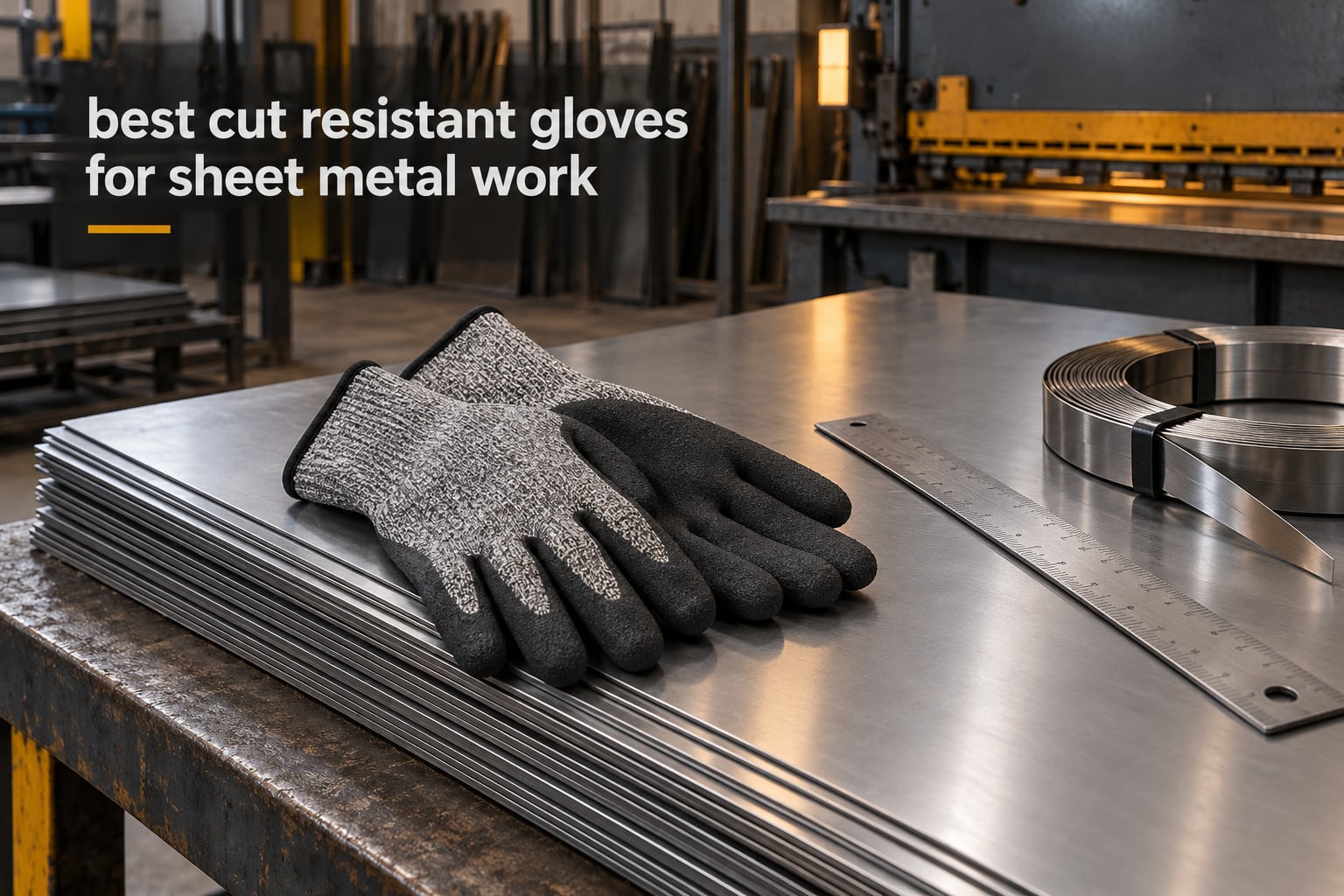
A sheet metal shop runs on edges. Every bracket, panel and laser-cut blank arrives with a cut edge sharp enough to open a forearm, and the difference between a good shift and a bad one usually comes down to what your hands are wearing when you grab it. I have spent the last few years watching fabricators, HVAC installers and stamping crews cycle through gloves, and the same three failures show up every time: a shell that is rated too low for the task, a palm that loses grip once coolant hits it, and a pair that gets pulled off in the middle of a job because it feels too stiff to work in.
That is the problem this guide solves. Below I break down the best cut resistant gloves for sheet metal work available right now, ranked by the two things that matter on a real job: how much cut protection the shell actually delivers and whether workers will keep the gloves on through hour six. We compared ANSI/ISEA 105 levels, shell materials, palm coating technology, gauge and cuff construction across twelve gloves, and we weighted the results toward the way sheet metal is actually handled, moved and stacked.
If your crew is moving raw sheet or sorting scrap rather than fitting finished ductwork, our broader work gloves for handling metal guide covers the wider category. This list stays focused on laceration risk from sheet stock, blanks and formed parts.
A note on what follows. Cut resistant gloves reduce laceration risk. They do not make anyone cut proof, and no glove in this roundup is rated for puncture or stab hazards unless the manufacturer says so on the label. For anyone working close to rotating machinery, a guard or press interlock does more for safety than any glove we list.
Our Top 3 Best Cut Resistant Gloves for Sheet Metal Work (October 2026)
These three cover the range most shops need. One is the all-day generalist, one is the maximum protection option for scrap and raw sheet, and one is the low-cost glove for crews who need basic coverage without overpaying for it.
EDITOR'S CHOICE

- ANSI A5 cut
- 13-gauge HPPE and nylon
- Water-based foam nitrile palm
- Touchscreen compatible
MOST VERSATILE

- ANSI A9 cut rating
- Sandy nitrile grip
- Reinforced thumb crotch
- 360-degree hand coverage
BUDGET PICK

- ANSI A3 cut protection
- Level 6 abrasion
- 13-gauge HPPE knit
- PU coated palm
As an Amazon Associate we earn from qualifying purchases. CERTAIN CONTENT THAT APPEARS ON THIS SITE COMES FROM AMAZON. THIS CONTENT IS PROVIDED 'AS IS' AND IS SUBJECT TO CHANGE OR REMOVAL AT ANY TIME.
All 12 Gloves Compared by Cut Level, Coating and Task
Use this table to narrow the field before you read the individual reviews. The cut rating tells you how much force the shell resists before a blade passes through, and the coating tells you whether you can hold the part once oil or coolant is on it.
As an Amazon Associate we earn from qualifying purchases, at no additional cost to you. CERTAIN CONTENT THAT APPEARS ON THIS SITE COMES FROM AMAZON. THIS CONTENT IS PROVIDED 'AS IS' AND IS SUBJECT TO CHANGE OR REMOVAL AT ANY TIME.
1. DEX FIT Cru553 Level 5 – The Glove Workers Actually Keep Wearing
EDITOR'S CHOICE
ANSI A5 cut
13-gauge HPPE, nylon and spandex
Foam nitrile palm
Touchscreen compatible
Machine washable
Pros
- Second-skin 13-gauge fit keeps full dexterity
- Foam nitrile grips wet
- greasy and smooth sheet
- Machine washable and reusable
- Touchscreen compatible at the fingertips
- Breathable enough for all-day wear
Cons
- Back of the hand is not cut resistant
- Not rated for heavy construction or abusive sheet metal work
- Coating can crack and peel after a few weeks of hard use
The Cru553 is the glove I recommend first to almost anyone, and the reason has less to do with its spec sheet than with its wear rate. Sixteen thousand reviews is a lot of people putting a glove on every morning for months, and the recurring word in that feedback is that it disappears. Workers stop noticing it, which is the highest compliment a hand protection product can earn.
The shell is a 13-gauge knit made from 60 percent HPPE, 10 percent fiberglass and 30 percent nylon and spandex. That blend is what gives it the second-skin stretch that lets you pick up a rivet, feel a burr or hold a pencil on a layout table without fighting the glove.
It is rated ANSI A5 for cut resistance, which makes it the right default for handling sheared and deburred sheet, bending thin gauge material and installing finished panels. It is not the glove for dragging sheet across a conveyor, feeding a scrap hopper or working a laser table where edges are freshly cut and undefended.
The palm coating is a water-based foam nitrile that passed the FDA food contact coating test, which is a reasonable indicator of grip on damp, greasy and smooth surfaces. Foam nitrile gives a softer, less tacky feel than a full sandy dip, and it is easier to get on and off at the end of a shift, though it is also easier to cut through. Foam coating is a grip surface, not armor.
How the A5 Rating Holds Up on Real Sheet
A5 is a middle-of-the-road rating in the ANSI/ISEA 105 scale, and for most sheet metal handling it is the sweet spot. The test applies a straight blade under increasing weight until it passes through the shell, so a higher number means more force is needed. A5 gloves are routinely used on the kinds of edges fabricators deal with daily: cut sheet, bent flanges and parts that have already been deburred.
What A5 does not cover is puncture. A sharp stud or a sheet corner driven into the palm will go through a coated knit without much resistance, and this is where gloves get blamed for injuries that the rating never promised to prevent.
Fit, Washing and Long-Term Comfort
The stretch knit and elastic closure mean there is no strap to break and no cuff hardware to lose in a drain. It weighs under three ounces per pair, which is light enough that fatigue is rarely the complaint. It runs in five sizes from X-Small to XX-Large, and the lightweight knit is a good pick for people with smaller hands who struggle to find cut gloves that fit.
Machine washing is the other reason crews standardize on this model. A glove that can go in a washer with shop towels survives far longer than one that gets tossed when it turns black, and the coating holds up reasonably well across a moderate number of cycles before it starts to crack. Watch for that cracking as your replacement signal, because a splitting palm is where contamination and grit get in.
Fit interacts with everything else a worker puts on. A crew that fusses with lace-up or pull-on work boots at the start of a shift tends to pull the gloves off mid-task, so if footwear is a problem, our pull-on work boot guide is worth reading alongside this one.
Where It Falls Short
Protection is on the palm and finger side. The back of the hand is a thin knit with no coating and no reinforcement, so a part that shifts while you are repositioning it can find the knuckle side of your hand unprotected. If your crew works around press brakes or does a lot of part stacking, pair this with a sleeve or move to an impact-rated model.
Reviewers also mention odor retention after the gloves get wet, and the fact that the touchscreen coating on the fingertips wears down over months of use. Neither is a safety issue, but both are the reasons some crews end up with a mix of old and new pairs in the same drawer, which makes it harder to know what protection anyone is actually wearing.
Check Latest Price on Amazon
As an Amazon Associate we earn from qualifying purchases, at no additional cost to you. CERTAIN CONTENT THAT APPEARS ON THIS SITE COMES FROM AMAZON. THIS CONTENT IS PROVIDED 'AS IS' AND IS SUBJECT TO CHANGE OR REMOVAL AT ANY TIME.
2. Schwer ProGuard Pr3326 A9 – Maximum Cut Protection Without the Chainmail Bulk
MOST VERSATILE
ANSI A9 cut
13-gauge knit with metal wire
Sandy nitrile coating
Reinforced thumb crotch
Touchscreen compatible
Pros
- Top-tier A9 cut resistance in a light knit
- Reinforced thumb crotch outlasts ordinary knit gloves
- Sandy nitrile holds grip when wet or greasy
- Machine washable
- Genuine touchscreen performance
Cons
- Not waterproof
- Nitrile coating can become brittle and peel after a few weeks
- Limited breathability leaves hands damp on long shifts
A9 is the top of the ANSI cut scale and the rating you want when the edges are undefended. Raw material coming off a shear, blanks that have just been laser cut, and scrap sorting bins are the tasks that justify this level, because the hazard there is not a deburred panel edge but an uncontrolled sharp surface with no fixed geometry.
The ProGuard is interesting because it delivers that rating in a 13-gauge knit rather than a chainmail shell. The fabric is HPPE, polyester and spandex with metal wire blended in, which means you get genuine blade resistance while keeping enough flexibility to turn a wrench and pull a cotter pin.
Why the Reinforced Thumb Crotch Matters on Sheet
The thumb crotch is where gloves fail first on sheet metal work, because it is the point that takes the load when you pinch a flange or pull a part out of a stack. Schwers reinforces that zone, and it is the single most practical detail on an A9 knit for anyone doing handling rather than static inspection.
The sandy nitrile coating is textured rather than foamed, which gives it a more aggressive grip on wet and greasy surfaces than foam nitrile. On an oily stamping line that difference is the whole ballgame, because foam coating goes slick the moment cutting fluid gets on it.
A9 Protection and Its Limits
An A9 shell will stop a lot. It will not stop a puncturing force, and it is not rated for impact. Buyers who need blade stopping plus stab resistance are better served by a chainmail shell like the one covered later in this roundup.
Breathability is the recurring complaint in reviews. A 13-gauge knit with a full sandy dip on the palm traps more heat than a foam coating, and crews working in a non-air-conditioned fabrication bay in summer will feel it. Gloves come off during hot work, and gloves that come off do not protect anyone, so plan for that trade-off rather than ignoring it.
Where This Fits in a Two-Glove System
The most practical use for this glove is as the second pair in a system. Workers keep a lighter A5 or A6 glove for fit-up, layout and handling, and switch to an A9 for raw sheet, scrap bins and cleanup. The ProGuard is light enough that the switch does not interrupt the workflow the way switching to chainmail does.
Reviewers report that the nitrile coating can turn brittle and start peeling after a few weeks of continuous service, so the practical replacement cycle is measured in weeks of hard use rather than months. It is also not waterproof, so standing water on a jobsite will eventually find a way in through the knit.
Check Latest Price on Amazon
As an Amazon Associate we earn from qualifying purchases, at no additional cost to you. CERTAIN CONTENT THAT APPEARS ON THIS SITE COMES FROM AMAZON. THIS CONTENT IS PROVIDED 'AS IS' AND IS SUBJECT TO CHANGE OR REMOVAL AT ANY TIME.
3. Schwer PM5201 Chainmail Glove – When the Hazard Is a Blade, Not an Edge
BEST FOR STAB AND BLADE WORK
316L stainless steel mesh
Individually welded rings
Reversible five-finger design
Adjustable mesh clasp
Pros
- Stops blade tips before they reach the skin
- Individually welded rings outlast cheaper mesh
- Food grade steel resists rust and sanitizes easily
- Reversible design fits either hand
- Mesh clasp is easy to clean
Cons
- Runs large in the palm and can bunch excess material
- Poor dexterity for fine or precision work
- Needs daily cleaning in food processing settings
- Wrong sizing can let loose mesh snag
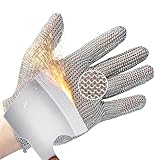
This is the only glove in the roundup that addresses stab and puncture risk, and that distinction matters. A cut resistant knit is rated against a blade drawn across the shell in a straight line. It is not rated against a point driven into the palm, which is exactly what happens when someone reaches into a bin of cut blanks or sorts scrap without looking.
The PM5201 is built from individually welded 316L stainless steel rings in a five-finger reversible design with an adjustable mesh clasp at the wrist. Ring count and weld quality are what separate a serviceable chainmail glove from a novelty one, and this is a genuinely welded construction rather than a stamped mesh sheet.
Sizing Is the Whole Conversation
Every review that matters on this glove is about fit. Chainmail has no stretch, so a size that is slightly too large produces slack material across the palm that folds and bunches when you close your hand. The recurring advice from buyers is to measure your hand against the size chart and size down when you are between sizes.
Some users solve the slack problem by wearing a thin nitrile glove underneath, which removes the gap between your hand and the mesh. That also solves the hygiene question in food processing, where the manufacturer recommends daily cleaning.
Where Chainmail Earns Its Cost
No knit in this roundup will do what this glove does against a puncture. In scrap sorting, knife handling, glass breaking-out and any task where a sharp point can find the palm, the chainmail shell is the only option here that addresses the actual failure mode.
The trade-off is dexterity. Rings do not flex the way a knit fiber does, so picking up a small fastener or turning a wing nut while wearing these is genuinely difficult. Most shops end up treating chainmail as task-specific gear that comes out for the risky job and goes back in the drawer for everything else.
Durability and Sanitation
Food grade 316L stainless steel is corrosion resistant and tolerates aggressive sanitizing, which is why this construction dominates food processing and slaughterhouse work. In a metal shop the same corrosion resistance means sweat and coolant do not attack the rings the way they would attack mild steel.
Mesh can snag if it is loose or if the clasp is not tightened properly. A caught ring can pull the glove out of shape and, in the worst case, catch on rotating equipment. Keep the clasp snug and check the shell for bent or broken rings before each shift.
For a fabricator this is a niche glove, and buying twelve pairs for a crew that mostly handles finished parts is a waste of budget. For a recycling or scrap operation where hand lacerations are a recurring injury category, it is the correct standard issue. Decide which side of that line your shop is on before ordering.
Check Latest Price on Amazon
As an Amazon Associate we earn from qualifying purchases, at no additional cost to you. CERTAIN CONTENT THAT APPEARS ON THIS SITE COMES FROM AMAZON. THIS CONTENT IS PROVIDED 'AS IS' AND IS SUBJECT TO CHANGE OR REMOVAL AT ANY TIME.
4. KAYGO KG21N A3 Two-Pack – The Sensible Starter Pair for New Crews
BEST FOR TWO-PACK CREW ISSUE
ANSI A3 cut, CE EN388 4X42C
Level 4 abrasion
MicroFoam nitrile palm
13-gauge seamless knit
Two pairs per pack
Pros
- MicroFoam nitrile grips greasy machinery well
- Lightweight seamless knit reduces fatigue
- Sold as two pairs per pack
- Machine washable while holding shape
- Snug fit still allows full finger movement
Cons
- Fingertips can shred within days on abrasive tasks
- Elastic cuff feels constrictive during long cuts
- Finger length runs long on the largest size
- A3 will not stop serious blades
The KAYGO KG21N is a two-pair pack of 13-gauge HPPE and glass fiber gloves with a MicroFoam nitrile palm. The MicroFoam coating is the reason mechanics and demolition crews like it, because it holds a grip on oily machinery without the heavy rubber feel of a full dip.
It is certified to ANSI A3 for cut and CE EN388 4X42C, with ANSI level 4 abrasion resistance. That is a modest cut rating. Treat this glove as protection for glass, banding straps, small burrs and general handling rather than for sharp sheared sheet.
When A3 Is Enough and When It Is Not
A3 covers the hazard of a glove sliding across a surface and catching on a burr, a tie wrap or a sheet edge that is not under load. It does not cover dragging a glove deliberately along a cut edge, which is how most lacerations on this kind of glove actually happen.
If you are introducing cut protection to a crew that previously wore no gloves at all, starting at A3 is a reasonable way to build the habit, then upgrading once workers understand what the rating means. If you are replacing an established standard, this is a step down.
Grip on Oily Parts
The MicroFoam palm performs well in the conditions that make metal work miserable: cutting fluid, hydraulic oil and wet coolant. It also carries ANSI level 4 abrasion, which means the coated surface itself holds up against rub and scuff better than the cut rating would suggest.
Knitting is seamless with spandex through the liner, so there are no seams to abrade at the palm, and the machine washable construction survives industrial laundering better than most gloves at this level. Launderability matters more than most buyers expect, because a shop that washes gloves extends service life dramatically.
Known Weak Points
Fingertips are the recurring failure. Reviewers report fingertips shredding within days of abrasive work, which is exactly where coated fingertip protection matters for sheet metal handling. The elastic cuff can also feel tight during long cutting sessions, and the finger length runs long on the largest size, which gets in the way of fine handling.
At A3, this glove will not stop a serious blade. Know that before you standardize it on a crew that works with sheared metal or laser-cut parts.
The two-pack format is the practical reason to buy this in volume. It lets you issue one glove to a worker while the other is in the laundry rotation, which is a simple way to keep a crew in gloves without doubling inventory. Warranty coverage is listed at six months, which is a useful baseline when you are setting replacement expectations.
Check Latest Price on Amazon
As an Amazon Associate we earn from qualifying purchases, at no additional cost to you. CERTAIN CONTENT THAT APPEARS ON THIS SITE COMES FROM AMAZON. THIS CONTENT IS PROVIDED 'AS IS' AND IS SUBJECT TO CHANGE OR REMOVAL AT ANY TIME.
5. Schwer PM3202 A9 Dipped – Built for Wet, Oily and Long-Shift Fabrication
BEST FOR WET AND OILY FABRICATION
ANSI A9 cut
3/4 double-dipped nitrile
Level 4 puncture, EN388 level 4 tear
18-gauge knit
Waterproof coating
Pros
- A9 cut with 3/4 nitrile coverage against oil and water
- Double-dip holds up to abrasion far better than single dip
- Lightweight 18-gauge knit reduces fatigue
- Strong grip wet
- greasy or dry
- Endorsed for sheet metal and MIG welding
Cons
- Not breathable
- sweat gets trapped inside
- Coating can turn brittle and flake after several weeks
- Can hold an unpleasant odor
- Runs large
Where the ProGuard uses a sandy dip, this glove goes further. The PM3202 has a three-quarter double-dipped nitrile coating, which covers well up the forearm and is described as waterproof and oil resistant. That is a meaningful upgrade for anyone working around coolant, cutting fluid or weather on a rooftop or exterior install.
It carries an ANSI A9 cut rating with level 5 abrasion, level 4 puncture and EN388 level 4 tear resistance. The puncture rating is worth noting because very few knit gloves in this roundup publish one, and it does not make the glove puncture proof, but it is a meaningfully stronger outer layer than a foam dip.
Double Dip Versus Single Dip
The coating is applied twice, which builds a thicker, more abrasion resistant rubber layer that resists the drag of sheet across a table or the repeated contact of a part being repositioned. Single-dip gloves in this category tend to wear through in the palm and fingertip within weeks on abrasive sheet handling, and double dip is the main engineering answer to that.
The tradeoff is heat. A three-quarter dip on an 18-gauge knit is a lot of material over a lot of surface area, and reviewers consistently report trapped sweat and reduced breathability. In a cool shop or an outdoor job this is a clear win. In a hot fabrication bay it can drive gloves off the hand.
Welding-Adjacent Work
The manufacturer positions this glove for MIG welding and metal fabrication work. The coated forearm is useful near a hot part or a spatter path, though it is not a heat-rated glove and should not be treated as protection against molten metal or sustained contact heat.
For fab shops that do forming, welding and handling on the same bench, the combination of A9 cut, oil resistance and a coated forearm covers more of the daily exposure list than any other knit in this roundup.
Long-Term Wear Behavior
Nitrile on any dipped glove hardens over time. Reviewers report the coating becoming brittle and cracking or flaking after several weeks of continuous service, which is a normal lifecycle for this chemistry but can be unsettling if you are expecting a permanent glove.
Track the coating, not just the shell. Once the nitrile starts to lift at the flex points, dirt and grit get underneath and the abrasion and cut performance both degrade quickly. Hand wash is the listed care method, which is gentler on the coating than machine washing at high heat.
Two other notes: the glove runs large, so check sizing before issuing to a crew, and there is no ventilation, so expect odor if gloves are not aired out overnight. For a shop with an enclosed wash station and a steady rotation of pairs, that is manageable. For individual installers carrying one pair in a tool bag, it is less forgiving.
Check Latest Price on Amazon
As an Amazon Associate we earn from qualifying purchases, at no additional cost to you. CERTAIN CONTENT THAT APPEARS ON THIS SITE COMES FROM AMAZON. THIS CONTENT IS PROVIDED 'AS IS' AND IS SUBJECT TO CHANGE OR REMOVAL AT ANY TIME.
6. MAGID D-ROC GPD820 A6 – The Crew Standardization Choice
BEST A6 FOR CREW STANDARDIZATION
ANSI A6 cut
13-gauge Hyperon shell
NitriX grip palm
Color-coded size overcast
Touchscreen fingertips
Pros
- Featherweight 13-gauge shell with an A6 rating
- NitriX palm grips oily or wet surfaces
- Machine washable and reusable
- Dark gray hides grime for extended wear
- Touchscreen compatible fingertips
Cons
- Water repellent only
- not waterproof
- Hand wash care required
- A6 sits below the A9 gloves in this roundup
The D-ROC sits at the level I think a general fabrication shop should standardize on. ANSI A6 is high enough for most sheet metal handling tasks and thin enough that workers do not resent wearing it for eight hours.
MAGID builds it on a 13-gauge Hyperon blended shell with a NitriX grip palm. The glove weighs about 0.07 kg and measures just under ten inches, so it disappears on the hand in a way that heavier shells do not.
A6 Is the Balance Point
The ANSI scale is a straight ladder: the higher the number, the more force is required to cut through the shell. A6 is far enough up the scale to handle sheared edges and formed flanges, low enough to keep dexterity for measuring, layout and fastener work. Most sheet metal handling does not need more than this.
Coatings matter as much as the shell on the fitting side of the job. This nitrile palm is a thin, flexible layer, which preserves the feel of a part in your fingers, and it grips adequately when there is cutting fluid or moisture present. If your shop is oil-heavy, a foam or sandy nitrile palm will outperform it on grip.
Color Coding for Multi-Site Crews
The overcast is color coded by size and the back of the hand carries a shield graphic indicating the cut level. That matters more than it sounds. Across multiple brands a large is not a large, and when a safety manager tries to roll a new glove out to three sites, a visual size reference removes the most common complaint about new PPE.
These gloves are frequently bought in bulk cartons for crews, and reviewers consistently call out the sizing system and cut-level graphic as helpful on the job site. That is exactly the kind of detail that makes a glove get adopted rather than tolerated.
What This Glove Does Not Do
It is water repellent rather than waterproof, so it handles damp handling but not standing water. Care is hand wash, which is gentler on the coating but slower in a busy laundry room.
It also has no impact protection and no puncture rating. If your crew works press brakes or feeds sheet into a shear, that is a gap you should fill with a different glove rather than with tape or a palm patch.
Weighing the whole list, this is the pick for a shop that wants one glove to standardize across a mixed crew doing handling, fitting and light fabrication. The dark gray color also hides shop grime better than a black or high-visibility shell, which extends the period people keep wearing a pair before requesting a replacement.
Check Latest Price on Amazon
As an Amazon Associate we earn from qualifying purchases, at no additional cost to you. CERTAIN CONTENT THAT APPEARS ON THIS SITE COMES FROM AMAZON. THIS CONTENT IS PROVIDED 'AS IS' AND IS SUBJECT TO CHANGE OR REMOVAL AT ANY TIME.
7. Ergodyne ProFlex 7042 A4 – Adding Cut Protection to Hot Work
BEST FOR WELDING ADJACENT HEAT
ANSI A4 cut, level 4 abrasion
EN407 level 1 contact heat
18-gauge aramid knit
Sandy nitrile palms
Pros
- Aramid fiber adds contact heat resistance
- Sandy nitrile grips rough surfaces
- 18-gauge seamless knit stays flexible
- Touchscreen capable
- Sold in single
- 12-pack and multipack sizes
Cons
- A4 is modest beside the A6 to A9 options
- Not waterproof
- Grip coating wears through with heavy yard or demolition work
The ProFlex 7042 is built on an aramid fiber knit, which is the difference that matters here. Aramid is the fiber family behind Kevlar and it carries EN407 level 1 contact heat resistance, so this glove does something most HPPE shells in this roundup cannot: it tolerates light contact with a warm part without the fiber degrading.
It is rated to ANSI/ISEA 105-2016 level A4 for cut and level 4 for abrasion, with a sandy nitrile coating on the palms and thumbs. For a fabricator working near a weld station or handling parts that have been off a brake, that combination is more useful than a higher cut rating with no heat tolerance.
Where A4 Fits and Where It Stops
A4 handles moderate sharp-edge exposure, which means burrs, light gauge sheet and general shop work. It is not in the same class as the A6 and A9 gloves for heavy sheet or scrap sorting, and it should not be sold to a crew as equivalent protection.
The 18-gauge seamless knit is noticeably softer and more flexible than the heavier gauges used for maximum cut levels, and reviewers consistently mention low hand fatigue across long stretches. That flexibility is what makes it a good pairing with a fit glove in a two-tier system.
Heat Tolerance in Practice
Contact heat level 1 is a modest rating. It is not permission to grab hot metal, and it does not substitute for a dedicated heat glove. What it does buy you is a margin when you brush against a part that is still radiating heat, or handle sheet that has come out of a brake a minute ago.
The sandy nitrile palms and thumbs grip rough surfaces well, which helps on unfinished metal and on parts with mill scale. It is not coated for oil, and the coating is not thick enough to be fully liquid resistant.
Coating Wear on Yard Work
Several users report the grip coating developing holes quickly under heavy yard and demolition use. If your crew splits time between the shop and outdoor work, plan on a faster replacement cycle than the shell rating would suggest.
Availability in single, 12-pack and multipack configurations is a genuine advantage for procurement, and Ergodyne is one of the more consistent names in sizing across the industry, which matters when you are reordering months later and want the same fit.
Overall this is a specialist pick. Buy it for the crew that works adjacent to welding and light heat. Keep it off the spec for crews handling sheared sheet or sorting scrap.
Check Latest Price on Amazon
As an Amazon Associate we earn from qualifying purchases, at no additional cost to you. CERTAIN CONTENT THAT APPEARS ON THIS SITE COMES FROM AMAZON. THIS CONTENT IS PROVIDED 'AS IS' AND IS SUBJECT TO CHANGE OR REMOVAL AT ANY TIME.
8. Ergodyne ProFlex 7030 A3 – Low-Cost Coverage That Holds Its Own
BUDGET PICK
ANSI A3 cut, level 6 abrasion
EN 388: 4x42c
13-gauge HPPE knit
PU coated palm
Long knit cuffs
Pros
- Genuine ANSI A3 protection at a low price
- Level 6 abrasion resistance is high for the class
- Flexible 13-gauge seamless HPPE knit
- PU grip that does not feel sticky
- Long knit cuffs keep debris out
- Machine washable
Cons
- Fiberglass in the liner can irritate sensitive skin
- A3 will not protect against puncture or high force
- Size runs small
- consider sizing up
- Knit holes develop between thumb and index finger on heavy yard work
The ProFlex 7030 is the value pick in this roundup. It delivers a certified ANSI/ISEA 105-2016 level A3 cut rating with level 6 abrasion resistance and EN 388 4x42c, and it does so at a cost that makes it reasonable to issue to every person on site.
The liner is a 13-gauge seamless HPPE, nylon and spandex knit with a polyurethane coating. PU is a thinner, drier coating than nitrile and it feels less tacky, which some workers prefer for fine assembly because it does not fight the sense of touch.
Level 6 Abrasion in an A3 Shell
The abrasion rating is unusually high for this cut level, which reflects how PU-coated HPPE handles rub and scuff. Abrasion matters on sheet metal because the most common glove destruction is not a clean cut, it is the gradual wear of a hand sliding repeatedly across a rough edge or a stack of parts.
Long seamless knit cuffs are a nice touch for keeping swarf, dust and small offcuts out of the sleeve, and the whole glove is machine washable, which is where most of the service life comes from in a shop that launders.
Fit Problems and Skin Sensitivity
Two issues come up repeatedly. The fiberglass content can itch sensitive skin over a long shift, and the glove runs small, so sizing up is usually the right call even if your usual size seems borderline.
On heavy yard work the knit develops holes between the thumb and index finger, which is the classic high-stress point in any glove. For indoor shop work and light handling it holds together well, but it is not built for abrasive outdoor use.
Where It Earns Its Place
This is the glove for a shop that needs to move everyone up from bare hands without a large budget line. Pair it with cut-resistant sleeves for forearm coverage and you have a coherent low-cost standard issue for handling, cleanup and light fabrication tasks.
Reviewers like the fit and comfort enough that it holds a 4.5 rating, and several note that it performs above what the rating alone would suggest for its class. A3 will not stop a puncture or a deliberate draw across a sharp edge, so set that expectation clearly when you roll it out.
Touchscreen performance works better on tablets than on phones with screen protectors, which is worth knowing if your crew uses tablets for work instructions on the shop floor.
Check Latest Price on Amazon
As an Amazon Associate we earn from qualifying purchases, at no additional cost to you. CERTAIN CONTENT THAT APPEARS ON THIS SITE COMES FROM AMAZON. THIS CONTENT IS PROVIDED 'AS IS' AND IS SUBJECT TO CHANGE OR REMOVAL AT ANY TIME.
9. toolant ComfyCut A6 – A6 Protection Without the Fiberglass Itch
BEST FIBERGLASS-FREE A6
ANSI A6 and EN388 certified
18-gauge MetalQ yarn
Tungsten wire core
Fiberglass-free
Sandy nitrile palm
Pros
- A6 protection in an unusually thin 18-gauge knit
- Fiberglass-free shell avoids irritation
- Lighter and more flexible than steel-wire gloves
- Sandy nitrile micro-foam grips wet or oily metal
- Usable touchscreen at every fingertip
- Color-coded cuffs aid bulk procurement
Cons
- Runs small and snug
- size up
- Not puncture resistant
- Back of the hand is uncoated and vulnerable
- Not waterproof
- can get hot and sweaty
The ComfyCut is the most interesting specification story in this roundup. It reaches ANSI A6 using an 18-gauge yarn the brand calls MetalQ with a tungsten wire core, and the entire shell is fiberglass-free. That is the differentiator: most A6 gloves achieve their rating with HPPE and fiberglass, and the fiberglass is what makes a lot of workers itch by the end of a shift.
Reviewers across metal fabrication, bench work and automotive repair single out the comfort and the thin, flexible shell. Delivering an A6 rating in an 18-gauge knit means this glove feels noticeably lighter than the 13-gauge A6 alternatives.
Why Fiberglass-Free Matters on a Long Shift
Fiberglass in a glove liner is a common source of contact irritation, particularly for people with sensitive skin or existing eczema. A fiberglass-free shell removes that variable entirely, which in a shop with mixed crew experience means fewer complaints and less reluctance to wear gloves at all.
The palm is a sandy nitrile micro-foam, which is a middle ground between full foam and full sandy dip. It grips wet and oily metal well and still allows enough feel through the fingertips to pick up a small fastener.
Palm Coating and Back-of-Hand Coverage
The keystone thumb has a reinforced patch between the thumb and palm, which is the correct place to reinforce on a glove designed for gripping metal. It is the failure point on most knit gloves and this one has addressed it.
Touchscreen capability works at all fingertips, which is a real convenience when the shop runs digital work instructions. Reviewers describe it as genuinely usable rather than a token feature.
Sizing and the Limits of Cut Resistance
Sizing runs small and snug across the board, and most buyers size up. It is offered in 1, 3, 12 and 36 pack configurations with color-coded cuffs, which makes it straightforward to standardize across several sites and to identify sizes at a glance.
Two limits are worth stating plainly. It is not puncture resistant, so a sharp point driven into the palm will still get through. And the back of the hand is uncoated and unprotected, so a part that shifts during handling can find the knuckle side.
The glove is not waterproof and the interior can get warm when the shell covers a large area of the hand. It carries a one year manufacturer warranty. For shops where glove-induced irritation is causing workers to take gloves off, this is often the fix that compliance programs need.
Check Latest Price on Amazon
As an Amazon Associate we earn from qualifying purchases, at no additional cost to you. CERTAIN CONTENT THAT APPEARS ON THIS SITE COMES FROM AMAZON. THIS CONTENT IS PROVIDED 'AS IS' AND IS SUBJECT TO CHANGE OR REMOVAL AT ANY TIME.
10. MAGID T-REX TRX441 A5 – Cut Protection That Also Handles Press Brake Knocks
BEST FOR PRESS BRAKE IMPACT
ANSI A5 cut
M-Force back-of-hand impact protection
Level 5 abrasion sandy nitrile
Hook and loop cuff
Reinforced thumb saddle
Pros
- Only glove here with back-of-hand and finger impact protection
- Sandy nitrile palm grips well when wet or lightly oiled
- Adjustable wrist closure for a precise fit
- Reinforced thumb saddle extends service life
- Thin enough to write with a pen
- Reported to last years of heavy work
Cons
- Hook and loop tabs can rip apart prematurely
- Not suitable for fine de-energized electrical work
- Not water resistant despite the impact rating
- A5 is a moderate cut level
The T-REX exists because cut protection and impact protection are usually sold as separate products. A shop that wants both ends up with two gloves, two fitting problems and two sets of worker complaints. This one puts a 13-gauge HPPE shell with ANSI A5 cut protection under the M-Force Defense System, which adds back-of-hand protection extending to the fingertips.
That matters on press brakes, on part-stacking benches and anywhere a formed part can shift while you are repositioning it. Impact to the back of the hand is a real injury category in sheet metal work, and most cut gloves do nothing about it.
Impact Protection Without Losing Dexterity
The T-REX is thin enough that reviewers report writing with a pen while wearing them, which is not something you can say about a molded impact shell. The protection is structured and targeted rather than a bulky back-of-hand plate, so it stays compatible with fine layout work.
The sandy nitrile palm carries ANSI level 5 abrasion resistance and grips well in wet or lightly oiled conditions. For a brake operator handling formed parts that carry a film of oil from the tooling, that is the correct coating.
Fit and Closure
The hook and loop closure lets each worker dial in wrist tension, and the reinforced nitrile thumb saddle extends service life at the wear point. A secure wrist matters more than it sounds on a glove like this, because a loose cuff on a structured impact glove is a snag risk.
The recurring complaint is the quality of the hook and loop tabs. Multiple reviewers report the tabs ripping apart before the glove itself showed wear, so check them at the start of each shift.
Where It Does Not Apply
This is not an electrical glove. The materials are not rated for de-energized electrical work and the manufacturer does not claim they are. Keep a separate glove for that work.
It is also not water resistant despite the impact rating, which surprises people who assume a structured glove is weatherproof. And A5 is a moderate cut level, so for raw sheet handling and scrap sorting you would still want an A9 or a chainmail shell.
Long service life is the standout in reviews, with owners reporting the same pair lasting years of heavy yard and demolition work. For a shop that wants one glove covering handling plus impact exposure, this is the most complete single product here, and it carries a latex-free construction for crews with latex sensitivity.
Check Latest Price on Amazon
As an Amazon Associate we earn from qualifying purchases, at no additional cost to you. CERTAIN CONTENT THAT APPEARS ON THIS SITE COMES FROM AMAZON. THIS CONTENT IS PROVIDED 'AS IS' AND IS SUBJECT TO CHANGE OR REMOVAL AT ANY TIME.
11. TitanFlex A5 – Stainless Wire Protection at an Entry Cost
BEST FOR LIGHT METAL AND GLASS
ANSI A5 cut resistance
13-gauge HPPE blend with 316 steel wire
Double-dipped sandy nitrile
Seamless construction
Ten-finger touchscreen
Pros
- Low cost with a genuine ANSI A5 rating
- Two strands of 316 stainless steel wire in the liner
- Double-dipped sandy nitrile grips dry
- wet or lightly oiled
- Seamless 13-gauge construction stays flexible
- Touchscreen works on all ten fingers
Cons
- Lowest star rating in this group at 4.2
- A5 is below the top-tier A6 to A9 gloves
- Mixed durability reports at the coated fingertips
- Not suitable for puncture or stab hazards
The TitanFlex takes a simple approach: an HPPE blend liner with two strands of 316 stainless steel wire, double-dipped in sandy nitrile. The wire strands are what push the cut resistance to A5 and add a layer of edge protection in the fingers that all-fiber shells do not have.
It is a seamless 13-gauge construction in HPPE, polyester and spandex, which keeps it flexible for detailed or long tasks, and it is one of the lower-cost A5 gloves in this roundup. That combination of rating and cost is why it makes the list.
What the Steel Wire Actually Does
Steel wire in the liner adds resistance to sharp edges that push straight into the fabric, which is a different failure mode from a blade drawn across the surface. Two strands is not a lot, and it does not make the glove puncture resistant, but it is a real improvement over an all-yarn shell of the same weight.
The double-dipped sandy nitrile is a proper textured coating with good grip in dry, wet and lightly oiled conditions, and it covers the palms and fingers rather than just the palm. Finger coverage matters more than it sounds when you are picking up a cut blank by the edge.
Durability Reports Are Mixed
The 4.2 rating reflects inconsistent long-term durability, particularly at the coated fingertips. For general metal and glass handling the glove performs, but for repeated contact with sharp burrs the coating gives up faster than the shell rating implies.
Do not use it for puncture or stab hazards. A9 chainmail or a proper mesh glove is the only correct answer for that exposure in this roundup.
Best Uses
Ten-finger touchscreen support on phones, tablets and handheld devices is unusual at this rating and price, and reviewers in fishing, gardening and general shop work call it out as a genuine convenience.
For sheet metal specifically, treat it as a light-duty handling glove for glass, banding, general parts and warehouse work rather than for sheared metal edges. If the budget is tight and you need A5 coverage, it does that job without breaking the numbers.
Sizing runs true for most hands in reviews, which is another point in its favor for a shop that has struggled with inconsistent fit across brands.
Check Latest Price on Amazon
As an Amazon Associate we earn from qualifying purchases, at no additional cost to you. CERTAIN CONTENT THAT APPEARS ON THIS SITE COMES FROM AMAZON. THIS CONTENT IS PROVIDED 'AS IS' AND IS SUBJECT TO CHANGE OR REMOVAL AT ANY TIME.
12. COOLJOB A9 – Maximum Rating, Small Hand Sizes and Honest Limits
BEST A9 FOR SMALL HANDS
ANSI A9 rated to 6000g
HPPE and metal yarn shell
Microfoam nitrile palm
Reinforced thumb crotch
Pros
- A9 rating at a low cost for that level
- Lightweight and easy to wear for long periods
- Microfoam nitrile grips dry
- wet or slippery surfaces
- True to size across a wide range including XS
- Reinforced thumb crotch improves tear resistance
- Sold in single and 3-pack options
Cons
- Small metal fiber fragments can shed after a few uses
- Coating wears off quickly under abrasive work
- Some reviewers doubt the cut protection matches the A9 claim
- Build quality is not premium despite the A9 label
The COOLJOB is rated ANSI A9, described as tested to withstand up to 6000g of cutting force, and it is one of the lower-cost gloves at that rating. The shell is an HPPE and metal yarn blend with a microfoam nitrile palm and a reinforced thumb crotch.
For shops that need A9 coverage for raw sheet or debris handling but cannot justify the cost of a chainmail shell, this is the practical middle ground. Just set expectations about the build quality honestly before you standardize it.
Sizing Down for Small Hands
The size run starts at XS and reviewers confirm it runs true to size, which is the single most useful thing about this glove for a specific group. Small-handed workers frequently end up in gloves that are too large, and a loose glove on sheet metal is both uncomfortable and less effective at controlling a part.
Microfoam nitrile gives a light, dry grip that works in dry, wet and slippery conditions, and the glove is light enough that workers keep it on through a long shift rather than taking breaks from wearing it.
Where the A9 Claim Gets Questioned
Some reviewers are openly skeptical that the cut protection matches the A9 labeling, and coated fingertips wear through within hours on abrasive work such as drywall screws and general yard tasks. Small metal fiber fragments can shed from the shell after a few uses.
Shedding is worth watching closely. Loose fiber fragments on a shop floor are a hazard in their own right, particularly around rotating equipment, and a glove that is shedding should come out of service regardless of how new it is.
Where It Still Makes Sense
Wood carving, blade handling and general shop work are the uses reviewers mention most, and comfort and fit are the consistent strengths. For an A9-rated glove this one is unusually light on the hand.
Against raw sheet and scrap sorting it delivers the rating you need at a cost that works for a budget-conscious shop, but if you need consistent performance month after month in a high-abrasion environment, the Schwer ProGuard or the double-dipped PM3202 will outlast it. Available in single and 3-pack options in grey and blue, so restocking a crew is simple.
One practical note: because several reviewers question the durability of the stated protection level, run this glove through your own wear trial before issuing it to a crew doing serious handling. A week of real work will tell you more than the label will.
Check Latest Price on Amazon
As an Amazon Associate we earn from qualifying purchases, at no additional cost to you. CERTAIN CONTENT THAT APPEARS ON THIS SITE COMES FROM AMAZON. THIS CONTENT IS PROVIDED 'AS IS' AND IS SUBJECT TO CHANGE OR REMOVAL AT ANY TIME.
How to Choose Cut Resistant Gloves for Sheet Metal Work
Match the ANSI Cut Level to the Actual Hazard
Start by identifying what the glove will touch. Sheared or laser-cut edges that have not been deburred are a high-energy hazard and justify A6 or higher. Deburred formed parts, banding, glass and general handling are lower energy and are adequately served by A3 to A5.
Rough rule of thumb from the shops we have worked with: A5 for handling and fit-up, A6 for general fabrication standardization, A9 for raw sheet, scrap sorting and debris, and chainmail when the hazard is a point or a stab rather than an edge. Do not pay for A9 on fit-up work, and do not settle for A4 on scrap sorting.
Cut level and puncture level are separate ratings. A glove can be A9 for cut and provide no puncture resistance at all, which is the most common misunderstanding in this category. Check the puncture figure separately, and use a chainmail shell when points are the hazard.
Pick the Shell Material for the Environment
HPPE with fiberglass or steel wire is the mainstream choice and delivers the best cut resistance per dollar. Its weakness is skin irritation from the fiberglass, which is why fiberglass-free constructions using alternative yarns are worth considering for sensitive crews.
Aramid and other para-aramid fibers add contact heat tolerance, which matters near welding and warm parts, and they run cooler than many synthetics. They are also more expensive and generally cap out below the highest cut levels. Dyneema and UHMWPE blends are extremely light and comfortable, but the highest ratings in that family require specialized construction.
Stainless steel mesh remains the only construction that addresses stab and puncture exposure. If your operation involves bins of cut blanks, glass breaking-out or scrap sorting by hand, no shell fabric substitutes for it.
Choose the Palm Coating by Grip Condition
Foam nitrile is the default and the best general choice for sheet metal. It is soft, cool, flexible and grips adequately on wet or lightly oily surfaces, which covers most fabrication work.
Sandy nitrile is textured and grips harder on wet and oily conditions, which makes it the right pick for stamping lines, coolant environments and outdoor work. It is thicker, hotter and more prone to eventual brittleness and peeling.
Polyurethane is thinner and drier than nitrile and preserves finger feel for layout and assembly, but it wears through faster under abrasion and offers almost no liquid resistance. A full double dip in nitrile is the most protective coating here and the least breathable, which is the trade-off to weigh carefully in a hot shop.
Whatever you choose, treat the coating as a wear item. Grip failure usually shows up as a rubbery feeling palm and slick handling well before the shell itself is damaged. The same logic applies to footwear on a shop floor, which is why many crews pair a grip glove with slip resistant work shoes rated for wet or oily surfaces.
Decide Between a Knit Cuff and a Sleeve
Ask four questions. Does your crew handle parts with edges that run past the wrist, such as full sheet panels or large blanks? Do they reach into bins or drawers with sharp contents? Do they work near rotating equipment? Is there a laceration history on the forearm?
If you answered yes to the first two, add cut resistant sleeves. A gauntlet cuff covers the wrist gap that appears when a knit cuff sits low on the wrist, which is where many forearm cuts start. If the crew works near rotating machinery, prioritize fit and a secure closure over extended length, because loose material near a press is a snag risk.
Keep sleeve and glove shell materials matched where possible. A mismatch in the same arm can create a seam where one fiber has worn thinner than the other, and reviewers on multiple brands note that cuffs sit loose as the knit stretches.
Check the Extras That Determine Whether Gloves Stay On
Touchscreen compatibility is no longer a novelty. Shops running digital work instructions, tablets for setup sheets and barcode scanning get more compliance from a glove that does not have to come off to check a drawing, and most of the gloves here support it at the fingertips. Verify it works on the devices in your shop, since coated fingertips perform differently on phones with screen protectors than on tablets.
Cuff closure matters less than you would think, as long as it is secure. Hook and loop gives the best fit but is the component most likely to fail early, and a knit or elastic cuff that stays put is preferable to a strap that tears out.
Run a Wear Trial Before You Buy a Carton
Hand a candidate pair to the four or five workers who will actually use them and give them a full week. Ask them to log which tasks they used the glove on and note anything that caused them to take it off mid-task. Watch specifically for gloves being removed for precision work, which is where most injuries happen.
At the end of the week, inspect for coating cracking at the flex points, holes forming between the thumb and index finger, fraying yarns, and any shedding of fiber fragments. Those four signals, plus a loss of grip and a fit that has loosened, tell you more than any rating on the label.
If the answer is that the crew takes the gloves off to do the delicate work, the answer is a thinner gauge or a second glove rather than better persuasion. Workers protect their hands with gloves that fit the task in front of them.
Know When to Replace
Set a replacement policy based on inspection rather than a fixed calendar, and inspect at the start of each shift. Replace immediately if the coating is split or lifting, if any hole is present in the shell, if yarns are frayed or exposed, or if fibers are shedding onto surfaces.
Machine washable gloves should be laundered and dried on low heat between wears, which extends life substantially. Hand-wash-only gloves should not go through industrial laundering, since the heat and detergent attack the coating and shorten its life. An A-rated glove with a compromised palm is not an A-rated glove, and no shop should be running one because nobody scheduled the inspection.
2026 buying guidance is less useful than inspection-based rules, but the underlying principle holds: buy a glove rated for the highest hazard your worker meets in a shift, not the average one.
Frequently Asked Questions
What cut level is recommended for sheet metal work?
ANSI A6 is the right standard for general sheet metal handling, covering sheared edges and formed flanges. Use A5 for deburred panels, fit-up and layout work, and step up to A9 for raw sheet, scrap sorting and debris. Cut resistance and puncture resistance are separate ratings, so add a chainmail shell when sharp points rather than edges are the hazard.
What are the best gloves for working with metal?
For sheet metal the best gloves pair an A6 shell with a foam nitrile palm for general work, an A9 sandy nitrile glove for wet and oily stamping lines, and a chainmail shell for scrap sorting and stab exposure. A two-glove system, a lighter glove for fitting and a heavier one for raw sheet, gives most crews the best balance of protection and worker acceptance.
Are cut resistant gloves cut proof?
No. Cut resistant gloves reduce laceration risk but do not eliminate it. ANSI/ISEA 105 levels are measured against a straight blade drawn across the shell under weight, so a blade held at an angle, a sharp point, or a high force can still penetrate. They also wear out, so inspection and replacement are part of the protection.
Are cut resistant gloves required by OSHA?
US general industry and construction rules require employers to assess workplace hazards and provide appropriate personal protective equipment, but there is no blanket regulation naming a specific ANSI cut level for sheet metal work. Compliance is driven by your own hazard assessment and written documentation, which is exactly why a documented level selection is worth keeping.
Should I choose foam nitrile, sandy nitrile or PU for metal work?
Foam nitrile is the best general choice because it is cool, flexible and grips adequately on wet or lightly oily surfaces. Sandy nitrile grips harder in wet and oily conditions and suits stamping and coolant environments, but it is hotter and eventually brittle. PU is the thinnest and preserves the most touch for layout work, though it wears through fastest under abrasion.
Do I need cut resistant sleeves for sheet metal work?
Yes, if your crew handles full sheet panels or large blanks, reaches into bins of sharp parts, or has a forearm laceration history. Sleeves close the wrist gap that appears when a knit cuff sits low on the wrist. Keep the sleeve snug rather than loose, since excess material near rotating machinery is a snag risk.
When should cut resistant gloves be replaced?
Replace immediately if the coating is split, cracking or lifting, if any hole is present in the shell, if yarns are frayed or exposed, if fibers are shedding, or if grip has become slick. Launder machine washable gloves between wears on low heat and hand wash the rest, since industrial laundering heat attacks coatings. Inspect at the start of every shift rather than on a fixed calendar.
Which Glove Fits Your Shop
If you run a mixed crew doing handling, fit-up and light fabrication, start with the DEX FIT Cru553 for handling and the MAGID D-ROC at A6 if you need one glove across several sites with consistent sizing. If your work is wet, oily or outdoors, the Schwer PM3202 with its three-quarter double-dipped nitrile is the tougher shell, and you will trade breathability for it.
For press brake work where parts shift and strike the back of the hand, the MAGID T-REX is the only glove here combining cut and impact protection in a package thin enough to write with. For scrap sorting and bin work where sharp points are the hazard, use the chainmail shell and size it down.
Whichever level you choose, run a one-week wear trial before committing to a carton and inspect at the start of every shift. Gloves that workers keep on protect people, and gloves in a drawer do not. If you want a broader view of PPE sizing for smaller hands, our small-hand glove fit guide covers the same fit problems in a different category.
Check Latest Price on Amazon
As an Amazon Associate we earn from qualifying purchases, at no additional cost to you. CERTAIN CONTENT THAT APPEARS ON THIS SITE COMES FROM AMAZON. THIS CONTENT IS PROVIDED 'AS IS' AND IS SUBJECT TO CHANGE OR REMOVAL AT ANY TIME.



 Denon AVR-S570BT
 Onkyo TX-NR6100
 Pioneer VSX935
 Yamaha RX-A2A
 Marantz NR1510
 Onkyo TX-NR7100