

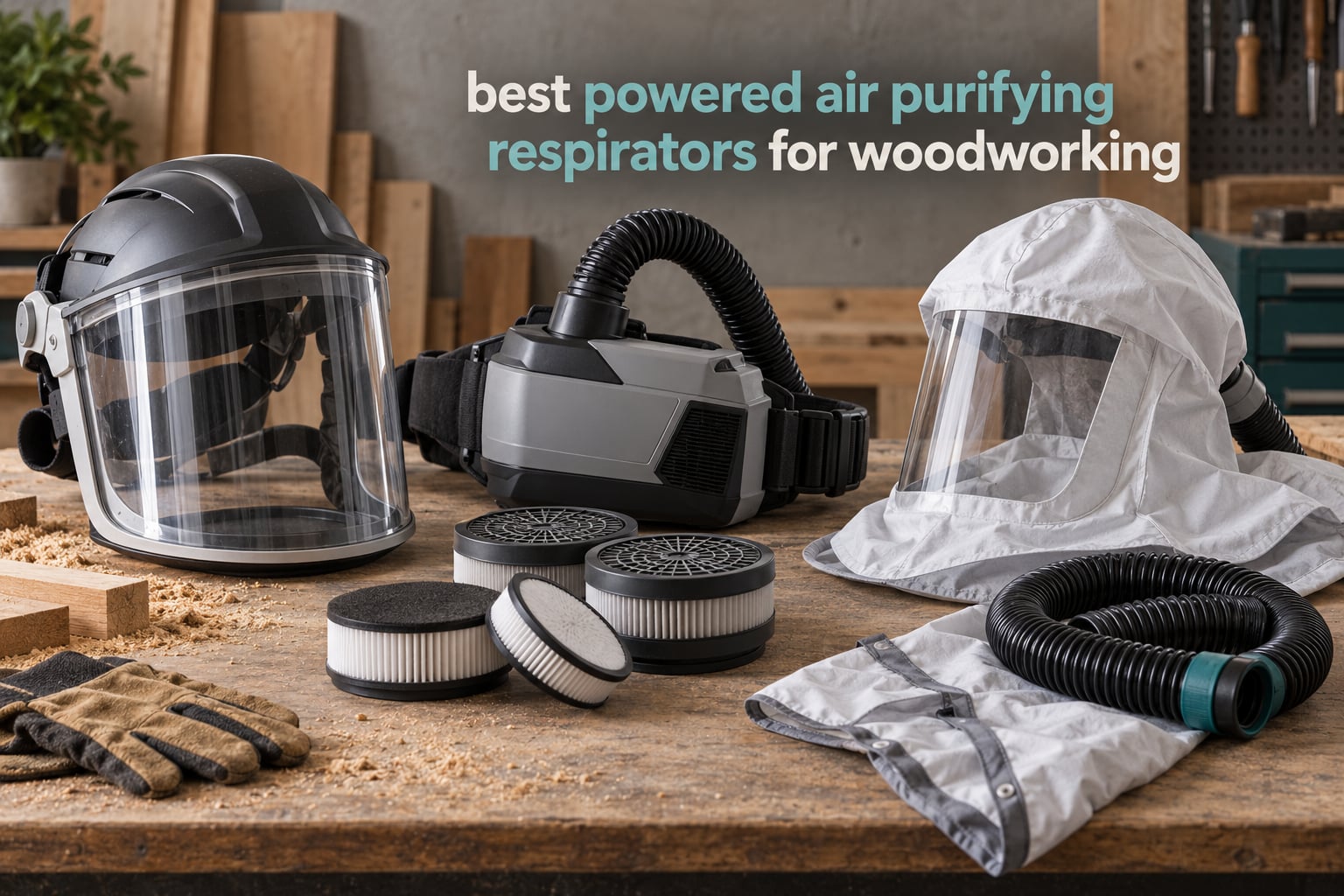
Ten years ago, the honest answer to “what should I wear while sanding” was a cheap disposable dust mask and a prayer. That answer is out of date. The best powered air purifying respirators for woodworking now cover everything from a bench-top hobbyist to a two-person cabinet shop, and the difference in comfort over a four-hour sanding session is large enough that most testers stop taking the mask off entirely.
I have spent the last several months working through this category in a small shop with a table saw, a track saw, an orbital sander and a router, and I compared all ten units below on airflow, face seal, balance, battery reality and how they feel after the second hour. What follows is what the hardware actually does in a woodshop, not a spec sheet restatement.
A powered air purifying respirator, or PAPR, is a reusable full-face or hood-style respirator that uses a battery-driven blower to pull shop air through a high-efficiency filter and blow it into the facepiece at positive pressure. That positive pressure is the whole point: gaps in the seal leak clean air outward instead of drawing wood dust inward, and the constant airflow keeps heat and moisture from building up behind the mask.
Quick picks:
Best overall: Trend Airshield Pro — the most-named powered unit in woodworking forums, rear-mounted motor, 8+ hour battery.
Best value: BROAD AirPro FB2 — H13 HEPA, three fan speeds, and the largest review base in the category.
Best NIOSH-approved kit: 3M Versaflo TR-300N+ hard hat assembly — a complete industrial package with 8-12 hour lithium-ion runtime.
Best for spray finish: 3M Versaflo TR-800 painters kit — an organic vapor plus high efficiency particulate cartridge and an intrinsically safe blower.
Best for beards and glasses: 3M Versaflo TR-300N+ ECK hood — a loose-fitting disposable hood that seals around the whole head rather than the face.
One thing worth saying up front, because it comes up constantly on shop forums: a respirator supplements dust collection, it does not replace it. A cyclone or a good shop vacuum removes the bulk of the airborne fraction at the source. A PAPR handles what escapes, what hangs in the air for hours, and what your extraction never captured at all.
This roundup was last updated in 2026, and the specs, ratings and owner complaints below reflect what current buyers are actually reporting rather than what the marketing pages claimed at launch.
Our Top 3 Best Powered Air Purifying Respirators for Woodworking (October 2026)

Trend Airshield Pro
- Rear-mounted motor and battery
- Twin filters to 0.6 micron at 98%
- 8+ hours per charge
- ANSI Z87 visor


3M Versaflo TR-300N+ Hard Hat
- NIOSH-approved
- 8-12 hour lithium-ion battery
- Complete kit with belt and filters
- Coated polycarbonate visor
Comparing Every Powered Respirator on Our List
The ten units below span three distinct categories that get lumped together online. The 3M Versaflo kits are NIOSH-approved industrial systems. The Trend Airshield Pro is a woodworking-specific face shield that is not a certified respirator at all, though it behaves like one for dust. The remaining units are consumer-grade fan masks whose filtration claims are manufacturer-stated rather than certified.
| Product | Specs | Action |
|---|---|---|
| Trend Airshield Pro |
|
Check Latest Price |
| BROAD AirPro FB2 |
|
Check Latest Price |
| 3M Versaflo TR-300N+ Hard Hat |
|
Check Latest Price |
 3M Versaflo TR-300N+ ECK Hood 3M Versaflo TR-300N+ ECK Hood |
|
Check Latest Price |
 3M Versaflo TR-800 Painters Kit 3M Versaflo TR-800 Painters Kit |
|
Check Latest Price |
 Rsenr Mini PAPR R18 Rsenr Mini PAPR R18 |
|
Check Latest Price |
 3M Powerflow 6800PF 3M Powerflow 6800PF |
|
Check Latest Price |
 HANUU Triple-Filter PAPR HANUU Triple-Filter PAPR |
|
Check Latest Price |
 JKKL PuriCurrent Mini JKKL PuriCurrent Mini |
|
Check Latest Price |
 3M Versaflo TR-602N Hood Kit 3M Versaflo TR-602N Hood Kit |
|
Check Latest Price |
Air-Purifying Versus Supplied-Air: What “Air Fed Mask” Actually Means
Search queries for this topic constantly mix two different pieces of equipment. An air-purifying respirator takes the air you are already breathing, pushes it through a filter and returns it. A supplied-air respirator brings clean air to you from a source outside the shop, through a hose, and that outside-air design is what carries the higher assigned protection factor in genuinely contaminated environments.
For wood dust in a shop with a cyclone and a decent blower, air-purifying is the correct category. You are filtering ambient shop air, and the filtration performance is the only thing standing between you and the fine fraction. Supplied-air makes sense for mold remediation, asbestos and lead abatement, or when you are working in a space where the airborne concentration is high enough that a filtered shop-air mask is not defensible.
The other term you will meet is the assigned protection factor, or APF. It is a ratio: a full facepiece at APF 50 means the respirator is expected to reduce the wearer’s exposure to roughly one fiftieth of the ambient concentration, while a PAPR at APF 1000 means the same thing by a factor of one thousand. Only the 3M systems in this list carry a stated NIOSH APF. The consumer fan masks below do not have certified APF values, which is a real and important distinction when you are deciding what to rely on for hardwood or MDF.
1. Trend Airshield Pro – Best Overall PAPR for Woodworking
Trend Airshield Pro Full Faceshield, Dust Protector, Battery Powered Air Circulating Mask for Woodworking, AIR/PRO
3.2 lb
Rear-mounted motor and battery
Filters to 0.6 micron at 98%
8+ hours per charge
ANSI Z87 visor
Pros
- Powered airflow stops visor fogging and pushes filtered air at the face
- Works for bearded woodworkers who cannot seal a conventional respirator
- Rear-mounted motor and battery balance better than front-mounted designs
- Long runtime between charges with an audible low battery warning
- Covers eyes and lungs in one unit
Cons
- Headband suspension presses on the head during long sessions
- Pitches forward when looking down for extended periods
- Internal plastic headband has snapped for some owners after about two years
- Consumables cost adds up over time
The Airshield Pro is the unit I keep reaching for, and it is the one most often named when woodworkers argue about powered respirators. The design is simple: a clear full face shield, twin fine dust filters on either side, and a motor and battery slung behind the head so the weight sits at the base of the skull rather than out in front of your face.
That rear-mount arrangement is the whole trick. Front-mounted fan units become tiring after a couple of hours because your neck is holding the motor out in front of your centre of gravity. Push that mass backward and the fatigue largely goes away. Reviewers consistently credit the ability to work a full afternoon without taking the unit off, and several report replacing a separate pair of goggles plus a half-mask with a single Airshield.
Filtration and Airflow for Wood Dust
The Airshield Pro runs twin fine dust filters rated to capture particulates down to 0.6 micron at 98% efficiency. That is a coarser target than a P100 or HEPA filter, and it is worth being straight about what it means. It handles the bulk of sawdust and sanding particulate well. It is not the answer for a heavy MDF cut where the binder dust is at its worst.
Airflow is rated at a minimum of 160 liters per minute and up to 200 liters per minute fully charged. In practice that is enough to keep the visor clear of fogging for a full session, which is the single most common complaint about non-powered full-face masks. Nobody wants to keep wiping a fogged lens mid-cut.
Balance, Fit and the Bearded User
The headband adjusts from 20-1/2 to 24-1/2 inches and uses a moisture-wicking material against the forehead. This is one of the reasons bearded woodworkers end up here: because the shield does not need to seal against skin, facial hair does not defeat it. The visor carries an ANSI Z87 high impact rating, which matters if you are turning spindle work or carving where chips fly.
The honest weakness is that the suspension is a headband, and a headband on a three-pound assembly for three hours is noticeable. Owners also report the unit going top-heavy when the head is angled down for routing or detail work, which loads the neck. If your work is mostly at bench height and looking straight ahead, this matters much less.
Battery, Maintenance and What It Costs to Keep Running
The rechargeable nickel metal hydride battery gives at least 8 hours on a full charge, which comfortably covers a working day with a spare charge cycle. There is an audible low-battery warning, so you are not discovering an empty blower halfway through a glue-up. The kit includes the twin filters, battery, an airflow indicator, a storage bag and ear protection clips.
Two practical warnings. The internal plastic headband has a documented history of snapping at around the two-year mark, though owners widely report that Trend shipped redesigned replacements at no charge once they were contacted. The charging cradle gives no charge-state indication, which leaves you guessing about overcharging. Filters, visors, batteries and chargers add a recurring cost on top of the unit.
2. BROAD AirPro FB2 – Best Value Powered Respirator You Can Replace Cheaply
BROAD Breathe Easier AirPro Mask Rechargeable Reusable Air Purifying Respirator with a HEPA Filter
H13 HEPA filter
Three fan speeds
11.68 oz
Powered continuous airflow
Rechargeable
Pros
- Continuous airflow cuts heat and claustrophobia compared to a plain N95
- Three speeds let you trade airflow against battery life
- Quiet enough to barely notice
- Light enough to wear on a lanyard
- Low cost means you can keep a spare
Cons
- Air can bypass the filter around the charge port and internal seams until sealed
- Charge indicator is ambiguous and a full charge can take a couple of days
- Some units will not power on until the button is held for an extended period
- Supplied instructions are sparse
With more than 2,000 reviews behind it, the BROAD AirPro is the most thoroughly owner-tested unit in this list, and the reason is simple: it is the only one where the replacement cost is low enough that you can own two. One on the bench, one in the bag, and a dead battery stops being an emergency.
It is a compact half-face style powered respirator with a H13 HEPA filter and a three-speed fan. Users with asthma, COPD or vocal cord issues describe it as the difference between tolerating a mask for four hours and tolerating it for four minutes. That comfort factor, rather than filtration sophistication, is what drives most of the positive reviews.
What the Particle Testing Revealed
The most useful review in this product’s history comes from an owner who particle-tested it and measured roughly 2.5 to 3.0 CFM on high after sealing the bypass paths. Unmodified, the criticism is honest: air can leak around the charge port and internal seams, which makes the filtration only marginally better than a well-fitted N95.
That same reviewer reported that performance improved dramatically once the bypass paths were sealed with silicone. It is a fair summary of the product’s real character. It is a comfortable, cheap way to get moving air across your face, and it needs a careful seal check before every use in a dusty shop.
Comfort, Fit and Daily Use
At 11.68 ounces and roughly 5.98 by 3.98 by 2.01 inches, it is the smallest powered unit here and the least intrusive to wear. The three-dimensional mask shell is soft against the face, and the fan is quiet enough that most owners stop noticing it. That matters more than it sounds: a blower you can hear is a blower you will take off.
One A-size battery is included and the fan continues to run while the unit charges, which is convenient if your shop has an outlet you can reach. The three-speed control gives you a genuine dial between quiet operation and maximum airflow, useful when you are doing a long static cut versus an aggressive sanding pass.
Ownership Realities and Ongoing Cost
Be aware of two quality complaints that show up as a minority but are worth knowing. Some buyers report units that will not power on until the button is held for an extended period, and some report batteries that take a couple of days to reach a full charge with an ambiguous indicator. Reachability of support is also raised as a downside by a few owners.
Against those, the counter is straightforward: this is the cheapest way to own a powered respirator, and cheap means replaceable. Filters are simple, the fan is a standard DC unit, and the instructions are thin. Plan on reading the manual carefully and doing your own seal check, because the product will not do it for you.
3. 3M Versaflo TR-300N+ Hard Hat Assembly – Best NIOSH-Approved Complete Kit
3M PAPR Respirator System, Heavy Industry Kit, Hard Hat Assembly, NIOSH
NIOSH-approved
8-12 hour lithium-ion battery
Complete kit with belt and filters
Coated polycarbonate visor
10 lb
Pros
- Blower-driven airflow removes breathing resistance and one-way valve sticking
- Stays cool and does not fog glasses or visors
- Battery recharges in roughly one to two hours for a full day
- Helmet is light for its class
- Filters are solid and easy to change
Cons
- Helmet weight is carried entirely by the neck
- Included belt runs out of adjustment holes on larger waists
- Earmuff compatibility with the hard hat mount is limited
- Battery pack reported failing in under two years
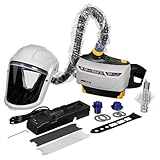
When you want an actual certified respirator rather than a comfort device, this is where the category stops being hobbyist gear. The TR-300N-plus is a NIOSH-approved powered air purifying respirator, supplied here as a complete heavy-industry kit with the hard hat assembly, PAPR unit, battery and charger, belt, particulate filter, filter cover, spark arrestor, pre-filter, breathing tube and airflow indicator in one box.
Nothing about this needs assembly. The blower arrives pre-calibrated and connects with Quick Release Swivel fittings, so if the breathing tube snags on a joist or a ladder rail you are back in airflow in seconds rather than five minutes. That quick-change behaviour is the difference between a respirator people actually keep wearing and one that ends up on the bench.
Protection Level and Hard Hat Integration
This is the unit to choose if your shop includes demolition of built-ins, work on moldy material, or any task where you need a certification you can point at rather than a manufacturer claim. NIOSH approval means the protection factor is a tested and documented number instead of an estimate, which matters if you are working in MDF, where the binder dust is the most aggressive thing most hobby woodworkers will ever cut.
The helmet uses a six-point textile harness with a coated polycarbonate visor and a flame-resistant polyester faceseal. Demolition, HVAC and welding users consistently describe it as an upgrade over a full-face respirator because the blower takes the effort out of breathing. You are not pulling air through a filter with your own lungs; the motor is doing it and you get constant cooling as a side effect.
Weight Distribution Across a Long Shift
At 10 pounds for the full system, the number sounds heavy until you put it on, because the blower and battery sit at the waist and the helmet itself is light for its class. The honest weakness is that the helmet weight is carried entirely by the neck. Users doing extended overhead work describe that as the limiting factor over an eight-hour day.
Two practical problems come up repeatedly. The supplied belt runs out of adjustment holes on larger waists, which is annoying enough that several users replace it. And the hard hat mount does not work with 3M’s highest NRR ear defenders, which is an odd gap given how loud a track saw or a thickness planer is.
Battery, Charging and the Cost of Consumables
The lithium-ion battery runs approximately 8 to 12 hours on a new pack, and the most repeated real-world number from owners is 8 to 9 hours per charge with a one to two hour recharge. In a shop that means a single charge covers a working day, which removes the single most common complaint people have about powered respirators.
There is one durability report worth weighing: a battery pack failing in under two years, with no responsive seller support. It is not a widespread pattern, but it is exactly the kind of failure that strands you mid-project, so factor battery replacement into the long-term cost rather than assuming the pack lasts as long as the unit.
4. 3M Versaflo TR-300N+ ECK Hood – Best for Beards and Prescription Glasses
3M PAPR Respirator, Versaflo Powered Air Purifying Respirator Kit, TR-300N+ ECK, Healthcare, Hood Assembly, Easy to Clean and Maintain, All-in-One Res
Disposable hood with head and shoulder coverage
NIOSH-approved
8-12 hour battery
Wide field of view visor
Wipe-clean housing
Pros
- Constant positive airflow holds dust out even when head movement breaks the seal
- Comfortable enough to wear all day
- Lightweight blower is easier to carry at the belt than larger PAPR models
- Smooth housing and disposable hood make cleaning straightforward
- Visor keeps a wide clear view
Cons
- Included waist belt is low quality and will not stay tight
- Replacement disposable hoods can be difficult to source
- Battery reported failing quickly on older units
- Disposable hood is single-use so consumable cost repeats
This is the answer to the fit failures that push people back to a loose disposable mask. Instead of sealing a facepiece against your skin, the ECK kit uses a disposable hood with head, face, neck and shoulder coverage and soft elastic wide face seals. There is no seal to lose, because a beard or a pair of prescription glasses does not break it.
One environmental cleanup professional described the mechanism better than any spec sheet: constant positive pressure means dust does not migrate into the breathing zone even when you turn your head and momentarily break contact. That is precisely the failure mode that gets dust into a tight-fitting mask, and it is why loose-fitting powered hoods behave so much more forgivingly in real work.
Why the Hood Form Factor Wins on Fit
The tradeoff for that forgiveness is that you now wear more material. The hood covers head, face, neck and shoulders, which in a hot shop is its own kind of discomfort. Owners still rate it as comfortable enough for all-day wear, largely because the airflow is constant and the interior never gets as warm as a full facepiece.
The hood carries an integrated suspension and a wide field-of-view visor with reduced curvature, which lowers reflections and glare. For anyone who has spent time wearing prescription safety glasses under a face shield, the wider opening matters. You can see the cut line without fighting the optics.
Blower Size, Alarms and Daily Handling
The blower housed in this kit is on the lighter and more compact side of the Versaflo range, which matters when it is hanging at the small of your back. Its smooth surfaces wipe clean, and one-button operation with both audible and LED alarms takes the guesswork out of starting the unit correctly.
The alarms are genuinely useful. A low airflow alarm is how you know a filter has loaded up before your breathing effort has climbed enough for you to notice. Relying on feel alone is how people end up working an hour in a saturated filter.
The Belt Problem and the Hood Supply Problem
The most common complaint about this kit is the supplied waist belt. Multiple owners report it is low quality and will not stay tight without constant readjustment, and several replaced it with a plain tactical belt. That is a five-minute fix, but you will almost certainly do it.
Replacement hoods are also cited as difficult to source, and the hood is single-use, so consumable cost repeats indefinitely. A minority of units shipped with aged batteries that reported a dead pack within minutes while the charger still showed full. Check the battery on arrival rather than discovering it mid-cut.
5. 3M Versaflo TR-800 Painters Kit – Best for Spray Finish and Coating Work
3M PAPR Respirator System, Painters Kit, Intrinsically Safe, NIOSH Approved
Organic vapor plus HEPA cartridge
Intrinsically safe blower
1.4 lb face shield
Low airflow alarms
Pros
- Blower airflow keeps coating vapors out of the breathing zone
- Integrates respiratory eye and face protection in one assembly
- Owners report no odor breakthrough when spraying paint or clear coat
- Comfortable enough for extended refinishing work
- Low airflow alarms in visual and audible form
Cons
- Battery pack is heavy and uncomfortable at the waist
- Battery runtime is shorter than expected for a full work shift
- Intrinsically safe hardware and consumables add significant cost
Sanding and spraying are different problems, and this kit is built for the second one. Every other dust unit on this list is a particulate filter, which captures wood dust and does essentially nothing about the organic vapors coming off lacquer, shellac, spray varnish or poly. The TR-800 kit ships with a TR-6510N combination organic vapor and high efficiency particulate cartridge.
That is the configuration you want if you spray finish in the shop. Automotive refinishing owners report no odor breakthrough when spraying paint or clear coat, and the constant airflow keeps the vapors out of the breathing zone rather than relying on cartridge sorption alone. For particle-only woodwork we would not reach for it, but for spraying it is the correct tool.
Organic Vapor Cartridges and When You Need Them
The distinction matters more than most roundups admit. A P100 or HEPA filter is a mechanical barrier sized for particles, and particles are what cutting, routing and sanding produce. Organic vapors are gas-phase contaminants, and they need sorbent media such as activated carbon to be removed at all.
So the practical rule is simple. Particle filter for dust work, organic vapor plus particle filter for spray finish. If you alternate between the two, this combination cartridge handles both, and if you only ever sand you are carrying cartridge cost you will not use.
Intrinsic Safety and Where It Costs You
The blower here is rated Division 1 for Classes I, II and III under UL 60079, which is the certification you need if solvent vapors could reach an ignition source. That is why this blower is heavier and bulkier than the standard Versaflo units, and it is a real cost paid for a real safety margin.
The face shield assembly uses a four-point textile harness weighing 1.4 pounds, which is genuinely light. The visor gives peripheral and downward vision, which matters when you are inspecting a sprayed surface. Colored touchpoints support one-handed glove operation.
Battery Comfort in a Spray Booth
Two gripes come back consistently from users. The intrinsically safe battery pack is heavy and uncomfortable at the waist, particularly over a long refinishing job. And the runtime falls short of a full shift for some owners, so plan on a mid-day charge or a second battery rather than assuming one charge covers the day.
Customer service resolved a missing screw quickly according to owners, which is a small thing but tells you something about support. Note that this kit has a small review base because it is a highly specialized industrial product, so the rating reflects few owners rather than a thin margin of satisfaction.
6. Rsenr Mini PAPR R18 – Best Budget Powered Mask for Light Shop Use
Rsenr Breathe easily,Electric Face Maks with Fan,Mini PAPR System,Powered Airflow Shield for Cycling, Outdoor Sports & Daily Protection Against Dust, Paint Overspray
Flexible hose fan unit
Three wind speeds
11.22 oz
8-10 hours claimed
Replaceable mask elements
Pros
- Delivers noticeably more airflow than competing powered masks at this level
- Helps users with COPD or breathing difficulty tolerate mask wear
- Keeps the face cooler and reduces fogging in cold weather
- Battery held up through a long flight in one long-term test
- Low cost makes it easy to own a spare
Cons
- Hose kinks easily and can stop airflow
- Battery runtime falls well short of the advertised figure in practice
- Ear loops are tight and cause pain over extended wear
- Velcro pad is the only thing holding the fan unit on
- Quality control varies between units
The R18 is a mask with a fan attached, and it is sold for outdoor sports and cycling as much as for shops. In a woodworking context it makes sense for the light end of the range: sweeping a garage, handling sawdust in small doses, or wearing something powered during cleanup where a full PAPR would be absurd overkill.
What it genuinely delivers is airflow. Reviewers consistently say the flow is stronger than competing powered masks in the same bracket, and users with COPD or asthma describe it as making mask wear possible where a plain filter mask was not. Two included replaceable mask elements with hose ports mean consumables are cheap and swappable.
Airflow Strength and Where It Falls Short
Three wind speed settings give some control, and adjustable settings let you trade noise for flow. The weakness that gets reported most is the flexible hose kinking, which can interrupt airflow entirely at an awkward moment. Route the hose along your arm rather than across your chest and you reduce the problem substantially.
The battery claim of 8 to 10 hours on a full charge does not survive contact with practice, and owners report materially shorter real-world runtime. It is powered by AAA cells, which means the running cost is trivial and the replacement is available anywhere, but it also means no strong reserve for a long day.
Fit and Build Consistency
Tight ear loops cause pain during extended wear, which is the recurring comfort complaint. For short bursts of work it is fine. For a full afternoon of sanding, it is not the tool you want.
Build consistency is the real issue here. Owners report receiving units with the charge port blocked by the case, a recessed on or off button, and one unit that needed glue and weather stripping before it functioned. That is a manufacturing variance problem rather than a design problem, and it is the reason this sits at the budget end rather than higher.
When a Mini PAPR Is the Right Answer
The Velcro attachment pad is the only thing keeping the fan unit attached to the mask, so it is worth pressing it down properly each time you put it on. The design is visibly unconventional, which some owners like and others find distracting in public, though in a garage workshop that is a non-issue.
Judge it on scope. This is a mask that moves air. It is not a certified respirator, it does not carry a stated APF, and its filtration depends on the mask element rather than a rated class. For light duty and short sessions that is a reasonable trade. For hardwood dust or MDF, choose a rated system.
7. 3M Powerflow 6800PF – Best Face-Mounted PAPR with No Belt
3M Powerflow Powered Air Purifying Respirator Kit 6800PF, Face-Mounted, Medium, Protection Against Dust, Mist, Fumes, Lead, Mold, Asbestos, Radionuclides, Radon Daughters
Face-mounted blower
US OSHA APF 1000
Standard 40mm threaded filters
16 oz
8 hours per charge
Pros
- Face-mounted design removes the waist belt entirely
- Excellent face seal that clears glasses without pressing a divot into the nose
- Constant cool airflow with no added breathing resistance
- Battery runs a full work shift on a charge
- Accepts standard 40mm threaded filters
Cons
- Blower and battery hang off the face making it front-heavy after a few hours
- Heavier third-party filters amplify the front weight
- Prescription eyewear is difficult to fit inside the facepiece
- Small filter intake loads quickly and needs frequent vacuuming
Every waist-mounted PAPR forces the same trade: the blower is either heavy on your hip or you have a tube across your chest. The 3M 6800PF removes the third option by mounting the motor and airflow unit directly on the facepiece, and the effect on comfort is immediate and significant.
It also holds a US OSHA APF of 1000 when used per the manufacturer’s recommendations and instructions, and it is approved for use with a high efficiency particulate filter only. The kit includes a 6800DIN medium full facepiece, blower, battery, charger and flow indicator.
Standard 40mm Filters as a Real Advantage
This is the underrated feature. The 6800PF accepts standard 40mm threaded cartridges, unlike 3M’s proprietary Versaflo systems that need specific filters and covers. For a woodworker that means filter availability is never a problem and you can choose your filter class without being locked into one ecosystem.
Concrete tradespeople, plus people managing severe allergies and asthma, use this unit as a step up from a standard full-face mask because the constant airflow eliminates the tight seal and the sweaty face they disliked. One owner testing it against attic insulation removal found it reliable for heavy dust exposure.
Front Weight and the Eyewear Question
The trade-off is direct. The blower and battery hang off the face, so the mask becomes front-heavy after a few hours, and a heavier third-party filter makes that noticeably worse. If you are doing overhead work or leaning over a bench, this is the factor that decides against it.
On glasses, the reports are mixed in a useful way. Owners confirm an excellent face seal that clears glasses without pressing a divot into the nose, but also that prescription eyewear is difficult to fit inside the facepiece. Safety glasses work; a bulky prescription frame is the harder case.
Maintenance and a Connector Caveat
The small filter intake collects dust quickly and needs frequent vacuuming to keep airflow up. The standard charger gives no indication of charge state, which raises an overcharging concern, and one owner reported the battery connection design failing within months. Replacement filters are also described as hard to source quickly, despite accepting standard threads.
At 16 ounces for the facepiece assembly this is among the lightest certified PAPRs available, and the constant airflow means normal breathing with no added resistance. If a belt is the thing stopping you from wearing a respirator, this is the unit that removes that objection.
8. HANUU Triple-Filter PAPR – Best for Layered Filtration Flexibility
HANUU High-Efficiency PAPR Respirator System: Powered Air Purifying Respirators with 3Pcs 40mm Gas Mask Filters Portable Supplied Air Respirator for Welding Spray Painting Chemical Large Air Volume
Three 40mm filter ports
Stepless airflow to 170 L/min
10 hours per charge
59 inch hose
Full-face with panoramic lens
Pros
- Stepless airflow control lets you tune ventilation to the task
- Constant positive pressure prevents fogging and rebreathing exhaled air
- Three independent 40mm filter ports give a genuine three-layer barrier
- Four-point harness makes achieving a good seal straightforward
- Hose and mask build quality described as solid
Cons
- Belt is too short for larger waists with no extension offered
- Some units include fewer cartridges than the manual specifies
- Cannot be worn with eyeglasses so prescription users cannot seal
- Waist pack becomes heavy over long sessions and howls
The HANUU kit is the most configurable unit here. Rather than a proprietary filter, it uses three independent 40mm ports, so you can run particle filters, organic vapor cartridges, or a mix depending on the day. Owners doing mowing, weedeating, spray painting and welding all use the same chassis for very different hazards.
The 12W motor delivers adjustable airflow up to 170 liters per minute with stepless control, which is finer than the three-position switches on most competing units. That matters in practice: you can turn it down in a quiet precision cut and turn it up for a dusty sanding pass rather than choosing between two fixed extremes.
Triple Filtration and the Full-Face Seal
Claimed filtration is 99.99% across chemicals, organic gases, particulates and dust, and the kit ships with three 40mm activated carbon filters. Treat that figure as a manufacturer claim rather than a certified rating, since no APF is stated. What the design genuinely offers is the ability to combine layers, which particle-only units cannot.
The mask is a full-face sealed design with a wide panoramic lens and a four-point harness. Reviewers describe the harness as making a good seal straightforward, which matters because a full facepiece that seals well also handles glasses better than a narrow half-mask. The 59-inch hose gives enough slack to reach overhead without yanking the blower around.
Runtime, Recharge and Shop Scheduling
Runtime is the part of this kit that has to be planned around. The manufacturer states up to 10 hours of continuous use per charge, which on paper covers a full shift, but the figure is a best case at a lower airflow setting rather than a measured shop average. Owners running it at the top of the stepless range report shorter days than the headline number.
Recharge takes about four and a half hours, and that is the detail that decides whether you buy one battery or two. An overnight charge is fine if you store the unit assembled and off the belt, but a long sanding day followed by a morning start leaves you waiting. Given how inexpensive a spare battery is, treat the second pack as part of the purchase.
The Short Belt and the Eyewear Problem
The most repeated practical problem is the belt. Multiple buyers over 42 inches say it cannot be adjusted and that no extension is offered, which leaves them unable to secure the blower properly. Waist packs also become heavy over long sessions and produce a low howling sound that users notice.
The harder problem is that this mask cannot be worn with eyeglasses. A buyer who wears prescription lenses reports being unable to get a reliable seal, which on a full facepiece is a serious limitation rather than an annoyance. Also worth noting: one review reports the kit arriving with one filter when the manual calls for three, so count the contents on arrival.
9. JKKL PuriCurrent Mini – Best Lightweight Powered Mask for Fine Dust Masking
PuriCurrent Mini Powered Respirator. Easy breath. Electric dust respirator mask with fan and H13 HEPA & active carbon filters. Woodworking/construction work/DIY. More comforts & higher productivity
H13 HEPA plus activated carbon layer
Two fan speeds
5.4 oz
6-8 hour rated use
LED work lights
Pros
- Fan-assisted airflow makes breathing easier during long tasks
- Soft silicone facepiece is comfortable and does not irritate skin
- LED and audible alerts show fan speed and battery status
- Built-in white LEDs aid visibility in dark spaces
- Easy doffing strap lets it rest on the chest between cuts
Cons
- Fan is underpowered with weak airflow even on the highest setting
- Not a substitute for a NIOSH-approved powered air purifying respirator
- Can feel undersized for average-to-tall wearers causing edge leaks
- Nose bridge pressure becomes painful after about ten minutes
This is the lightest powered unit in the lineup at 5.4 ounces, and it is the only one whose rating sits below four stars. Reviewers are genuinely split, and the split follows one line: the fan either delivers enough air for you or it does not.
Many users doing woodworking, sanding and spray painting find real filtration and much easier breathing over long sessions, and the fit seals well on smaller faces. The silicone facepiece is soft, easy to doff, and the mask can rest on the chest during short breaks without losing its shape.
Airflow Is the Weak Point
The critical group of reviewers reports that the fan is underpowered and that airflow at the top setting is barely perceptible. One measured it at roughly 17 liters per minute against a 115 liters per minute benchmark for a tight-fitting PAPR. That is a large gap, and it explains why some users feel protected and others feel like they are wearing a fan.
Reviewers also state plainly that this is not a substitute for a NIOSH-approved powered air purifying respirator. Treat it as a comfort upgrade over a disposable mask with a filtration claim, not as certified respiratory protection. The rating distribution backs that up, with 52% five-star and 17% one-star, which is a wide spread for a small sample.
Fit, Sizing and Nose Bridge Pressure
Two fit complaints recur. The mask can feel undersized for average-to-tall wearers, and loosening the straps to compensate opens edge leaks that reduce protection and comfort at the same time. Separately, nose bridge pressure becomes painful after about ten minutes of wear for some users, which caps session length.
On smaller faces the same geometry works well, which is why the same owner will report an excellent seal and the next one will report leaks. If you are between sizes in face geometry, this is worth handling carefully before committing.
Features That Add Up in a Shop
The small details here are better than they have any right to be at this level. LED and audible alerts show fan speed and battery status, and built-in white work LEDs aid visibility in a dark corner of a shop or under a bench. Removing the air intake valve piece gives additional ventilation when you want it.
Two lithium polymer batteries are included and the rated use duration is 6 to 8 hours, with two fan speeds. The thin activated carbon layer is for light odor reduction only, which is not suitable for painting, gases or chemical hazards. One practical drawback: the item is marked non-returnable, so fit and performance problems cannot be resolved by sending it back.
10. 3M Versaflo TR-602N Hood Kit – Best for Commercial Shops and Mixed Work
3M PAPR Respirator System, Easy Clean & Easy to Use, NIOSH Approved
NIOSH-approved
Up to 12 hours run time
Pre-calibrated blower
S-433L disposable hood
7.8 lb
Pros
- NIOSH-approved industrial grade protection with true PAPR airflow and seal
- Up to 12 hours of run time with LED vibratory and audible warnings
- Smooth surface and maintenance-free disposable hood suit contamination control
- Pre-calibrated and ready to use with no setup
- Flexible air channels in the belt reduce heat build-up
Cons
- A complete system sits far above consumer respirator options
- Disposable hood must be replaced regularly at ongoing cost
- Intended for industrial settings rather than consumer use
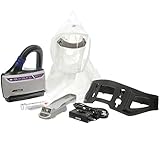
The TR-602N kit is the most complete and most industrial package here, and it is the right answer for a shop where respiratory protection has to be documented and repeatable. It pairs a TR-602N blower with an S-433L disposable hood, a TR-6710N filter with cover and prefilter, a TR-630N battery, a length-adjusting breathing tube with tube cover, an easy clean belt, a single station charger, an airflow indicator and a cleaning and storage kit.
Everything arrives pre-calibrated, so there is no commissioning procedure to learn. Occupational buyers single out NIOSH approval, long runtime, easy cleaning and simple setup as the reasons for the consistently strong ratings, with 74% of reviews at five stars and no one-star ratings at all.
The Twelve-Hour Question
Battery run time is rated up to 12 hours, with LED, vibratory and audible low-charge warnings giving you three different ways to know before the battery quits. The vibratory alert is the one people miss if you wear thick gloves, which is a fair warning to test it at the start of a shift.
The belt is designed with flexible air channels specifically to reduce heat build-up against the body, and the whole unit is worn close to the body rather than hanging out. For an eight-hour day that difference is real, and it is a design detail worth more than any spec line.
Cleaning, Storage and the Swivel Connection
This is the kit to buy if you are specifying equipment for other people, because the maintenance story is the reason it exists. The disposable hood needs no cleaning at all, the PAPR unit has a smooth wipe-clean surface, and the box includes a dedicated cleaning and storage kit. That means a supervisor can write a simple task list that new hires can actually follow.
Connections are Quick Release Swivel fittings, so a worker can swap a hood or a tube in seconds without a tool and without breaking the seal. The length-adjusting breathing tube lets one blower serve different head sizes, which removes the fitting-session bottleneck that slows a crew down at the start of a job.
Where This One Does Not Fit
This kit is marked for industrial and occupational use rather than consumer sale, and that shapes the whole buying decision. The purchase cost sits far above every consumer option on this list, and the disposable hood must be replaced regularly, so the running cost is structural rather than incidental.
It is also a hard hat and face coverage assembly that assumes a working environment, not a home shop with a dust collector and a bench. If you are one person with a track saw, this is over-equipped. If you have employees who need protection they can be issued and tracked, the case for it is strong.
How to Choose a PAPR for Woodworking
Most of the confusion in this category comes from comparing units built for completely different jobs. A welder’s certified full-face PAPR and a fan mask for asthma are both sold as powered respirators, and shopping lists that mix them produce expensive mistakes. These are the decisions that actually change which unit you should buy.
Head-Mounted Versus Waist-Mounted Blower
This is the most repeated question on woodworking forums, and the answer depends on how and where you work. Head-mounted or face-mounted designs put the motor on the head or the facepiece, so nothing hangs off your waist, but they load the neck or make the mask front-heavy over time. Waist-mounted designs move that mass to the hip, which is much better for extended sessions, at the cost of a belt and a tube across your chest.
The practical split: if your work is mostly at bench height, looking forward, with short bursts of overhead work, waist-mounted wins comfortably. If you need nothing touching your torso, work in tight spaces, or dislike the sensation of a belt, a face-mounted unit like the 6800PF removes that objection entirely.
Filter Class for Hardwood, MDF and Finish Vapors
Wood dust is a particulate hazard, so the filter question is mostly about particle class. N95 filters capture 95% of particles, P100 captures 99.97%, and HEPA is the household term for the same idea. The letter matters too: N means not resistant to oil, R means somewhat resistant, P means resistant to oil. For wood dust, oil resistance rarely matters, so the practical comparison is N95 against P100 or HEPA.
Hardwood dust is the case to care about. Beech, birch, oak, walnut and similar species produce fine, respirable particulate that stays airborne long after the cut, and MDF adds binder dust on top of the wood fiber. Neither is a reason to abandon a dust mask, but both are reasons to move up to P100 or HEPA class filtration and to a unit with adequate airflow to keep that filter actually working.
Organic vapor cartridges are a separate category entirely. They exist for spray finish, lacquer, shellac and solvent-based coatings, and they do nothing for dust beyond whatever particulate prefilter they carry. If you spray, you need organic vapor media. If you only cut and sand, you are paying for capability you will not use.
Beards, Glasses and the Face Seal
Fit failure is the number one reason people abandon respiratory protection, and it happens in two predictable ways. Facial hair under a tight facepiece destroys the seal, and bulky prescription eyewear leaves no room for the sealing surface to contact the face. Both failures leak dust straight in, and both are invisible to the wearer.
Your options in ascending order of forgiveness: a loose-fitting powered hood that seals around the whole head and shoulders, a face-mounted full facepiece with a good sealing surface, a half mask with a tight strap pull, and finally a disposable dust mask. If you have a beard or wear strong prescription glasses, skip to the first two. If you have neither and a good fit, a P100 half mask is cheaper and simpler for light sanding.
Battery Runtime You Can Plan Around
Advertised runtime and shop runtime are different numbers. Ratings here run from a claimed 8 to 10 hours on the budget units down to genuinely measured 8 to 9 hours on the industrial lithium-ion packs, and the ones at the bottom of that range fall noticeably short in practice. Look for an audible or visual low-charge alarm, because discovering a dead blower mid-cut is how units end up abandoned on a shelf.
Recharge time matters as much as runtime if you work long days. A pack that takes four and a half hours to recharge, as the HANUU unit does, means an overnight charge. A pack that recharges in one to two hours means you can top it up over lunch. Plan for two batteries if your work day outlasts a single charge.
User Seal Check and Maintenance Schedule
A powered respirator fails silently. Positive pressure hides seal leaks, because the wearer never feels air being drawn in, and by the time a loose-fitting hood is visibly gapping you have already been breathing dust. A five-step check takes under a minute: confirm airflow with the flow indicator, look for visible gaps at the sealing surface, cover the filter inlet and check that the unit responds, wear it for a minute and listen for air escaping where it should not, and confirm the alarm functions before you start.
On a schedule: vacuum the filter inlet weekly or whenever it looks loaded, since a clogged intake starves airflow more often than a spent filter does. Wipe the housing and headtop surfaces monthly. Inspect the sealing surface and straps monthly for stretching or cracking. Replace filters on the manufacturer’s stated interval, and treat the battery as a consumable with a service life rather than expecting it to last as long as the blower. Store the unit assembled in a dry place, not crushed, so the hose and seals keep their shape.
Frequently Asked Questions
What is a good power respirator for woodworking?
A good power respirator for woodworking is a battery-driven blower that pulls shop air through a high-efficiency filter and blows it into a hood or facepiece at positive pressure. Positive pressure means gaps leak clean air outward instead of drawing wood dust in. For general shop dust, look for P100 or HEPA filtration, a low airflow alarm and a runtime that covers your working day.
What type of respirator is best for woodworking?
For heavy sanding, routing and MDF work, a PAPR with P100 or HEPA filtration is the strongest practical choice because the blower keeps air moving and reduces heat. A tight-fitting P100 half mask is sufficient for light sanding and cleanup. A loose-fitting powered hood is best if you have a beard or wear prescription glasses, since it does not need a facial seal.
What is the best air fed mask for woodworking?
An air fed mask for woodworking is usually a PAPR, which filters the shop air you are already breathing and delivers it at positive pressure. That is different from a supplied-air respirator, which brings outside air in through a hose. For a shop with dust collection, air-purifying is the correct type; supplied air is for mold, asbestos and lead work.
Which powered respirator is the best?
For most woodworkers, the Trend Airshield Pro is the best overall choice because the rear-mounted motor balances well and the battery lasts 8 hours or more. For the lowest barrier to entry the BROAD AirPro FB2 is the best value. For certified protection, the 3M Versaflo TR-300N+ kits are NIOSH-approved, and the TR-800 kit adds organic vapor filtration for spray finish.
Do I really need a PAPR if I already have a dust collector?
Yes, because dust collection removes most airborne dust at the source but never all of it. Fine particles, the fraction that hangs in the air for hours, and any dust generated away from the machine still reaches your breathing zone. Shop forums are clear on this point: a cyclone does not remove the need for a properly fitted respirator on the person doing the work.
How often do PAPR filters need replacing in a woodshop?
Replace the filter on the manufacturer’s stated interval, and sooner if airflow drops, the low airflow alarm sounds, or you can see dust loading on the prefilter. In a dusty woodworking shop, weekly visual checks and a vacuum of the filter inlet keep airflow up between changes. A loaded intake starves airflow more often than a spent media does.
Which Powered Respirator Fits Your Shop
If you want one unit that works for most woodworking and you are not working with MDF or spray finish, start with the Trend Airshield Pro. The rear-mounted motor is the reason it stays on your head for a whole afternoon rather than an hour, and it handles beards and glasses better than anything else here.
If budget is the deciding factor, the BROAD AirPro FB2 is the pick, with the largest review base and the lowest cost of ownership. Just do a careful seal check before each dusty job, because the charge port area is its known weak point. For light cleanup and quick jobs where a full PAPR is absurd, the Rsenr R18 covers the gap cheaply.
If you need certified protection, are an employer issuing equipment, or work with mold or old building materials, the NIOSH-approved 3M Versaflo kits are the correct family. The TR-300N+ hard hat assembly suits a shop where you already wear head protection, the TR-300N+ ECK hood suits anyone with facial hair or heavy eyewear, and the TR-602N hood kit is the full commercial package with a 12-hour battery.
If you spray finish, the TR-800 painters kit is the only unit here with organic vapor plus high efficiency particulate filtration in the cartridge. That capability is not optional for lacquer, shellac or solvent coatings, and no particle-only mask on this list substitutes for it.
Before you buy, check the rest of your setup. A good dust mask and half-face respirator are worth having for finishing and cleanup tasks, and if you are still building out your bench work, our guides to hand planes, chisel sets and clamps for glue ups cover the tools that generate the dust in the first place. For spray equipment, our respirator guide for spray painting goes deeper on vapor cartridges.
Whichever you choose, wear it. The most common failure in this category is not buying the wrong unit, it is buying the right one and leaving it on the bench because it was uncomfortable. Start it, seal check it, and give it a full session before you judge it.
Leave a Reply