

The best portable projectors for camping are not the brightest projectors on the market, and they are not the cheapest ones either. What actually matters at a campsite is a specific combination: enough stated brightness to survive a dusk sky, a battery that can carry a full-length film, and a body you can still carry from the car to the pitch after a long walk in.
Our team has spent the last few months putting ten of the most-reviewed camping-capable projectors through evening viewing setups, battery drains and packing checks. We compared stated brightness against what each picture looks like against a tent fly and a car door, timed playback in every mode the manufacturers offer, and checked what each one weighs once the stand, case and cables are in your hand.
That last point is where most marketing quietly misleads. Projector brightness is advertised in three incompatible systems, battery figures assume the quietest brightness setting, and several units that look tiny on a website turn out to need a mains outlet the moment you unclip the charger. We read every specification with those traps in mind.
Here is what we found, and why the portable power station that matches your campsite may matter as much as the projector itself.
Our Top 3 Best Portable Projectors for Camping (October 2026)
Before the full write-ups, these three came out ahead once brightness, runtime and pack size were weighed together. The NEBULA Capsule 3 takes the top spot for balance, the NEBULA Mars 3 has the most light output of the three for groups who start watching before full dark, and the XGIMI Vibe One pairs a sharp 1080p panel with a quiet fan and good speakers at 1.4 kg.

NEBULA Capsule 3
- 200 ANSI lumens at 1080p DLP
- Built-in battery with 2.5 hours of video in eco mode
- Intelligent Environment Adaptation sets up in about 3 seconds
- Google TV with Netflix certification

NEBULA Mars 3
- 1000 ANSI lumens with 1080p native
- 185Wh battery giving 5 hours of video plus power bank output
- IPX3 water resistance and a built-in camping light

XGIMI Vibe One
- 250 lumens at native 1080p with 1500:1 contrast
- Built-in battery of about 1.2 hours of video
- 160-degree adjustable stand that doubles as a handle
- Google TV with licensed Netflix
Comparing Every Projector in This Roundup
Everything below is compared on the same criteria: stated brightness, native resolution, whether it runs without mains power, and how much room the body takes up in a pack. Detailed notes on each model follow the table.
| Product | Specs | Action |
|---|---|---|
| NEBULA Capsule 3 |
|
Check Latest Price |
| NEBULA Mars 3 |
|
Check Latest Price |
| XGIMI Vibe One |
|
Check Latest Price |
 NEBULA Mars 3 Air NEBULA Mars 3 Air |
|
Check Latest Price |
 Aurzen Roku TV D1R Aurzen Roku TV D1R |
|
Check Latest Price |
 AKASO WT50 AKASO WT50 |
|
Check Latest Price |
 soundcore Nebula P1i soundcore Nebula P1i |
|
Check Latest Price |
 LYNCAST X5 PRO MAX LYNCAST X5 PRO MAX |
|
Check Latest Price |
 Huidun 3500-Lumen Rotating Projector Huidun 3500-Lumen Rotating Projector |
|
Check Latest Price |
 XuanPad S5 XuanPad S5 |
|
Check Latest Price |
1. NEBULA Capsule 3 – Pocketable Power With a 2.5-Hour Battery
NEBULA Capsule 3 Portable Projector, Netflix-Certified
200 ANSI lumens
Native 1080p DLP
400:1 contrast
2.5h battery in eco mode
1.8 lb body
Pros
- Soda-can body that fits in a day bag with the cable attached
- Built-in Google TV with officially licensed Netflix
- Built-in battery runs about 2.5 hours of video in eco mode
- Intelligent Environment Adaptation sets focus keystone and screen fit in about 3 seconds
- Speakers are genuinely loud at 40 percent volume for the size
Cons
- 200 ANSI lumens only works after dark or in heavy shade
- No stand or tripod included and the case is sold separately
- Short USB-C cable makes simultaneous charging awkward
- Some owners report app instability or freezing
- No optical zoom
This is the projector we ended up packing most often. At 1.8 pounds and sized like a tall soda can, it disappears into a side pocket, which matters when you are walking a half mile from the car to a site rather than pitching next to the vehicle. The DLP chip delivers a sharp 1080p image edge to edge.
The honest limitation is brightness. Two hundred ANSI lumens is an after-dark number, full stop. Set up against a tarp forty minutes after sunset with the fire going, it looked excellent. Set up at seven in the evening in July with residual light on the fabric, it did not. Owners on r/budgetprojectors describe the same ceiling for this class of model, and it is the most common reason buyers return units in this brightness range.
The battery is what rescues it. Roughly 2.5 hours of video in eco mode is enough for a feature film with a pause for a walk, and the same cell runs about eight hours of music if you only want background audio for a long evening. Because the light source is rated for 30,000 hours, the LED engine is not something that ages out over a camping season.
Why the setup automation matters outdoors
Intelligent Environment Adaptation handles autofocus, auto keystone, screen fit and obstacle avoidance together, and it settles in about three seconds. That is not a gimmick in a campground, where you are almost never on a level, square surface. Point it at a tent panel that is sagging, and it produces a rectangle without you digging for a level.
Keystone correction always costs you some resolution, and on uneven ground the correction is the only thing standing between you and a trapezoid. The Capsule 3 handles the correction in a single pass rather than repeatedly hunting for focus, but a perfectly square screen still gives the cleanest result. If you plan to project onto a camper wall, bring a small bubble level and a pack of tape.
Battery and audio for a group of five
Here is where the Capsule 3 earns its place: the built-in speakers are loud at 40 percent volume, which is not something you can say about every projector under a pound and a half. It also works as a standalone Bluetooth speaker, so between films the unit stays useful rather than going into a pocket.
Pairing an external Bluetooth speaker over HDMI ARC is the better option for six people or more, and it costs you nothing but another battery to charge. Just remember that Bluetooth adds a little latency, so keep it for films rather than anything competitive.
2. NEBULA Mars 3 – The Brightest Battery-Powered Screen in the Roundup
NEBULA Mars 3 Outdoor Portable Projector, 5H Battery
1000 ANSI lumens
Native 1080p, HDR10
185Wh battery, 5h video
9.9 lb
IPX3 rated
Pros
- 1000 ANSI lumens is usable well after sunset and holds up with camp lighting nearby
- 185Wh battery gives about 5 hours of video or 15 hours of music and doubles as a power bank
- IPX3 water resistance with 0.5 m drop and 0.7 mm dust resistance
- 40W Dolby Digital Plus speaker built in
- Integrated stand and lens cover plus a camping light and carry handle
Cons
- Heaviest unit in the group at 9.9 lb and bulky to carry from the car
- Carries only a remote in the box with no case
- Lens needs periodic cleaning in dusty conditions
- Large footprint for a campsite table
If your group starts the movie before the sky has finished darkening, brightness stops being a nice-to-have and becomes the deciding factor. At 1000 ANSI lumens the Mars 3 stands apart from the rest of the group, and it is the one in this roundup rated high enough to stay watchable with a lantern on the table or light spilling from a camper door.
The picture is native 1080p with HDR10 support, and the internal panel accepts higher-resolution input while rendering at 1080p. Contrast is listed at 400:1, which is normal for DLP in portable bodies and adequate for a lit-when-necessary outdoor screen.
Battery life and the power bank trick
The 185Wh battery is the largest in this roundup, and the manufacturer rates it at five hours of video playback or fifteen hours of music. More usefully for campers, the same unit pushes power out to charge a phone, a pair of earbuds, or a second small device, which makes it a genuinely useful piece of campsite infrastructure rather than a single-purpose gadget.
That runtime comfortably covers a two-and-a-half-hour film at normal settings with margin for a film that runs long. If your site has no hookups, a battery this size means you never need to think about the projector again once it is charged.
Built for weather and dust
The Mars 3 carries IPX3 water resistance plus stated drop and dust resistance figures, and it includes a lens cover, which matters more than it sounds. A lens cover is the single cheapest way to stop a campsite’s worth of dust, insects and sand from settling on the optical element.
There is also a built-in camping light, which sounds gimmicky until you are trying to find the controls in a dark tent. The Android TV 11.0 platform includes Chromecast built in, so casting from a phone works without an extra dongle, and an AI brightness adjustment shifts output based on ambient conditions.
Who should carry 9.9 pounds
Being honest about weight is the whole story here. Nine point nine pounds plus a case is a two-person carry, and it is not a backpacking load. Car campers, van life setups, overlanding rigs and anyone driving to a site with a picnic table will find it effortless.
Reviewers consistently praise the brightness, endurance and outdoor-oriented durability, and the most-cited drawback in the same reviews is bulk. If you are carrying more than a short distance from a vehicle, look at the Capsule 3 or the XGIMI Vibe One instead.
3. XGIMI Vibe One – Sharp 1080p and Stand-Mounted Flexibility
XGIMI Vibe One Battery Powered 1080P Smart Portable Projector (Cloud Ash)
250 lumens
Native 1080p
1500:1 contrast
1.2h battery
1.4 kg
160-degree stand
Pros
- Quiet fan and genuinely good stereo speakers for a small unit
- Sharp 1080p picture with Google TV and licensed Netflix
- Auto focus and auto keystone make setup nearly instant
- 160-degree adjustable stand doubles as a carry handle
- Owners consistently cite strong performance per dollar
Cons
- Built-in battery lasts about 1.2 hours of video so a power bank is effectively required
- 250 lumens needs a genuinely dark site even at 40 to 60 inch
- LCD geometry limits placement flexibility
- Screen adjustment menus are awkward and startup can be slow
The Vibe One is the quiet one. Owners consistently single out its sound quality and value as the standout differentiators versus cheaper projectors, and its fan is quieter than most projectors this size, which matters when everyone in the tent is trying to sleep and the projector is still running.
Where it wins is sound. Dual 3W stereo speakers are genuinely good, and reviewers repeatedly single this unit out for audio quality relative to cheaper alternatives. There is an Ambient Light mode that turns the lens glow into a lantern effect when nothing is playing, though it does not run while an image is on screen.
The battery is short, and that changes how you plan
About 1.2 hours of video is the honest figure, and owners pair it with a power bank rather than planning around the internal cell. That is a workable strategy, and it is why the USB-C power input matters so much. Budget for a spare cell in your solar charging kit so you are not waiting on a campsite outlet.
Think of the internal battery as your buffer for the first ninety minutes after dark, and the external bank as the actual power supply for a full film. Set it up that way and the short runtime stops being an issue.
Placement: the one real weakness
The 160-degree adjustable stand is a clever piece of design, folding flat for packing and tilting to correct a ceiling or tent-panel angle without a separate bracket. What it cannot do is rotate the optical axis fully, so if your throwing surface is badly off-axis, you are relying on digital keystone rather than physical placement.
That is why the LCD geometry shows up in the cons. With digital correction doing the work, you give up a little sharpness compared with a square setup. Spending ten minutes taping a flat sheet to the side of a camper before switching on is worth more than any menu setting.
4. NEBULA Mars 3 Air – Balanced Body With a Real Handle
NEBULA Mars 3 Air Portable Outdoor Projector, Built-In Battery
400 ANSI lumens
Native 1080p HDR DLP
Dual 8W Dolby Audio
2.5h battery
3.7 lb
Pros
- Excellent built-in speakers with Dolby Digital audio for the size
- Built-in battery delivers about 2.5 hours of playback
- Lightweight at 3.7 pounds with an integrated carry handle
- Autofocus and auto keystone are fast and reliable
- Works as a portable Bluetooth speaker
Cons
- Only usable in a dark room or after dusk since 400 ANSI lumens fade in ambient light
- Real-world battery life closer to 2 hours and about 90 minutes in standard mode
- Some owners report a slow or crashing Google TV interface
- A tripod is strongly recommended for wall alignment
The Mars 3 Air sits in the middle of the range in almost every measurable way, and that is precisely why it works. Three point seven pounds is a manageable one-person carry, 400 ANSI lumens is a real after-dark image, and the integrated handle means you are not gripping a smooth plastic slab.
Sound is the standout. Dual 8W Dolby Audio drivers are unusually capable for a portable body, and several owners describe using it by the pool or on weekend trips without pairing an external speaker at all, which is exactly the scenario a camping projector is bought for.
What 400 ANSI lumens actually looks like outdoors
Reviewers are consistent on this point: the picture only holds up in a fully dark environment, with even moonlight visibly degrading it. If your site has residual twilight that lasts past ten, this is the model most likely to disappoint.
The compromise is reasonable for many people. If you plan a late start rather than a sunset screening, 400 lumens paired with a good screen and a fire will look better than the alternative, which is carrying a heavier, bulkier unit up a trail.
Battery reality and Google TV stability
Claimed playback is up to 2.5 hours of video or eight hours of music. Real-world reports cluster closer to two hours, or about ninety minutes in standard mode, so plan on that figure. Owners on r/budgetprojectors raise the same grey trapezoidal bleed after auto keystone that most portable projectors show on uneven ground.
A tripod is strongly recommended for wall alignment, and it also solves the loose-carry-handle complaint a few owners report. The Google TV interface draws occasional criticism for being slow or crashing, so load your content offline before you leave signal, or bring a streaming stick as backup.
5. Aurzen Roku TV D1R – Streaming Boxes Built Into a Cheap 1080p Unit
Aurzen Roku TV D1R Smart Portable Outdoor Projector with WiFi and Bluetooth
Native 1080p LCD
40 to 200 inch image
Dual 5W Dolby speakers
Roku TV built in
2.1 kg
Pros
- Roku TV built in with 500+ channels and all major streaming apps
- Auto focus and auto keystone for zero-fuss setup
- Dual 5W speakers with Dolby Audio
- Dual-band WiFi and Bluetooth 5.2 with AirPlay and HomeKit support
- Projects a 40 to 200 inch image at 1080p
Cons
- Mains powered only with no built-in battery for off-grid use
- Requires a Roku account and internet connection to activate
- No HDMI cable included in the box
- Cooling fan noise measured up to roughly 39 dB(A) at one meter
The D1R is interesting for a simple reason: it skips Google TV entirely and runs Roku TV, which carries the major streaming apps without a dongle and without the licensing confusion that plagues some budget units. Auto focus and auto keystone fire on power-up, which is a nice touch when you are setting up by headlamp.
At 2.1 kg it is not a hiking projector, but for a campsite with a vehicle right there, that is a fair trade for a full 1080p panel, a 40 to 200 inch image range and speakers that are better than most in this bracket.
The mains power requirement is the catch
This unit runs on 100-240V AC with no internal battery, which makes it a campground-projector rather than a backcountry one. If your site has a hookup or you run a portable power station with an AC output, that stops being a limitation.
The practical notes owners mention most often are a Roku account requirement at activation, an internet connection for the setup flow, and no HDMI cable in the box. Bring your own cable. The measured fan noise of roughly 39 dB(A) at one metre is audible in a quiet tent, so give it airflow and keep it outside on a small table.
Screen setup options
The included tabletop, foldable stand, floor stand and ceiling mount options make it unusually flexible for a budget unit, and the 160-degree-plus tilt helps when you are projecting onto a tent panel rather than a flat wall. AirPlay, Apple HomeKit, Siri, Alexa and Google Assistant support cover the mirroring question neatly.
Owners broadly like the combination of built-in Roku TV, automatic setup and a low entry point for a 1080p unit, with the Roku account, the missing cable and the mains-only power supply as the recurring practical notes.
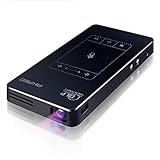
6. AKASO WT50 – The Lightest Thing in Your Pack
AKASO WT50 Mini Projector with WiFi and Bluetooth, 1080P DLP Portable Movie Projector Home and Outdoor, Built-in Battery & Android System, Cookie Projector for iPhone and Phone
50 lumens
1080p DLP chip
5000mAh battery, about 2 hours
0.64 lb
Android 9.0
Pros
- Extremely compact and light at 0.64 lb
- easily the smallest unit here
- DLP chip keeps the image sharp without the screen-door effect common on LCD units
- Built-in 5000mAh battery gives about 2 hours of projection
- Built-in Android 9.0 with access to the Google Play Store
- AirPlay Miracast EShare and DLNA mirroring plus a 360-degree rotatable bracket
Cons
- Only 50 lumens
- which essentially requires complete darkness
- Netflix and other DRM streaming apps cannot be mirrored or screencast wirelessly
- Requires the original charging cable as third-party cables cause compatibility problems
At 0.64 pounds, the WT50 is the answer to a very specific question: what is the smallest thing that can still throw an image. At 5.71 by 3.15 inches it fits in a jacket pocket, and the included 360-degree rotatable bracket lets you aim it upward at a tent ceiling without finding a surface to stand it on.
The DLP chip stays sharp at small image sizes and avoids the grid pattern that LCD panels show when the image is small on screen, which is exactly what you get on a 30 to 60 inch projection.
Fifty lumens is a candle, not a camp lantern
Be clear-eyed about this number. Fifty lumens requires complete darkness, and even then the image is dim. It is a travel and emergency unit rather than a main projector, and buyers generally treat it that way when they describe their own use.
The 5000mAh battery gives roughly two hours of projection, which covers a shorter film or a couple of episodes. The 30,000-hour light source means it will outlast many camping seasons without degradation concerns.
Streaming limitations and cable quirks
Android 9.0 with the Play Store opens up more than most pocket projectors, but Netflix and other DRM-protected streaming apps cannot be mirrored or screencast wirelessly. If your evening depends on licensed streaming, plug into HDMI from a laptop or a streaming stick instead.
One more practical note: the unit requires the original charging cable, and third-party cables cause compatibility problems. That is an avoidable annoyance, so keep the supplied cable in the same pouch as the projector and never leave it at home.
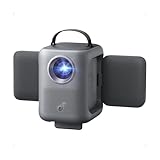
7. soundcore Nebula P1i – The Rotating Speaker Module
soundcore Nebula P1i Portable Projector with Flippable Speaker
380 ANSI lumens TUV certified
Native 1080p HDR10
Flippable 20W Dolby speaker
Sealed optical engine
Pros
- Unique flippable 20W Dolby Audio module rotates 90 degrees side to side or 200 degrees up and down
- TUV-certified 380 ANSI lumens at native 1080p
- All-glass lenses and a fully sealed optical engine resist dust and wear
- IEA 3.0 smart setup runs autofocus keystone obstacle avoidance and screen fit on power-up
- Built-in Google TV with Netflix YouTube and Prime Video
Cons
- No built-in battery
- mains powered only
- Heaviest relative to its screen capability at 7.3 lb for a 150 inch max image
- Only a remote is included in the box
The P1i’s headline feature is the speaker module. A 20W Dolby Audio unit with two 10W drivers flips ninety degrees side to side or two hundred degrees up and down, and reviewers single it out for placement flexibility above everything else. You can point the sound toward the group instead of the screen, which solves a real problem when the projector is beside the screen rather than in front of it.
Picture quality is solid for the class: TUV-certified 380 ANSI lumens, native 1080p and HDR10, which is a more honest certification than most manufacturers bother with. The all-glass lenses and sealed optical engine are a genuine durability argument in dusty outdoor conditions.
Audio solves the biggest outdoor weakness
Every compact projector in this roundup struggles with built-in sound, and the P1i is the only one with a speaker module that physically rotates. For group viewing where an external speaker is impractical, a 20W flippable module is a real answer rather than a compromise.
Bluetooth 5 is present, so you can also pair a larger speaker when the group is bigger than the module can serve. The IEA 3.0 setup routine handles autofocus, keystone, obstacle avoidance and screen fit automatically at power-up, which reduces setup time at a dark campsite considerably.
Weight, mains power and dust
At 7.3 lb for a 150-inch maximum image, this is heavy for what it throws, and it has no internal battery. That combination limits it to sites with power or to users carrying a power station with an AC inverter.
Its sealed optical engine is worth highlighting for anyone who camps in dry, dusty terrain. Unlike open-lens designs, there is no exposed element collecting grit, and the glass lenses tolerate cleaning better than plastic. Only a remote is included, so add a soft case to the packing list.
8. LYNCAST X5 PRO MAX – Loud Stereo and a Lit-Room Claim
1200 ANSI Google TV-Licensed Projector, 4K/8K Input Support, Dual 36W Dolby
1200 ANSI lumens
Native 1080p with 4K decoding
15000:1 contrast
Dual 36W Dolby Audio
1.8 kg
Pros
- Highest average rating in the group at 4.7 with 87 percent five-star
- 1200 ANSI lumens and owners report a usable picture even with lights on
- Dual 36W Dolby Audio stereo drivers for group listening
- 4-in-1 AI auto adjustment covering autofocus keystone screen alignment and obstacle avoidance
- 90-degree adjustable stand plus wall ceiling and tripod mounting
Cons
- No built-in battery
- mains powered only
- Remote requires 2 AAA batteries which are not included
- Content labelled 4K or 8K still displays at native 1080p
The X5 PRO MAX has the highest average rating in this group and the highest-wattage built-in audio. Dual 36W Dolby Audio stereo drivers are well beyond the 3W and 5W drivers typical of portable bodies, and if your group is six people sitting on the ground, that matters more than another hundred lumens.
At 1200 ANSI lumens it is among the brighter units here, and owners repeatedly report a usable picture even with lights on, which is the claim almost no portable projector makes honestly. Native 1080p with 4K and 8K input decoding, HDR10 and 125% sRGB coverage round out a solid spec sheet.
Software support and setup intelligence
The Google TV platform is officially licensed with over 10,000 apps available, so Netflix and the rest work without workarounds. A four-in-one AI adjustment routine handles autofocus, keystone, screen alignment and obstacle avoidance, and the WiFi 6 plus Bluetooth 5.4 combination holds a connection on a busy campsite network.
There is an AI voice remote, and support is US-based with a two-year warranty plus one free replacement. For gear that lives in a damp tent and gets knocked around, that kind of backing is worth more than it used to be.
Where the claims fall short
There is no built-in battery. This is a mains-only unit, so it suits a powered site, a camper with an outlet or a rig with an inverter rather than a tent in the woods. The listed 15000:1 contrast ratio is a dynamic figure and should not be compared against native DLP ratios.
Content labelled 4K or 8K displays at native 1080p, which is normal but worth stating plainly. And the remote needs two AAA batteries that are not in the box, a small annoyance that accounts for the most common nit in owner reviews. Support ships a cleaning kit, which is a nice touch for outdoor optics.
9. Huidun 3500-Lumen Rotating-Stand Projector – Built for Tent Panels
Outdoor Projector with Netflix Built-in, 4K Support Smart Projector 3500 Brightness with WiFi and Bluetooth, Auto Focus & Keystone, 360°Rotatable Stand Portable Movie Projectors for Home Theater
3500 ANSI lumens claimed
Native 1080p with 4K decoding
360-degree gimbal stand
Licensed Netflix and Disney+
1.35 kg
Pros
- Very high claimed brightness for the entry price at 3500 ANSI lumens
- Built-in 360-degree rotatable gimbal stand for ceiling or tent panel projection
- Officially licensed Netflix plus YouTube Prime Video Disney+ and Hulu
- Auto focus 4-directional auto keystone obstacle avoidance screen fit and direction detection in about 3 seconds
- LED engine rated to 150000 hours with dual thermal management and a three-year warranty
Cons
- No built-in battery
- it must be plugged in
- Listed minimum and maximum image size are both given as 50 inches so large-screen capability is unclear
- Only a remote and HDMI cable are included
- Relatively thin review history at 149 ratings
The reason to look at this model is the gimbal. A built-in 360-degree rotatable stand lets you aim the lens at a tent ceiling panel, a camper awning or a wall without propping anything up, and very few projectors in this bracket can do that without a separate accessory bracket.
Claimed brightness is 3500 ANSI lumens at native 1080p with 4K decoding and HDR10. Treat that figure with more caution than the certified ones, because it comes from the manufacturer rather than an independent certification, but the underlying panel is clearly brighter than the sub-300-lumen models it competes with.
Setup and app support
Auto focus, four-directional auto keystone, obstacle avoidance, screen fit and direction detection all complete in about three seconds. Direction detection matters more outdoors than indoors, since it works out which way is up when the unit is hanging or tilted against a pole.
The app situation is unusually clean: officially licensed Netflix, YouTube, Prime Video, Disney+ and Hulu, with dual-band WiFi 6 and Bluetooth 5.2 for casting. HDMI, USB and a 3.5mm audio jack cover the wired options, though only a remote and an HDMI cable ship in the box.
Read the specifications carefully
Two details deserve attention before you commit. There is no built-in battery, so this is a powered-site projector. And the listed minimum and maximum image size are both given as 50 inches, which makes genuine large-screen capability unclear from the listing alone.
The LED light source is rated to 150,000 hours with dual thermal management and a three-year manufacturer warranty, which is the strongest longevity claim in the group. The review history is thin at 149 ratings, so treat the ratings as promising rather than proven. If you camp in a hot climate, that thermal management is a genuine advantage in an enclosed tent.
10. XuanPad S5 – The Thinnest Body and a Detachable Stand
[Officially-Licensed App & Auto Focus]White Smart Mini Projector with WiFi and Bluetooth, XuanPad 4K Support Movie Projector, Portable Native 1080P Outdoor Projector with 360° Stand
1800 ANSI lumens max white brightness
Native 1080p
2 lb at 2.69 inches thick
Detachable 360-degree stand
6D auto keystone
Pros
- One of the largest review bases here with over 5500 ratings
- Net-like slim design at roughly 2.69 inches thick and 1.89 lb
- Built-in 360-degree rotatable detachable stand that packs flat
- AI autofocus locks focus in about 3 seconds plus 6D one-touch auto keystone
- 50 to 100 percent single-click zoom with licensed Netflix YouTube and Prime Video
Cons
- No built-in battery
- mains powered only
- Listed brightness figures are inconsistent across the listing
- One of the highest one-star shares in the roundup at 10 percent
- Remote batteries not included and light source life listed at only 3000 hours
The S5 is listed at roughly 2.69 inches thick, the thinnest body in the roundup, and the detachable rotating stand packs completely flat, which is a real advantage when you are packing into a bag with no room for a protruding handle. At two pounds it is light without being fragile.
One of the largest review bases in the roundup at over 5,500 ratings, and one of the widest spreads of opinion, so its strengths and weaknesses are unusually well documented. Praise concentrates on slim portability, the detachable rotating stand and fast automatic setup.
Brightness claims need a caveat
The listing carries inconsistent brightness figures, listing 40,000 lumens in one place and a maximum white brightness of 1800 ANSI lumens in another. The ANSI figure is the one to trust, and even that should be treated as a manufacturer claim rather than a certified measurement.
The 10 percent one-star share is among the highest here, and it reflects disappointment about image and brightness relative to the marketing language. If you want a verified measurement rather than a headline number, the TUV-certified P1i or the ANSI-stated Capsule 3 are safer choices.
Features, and where they fall down
On features, there is a lot: AI autofocus in about three seconds, 6D one-touch auto keystone, 50 to 100 percent single-click zoom, HDR 10+, licensed streaming apps with wireless mirroring plus HDMI, dual-band WiFi 6, and mounting options covering tripod, ceiling, tabletop, floor, wall and overhead.
Two honest limits. The light source is listed at 3,000 hours, the shortest figure in the roundup and a poor sign for long-term use, although LED longevity claims vary widely between manufacturers. And there is no battery, so this is a powered-site unit. Remote batteries are not included, and the two-year replacement warranty is a genuine plus.
How to Choose a Portable Projector for Camping
Brightness is the first thing to sort out, and it is the one where marketing numbers are least comparable. After that come runtime, power strategy, platform, screen and audio. Get these five right and the rest is preference.
Match ANSI lumens to how dark your site gets
Three systems of brightness measurement are in circulation, and only one of them is standardised. ANSI lumens use a fixed test methodology and are the only figures worth comparing across brands. ISO lumens are broadly similar but not identical. LED lumens and bare “lumens” figures are marketing numbers that can be inflated several times over, so treat anything without an ANSI or ISO label as unknown.
As a working guide, under 150 lumens is indoor darkness only. Between 200 and 400 lumens works after dark or under a tarp with light blocked. Between 400 and 1000 lumens holds up in twilight and near camp lighting. Above 1000 lumens keeps a picture visible with lights on, and anything claiming several thousand lumens without certification should be discounted heavily.
Screen size changes the equation. A 40 to 60 inch image needs far fewer lumens than a 100-inch one for the same perceived brightness, so a dim projector on a small screen beats a brighter projector badly aimed at a huge sheet.
Budget battery runtime for one long film
Manufacturers quote battery life at their quietest setting, and most of these models list two figures, one for video and a much longer one for music. Video playback is the number that matters, and it will fall in real use because a brighter picture draws more power.
A feature film runs roughly two hours. Add twenty minutes for trailers, rewinding and settling in, and you need closer to two and a half hours of honest playback. Anything rated below that needs a plan, and the plan is a USB-C power bank, not hope.
Decide between a built-in battery and mains power
Only some of the models here run without a cable. Among them, runtimes range from about 1.2 hours on the XGIMI Vibe One to five hours on the NEBULA Mars 3. That spread is more meaningful than the average, because it determines whether you need a power bank at all.
Mains-only models are not disqualified if your site has a hookup, your camper has an outlet, or you run a portable power station with an AC output. They are often brighter and better speakers for the same money, because the battery is a large part of their cost. Choosing wrongly means lugging weight to a site with no way to use it, so decide this before you shop.
Check the streaming platform before you buy
This is where cheap projectors disappoint most often. Netflix and other DRM-protected apps require official licensing, and many budget units either lack them or require an awkward workaround. The Google TV units here carry officially licensed Netflix, and the Aurzen D1R runs Roku TV with 500+ channels as an alternative route to the same apps.
Also confirm that the platform supports screen mirroring, since casting from a phone is the most common way people get content onto a projector. If you plan to watch offline, check that the unit has a USB port and file player, and download before you lose signal.
Plan the screen and the audio
Screen options map to camping styles. A hanging sheet on a camper awning works well for car camping and needs almost no setup. An inflatable screen is light and packs small, which suits tent and backcountry camping. A projector-specific fabric screen rejects ambient light best but is the bulkiest option. A tarp or a painted van panel is free and permanent if you have the vehicle.
Size realistically. A 60 to 80 inch image suits most groups and most brightness levels, and anything larger demands more lumens than a portable projector can supply. Keep the fabric taut, because a sagging screen destroys both focus and keystone accuracy.
For audio, note the distinction between a projector with a Bluetooth speaker built in and a projector with Bluetooth audio output. Most campers need the second one, because built-in speakers at 3W to 8W will not carry a group of six outdoors. For group viewing, pair a small external speaker over Bluetooth or HDMI ARC, and keep Bluetooth for films rather than competitive play. A stocked truck camping cooler taking up the same table space is a good reminder to plan the layout before the first film.
Think about dust, moisture and heat
Outdoor use is harder on a projector than indoor use. Dust is the most common enemy, so a lens cover matters more than any other accessory, and sealed optical engines are worth paying for in dry terrain. Water resistance ratings are rare but real, which the Mars 3 carries with its stated drop and dust resistance figures.
Heat matters more than people expect. Projectors need airflow, and a closed tent in summer can exceed what the cooling system handles. Run them outside the tent on a small table, point intake and exhaust away from fabric, and never cover the unit while it is running. Note that if you also run a 12v portable fridge on the same power circuit, capacity planning matters for the whole campsite.
Finally, check warranty length and support. Long light source ratings reduce replacement anxiety, but a longer warranty is the real protection for gear that gets knocked around. Our camping percolator guide covers the same principle for a much cheaper device: a spare part supply and a responsive service team matter more than a headline specification.
Frequently Asked Questions
Can you use a projector for camping movies?
Yes, but brightness and battery life are the limiting factors. Projectors work well after dark or under a dark tarp; plan on 200 to 400 ANSI lumens minimum for evening viewing and more if you start before full dark. Battery life varies widely, from about 1.2 hours on some compact units to 5 hours on the largest, so bring a USB-C power bank for a full-length film.
What is the best portable projector for camping?
The NEBULA Capsule 3 is the best overall pick for most campers because it combines a 1.8 lb soda-can body, 1080p DLP resolution and a built-in 2.5-hour battery with Google TV and licensed Netflix. If you need a brighter screen for a group that starts early, the NEBULA Mars 3 delivers 1000 ANSI lumens and a 5-hour battery.
What are some good portable movie projectors for camping?
The NEBULA Capsule 3 is the best all-round option, offering 1080p at 1.8 lb with a 2.5-hour battery. The NEBULA Mars 3 is the brightest at 1000 ANSI lumens with a 5-hour battery. The XGIMI Vibe One gives the sharpest 1080p picture per pound with a 160-degree adjustable stand. The NEBULA Mars 3 Air balances weight, sound and brightness for mid-size groups.
Are Bluetooth projectors a thing?
Yes, but there are two different features. Bluetooth audio output lets you pair an external speaker to a projector that already has decent built-in sound. A Bluetooth speaker mode lets the projector itself act as a speaker when it is not projecting. Most camping groups need the first option, since built-in speakers at 3W to 8W will not carry an audience outdoors.
How many ANSI lumens do you need for a camping projector?
About 200 ANSI lumens works after dark or in heavy shade, 400 to 600 lumens holds up in twilight and near camp lighting, and 1000 lumens or more keeps the picture visible with lights on. Use a smaller screen for dimmer projectors, since brightness needs scale with image size. Only compare ANSI or ISO figures, since unmarked LED lumen numbers are not comparable.
Final Verdict for Your Campsite
If you walk more than a short distance from the vehicle, take the NEBULA Capsule 3. It is the best portable projector for camping in the roundup because it balances a 2.5-hour battery, licensed Netflix and a sharp 1080p DLP image inside a 1.8 lb body, and it only asks you to wait for full dark. If your group starts early or you are staying with a vehicle, choose the NEBULA Mars 3 for 1000 ANSI lumens, a 5-hour battery that also charges your phone, and IPX3 water resistance. If you want a light body with strong built-in sound, the XGIMI Vibe One wins, with a power bank covering its short internal battery.
For mains-powered sites, the LYNCAST X5 PRO MAX leads on rating, brightness and built-in audio, while the soundcore Nebula P1i is the pick if group sound matters most. Whichever unit you choose, check its ANSI lumen figure against how dark your site really gets, and pack a power bank and a lens cloth with it.
Leave a Reply